Lee Joonbum, Muñoz Mauricio, Fridman Lex, Victor Trent, Reimer Bryan, Mehler Bruce
AgeLab and New England University Transportation Center, Massachusetts Institute of Technology, Cambridge, MA, United States of America.
Technical University of Munich, Munich, Germany.
PeerJ Comput Sci. 2018 Feb 19;4:e146. doi: 10.7717/peerj-cs.146. eCollection 2018.
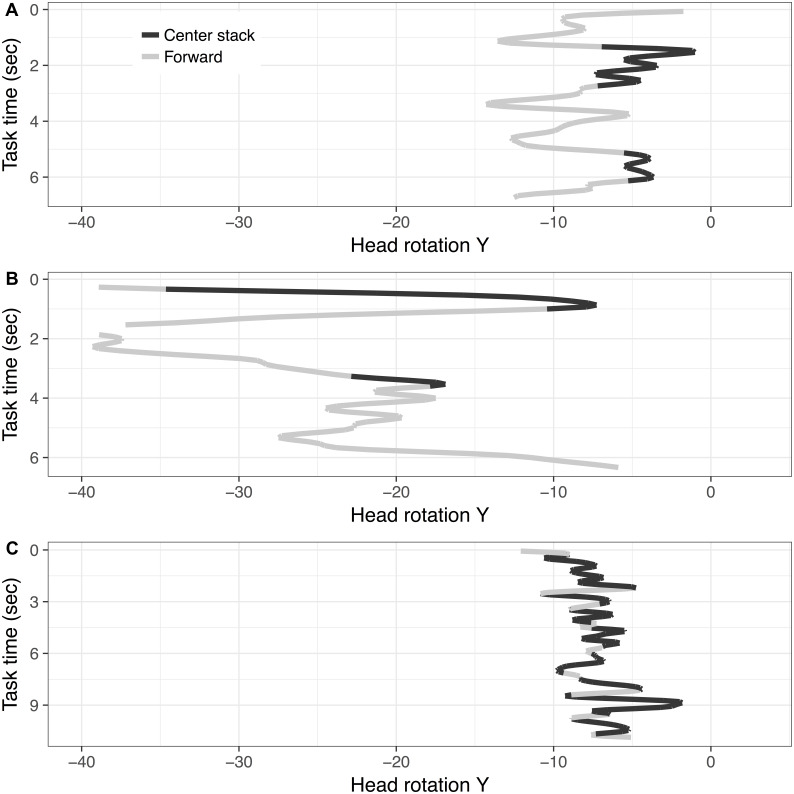
The relationship between a driver's glance orientation and corresponding head rotation is highly complex due to its nonlinear dependence on the individual, task, and driving context. This paper presents expanded analytic detail and findings from an effort that explored the ability of head pose to serve as an estimator for driver gaze by connecting head rotation data with manually coded gaze region data using both a statistical analysis approach and a predictive (i.e., machine learning) approach. For the latter, classification accuracy increased as visual angles between two glance locations increased. In other words, the greater the shift in gaze, the higher the accuracy of classification. This is an intuitive but important concept that we make explicit through our analysis. The highest accuracy achieved was 83% using the method of Hidden Markov Models (HMM) for the binary gaze classification problem of (a) glances to the forward roadway versus (b) glances to the center stack. Results suggest that although there are individual differences in head-glance correspondence while driving, classifier models based on head-rotation data may be robust to these differences and therefore can serve as reasonable estimators for glance location. The results suggest that driver head pose can be used as a surrogate for eye gaze in several key conditions including the identification of high-eccentricity glances. Inexpensive driver head pose tracking may be a key element in detection systems developed to mitigate driver distraction and inattention.
由于驾驶员的视线方向与相应头部转动之间的关系对个体、任务和驾驶环境存在非线性依赖,所以这种关系极为复杂。本文详细介绍了一项分析研究及其结果,该研究通过运用统计分析方法和预测(即机器学习)方法,将头部转动数据与人工编码的注视区域数据相联系,探讨了头部姿态作为驾驶员注视估计器的能力。对于后者,随着两个视线位置之间视角的增加,分类准确率也随之提高。换句话说,注视的偏移越大,分类的准确率就越高。这是一个直观但重要的概念,我们通过分析将其明确呈现出来。对于(a)向前方道路的注视与(b)向中控台的注视这一二元注视分类问题,使用隐马尔可夫模型(HMM)方法所达到的最高准确率为83%。结果表明,尽管驾驶时头部与视线的对应存在个体差异,但基于头部转动数据的分类器模型可能对这些差异具有鲁棒性,因此可以作为视线位置的合理估计器。结果表明,在包括识别高偏心率注视在内的几个关键条件下,驾驶员头部姿态可以用作眼睛注视的替代指标。廉价的驾驶员头部姿态跟踪可能是为减轻驾驶员分心和注意力不集中而开发的检测系统中的一个关键要素。