Lintuluoto Masami, Horioka Yota, Hongo Saki, Lintuluoto Juha Mikael, Fukunishi Yoshifumi
Graduate School of Life and Environmental Sciences, Kyoto Prefectural University, Shimogamohanki-cho, Sakyo, Kyoto 606-8522, Japan.
Graduate School of Engineering, Kyoto University, Katsura Campus, Nishikyo-ku, Kyoto 615-8530, Japan.
ACS Omega. 2021 Mar 16;6(12):8045-8055. doi: 10.1021/acsomega.0c05502. eCollection 2021 Mar 30.
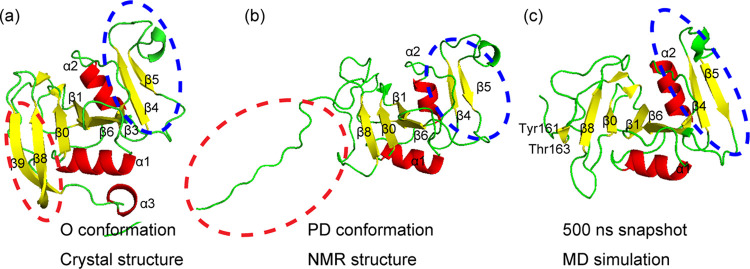
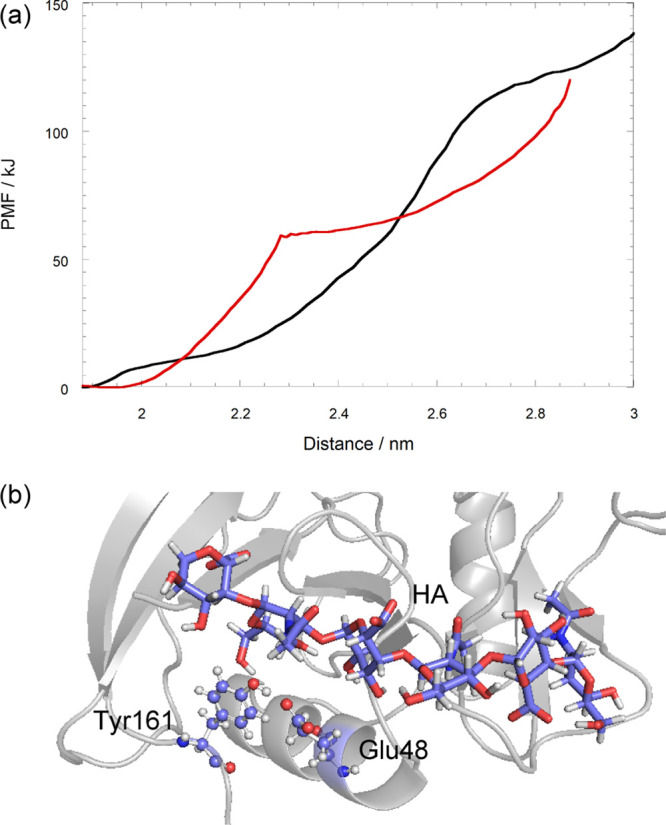
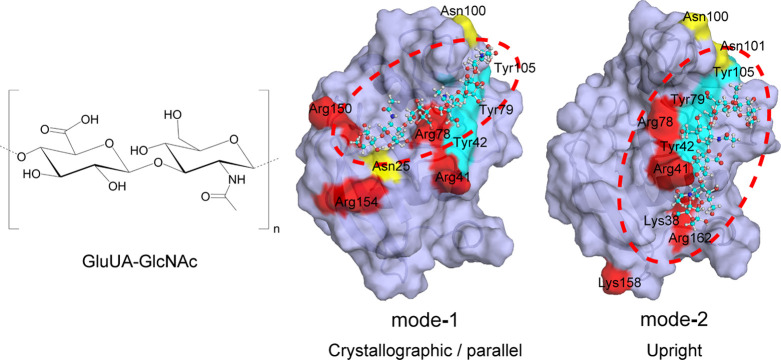
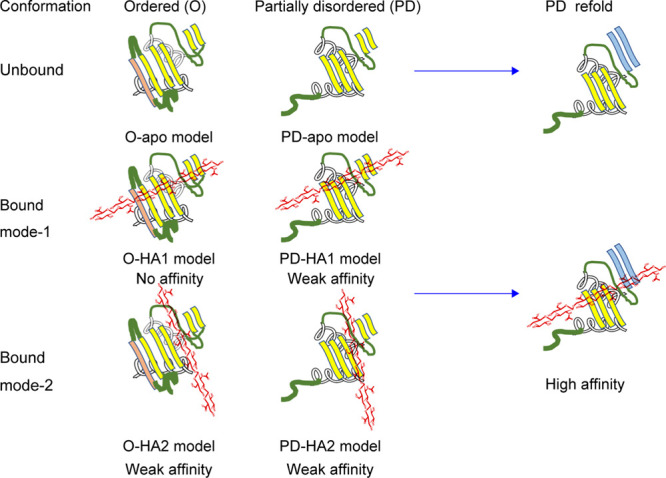
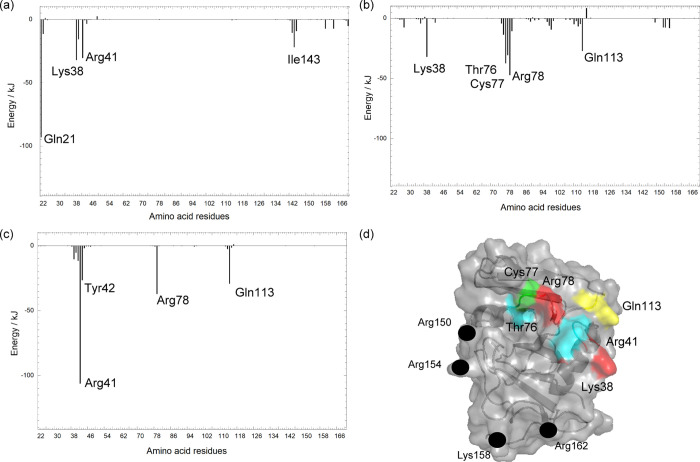
CD44 protein exists on surfaces of a variety of human cells, acts as a receptor for the hyaluronan (HA) molecule, and mediates cell adhesion via the HA binding in leukocyte trafficking, cell rolling, and so on. The molecular structures of both CD44 and HA are well known, and the previous work shows that the external-mechanical force induces the partially disordered (PD) conformation from the ordered (O) conformation of CD44. The PD conformation has the higher HA affinity compared to the O conformation. However, the details of force-sensing mechanics have remained unclear. This study provides new insights into allosteric regulation of HA binding by conformational shift from the O to the PD conformation of the CD44 HA binding domain by using the classical molecular dynamics simulations. The O conformation was more favorable than the PD conformation under the equilibrium state, and the O conformation showed weak HA-binding affinity. Our simulation suggests that the PD conformation induced by the external force can refold to a compact structure similar to the O conformation keeping the bound HA. This new conformation showed a higher affinity than the O and PD conformations. Our results show that the unfolding of a remote disordered region from the ligand binding site by the external force allosterically regulates the HA affinity. This study promotes understanding not only the mechanism of CD44-mediated cell rolling but also the allosteric regulation induced by the external mechanical force.
CD44蛋白存在于多种人类细胞表面,作为透明质酸(HA)分子的受体,并在白细胞运输、细胞滚动等过程中通过HA结合介导细胞黏附。CD44和HA的分子结构均已为人所知,先前的研究表明,外部机械力可诱导CD44从有序(O)构象转变为部分无序(PD)构象。与O构象相比,PD构象具有更高的HA亲和力。然而,力传感机制的细节仍不清楚。本研究通过经典分子动力学模拟,对CD44 HA结合结构域从O构象到PD构象的构象转变对HA结合的变构调节提供了新的见解。在平衡状态下,O构象比PD构象更有利,且O构象显示出较弱的HA结合亲和力。我们的模拟表明,外力诱导的PD构象可以重新折叠成类似于O构象的紧凑结构,并保持结合的HA。这种新构象显示出比O构象和PD构象更高的亲和力。我们的结果表明,外力使配体结合位点远端无序区域展开,从而变构调节HA亲和力。本研究不仅有助于理解CD44介导的细胞滚动机制,还能促进对外部机械力诱导的变构调节的理解。