Wolters Anna, Reuther Judith, Gude Philipp, Weber Thomas, Theiss Carsten, Vogelsang Heike, Matschke Veronika
Institute of Anatomy, Department of Cytology, Medical Faculty, Ruhr University Bochum, Bochum, Germany.
Department of Anaesthesiology and Intensive Care Medicine, Ruhr University Bochum, St. Josef Hospital, Bochum, Germany.
Neural Regen Res. 2021 Nov;16(11):2243-2249. doi: 10.4103/1673-5374.310689.
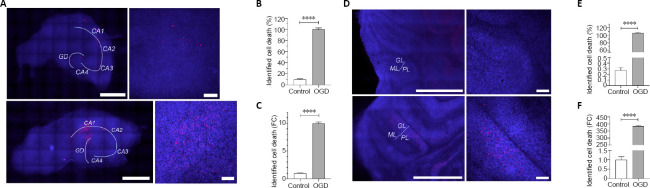
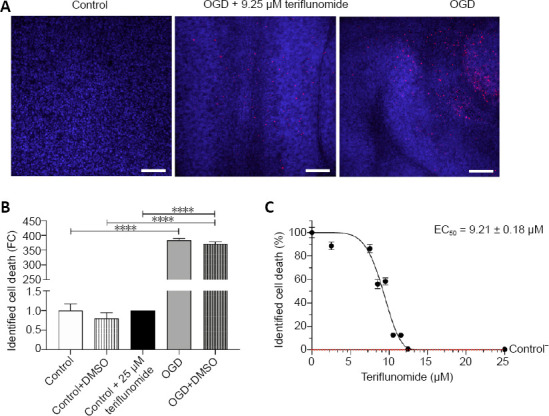
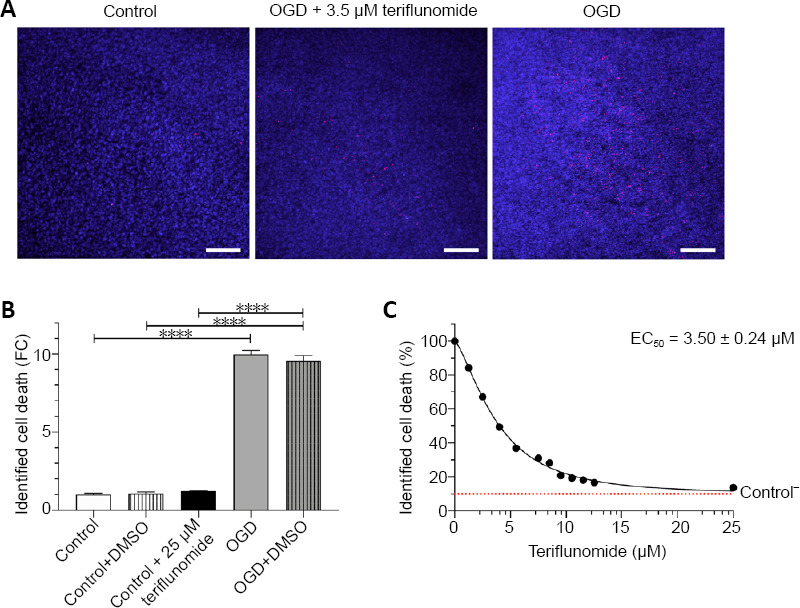
One of the major challenges in emergency medicine is out-of-hospital cardiac arrest (OHCA). Every year, about 53-62/100 000 people worldwide suffer an out-of-hospital cardiac arrest with serious consequences, whereas persistent brain injury is a major cause of morbidity and mortality of those surviving a cardiac arrest. Today, only few and insufficient strategies are known to limit neurological damage of ischemia and reperfusion injury. The aim of the present study was to investigate whether teriflunomide, an approved drug for treatment of relapsing-remitting-multiple-sclerosis, exerts a protective effect on brain cells in an in vitro model of ischemia. Therefore, organotypic slice cultures from rat hippocampus and cerebellum were exposed to oxygen-glucose-deprivation and subsequently treated with teriflunomide. The administration of teriflunomide in the reperfusion time on both hippocampal and cerebellar slice cultures significantly decreased the amount of detectable propidium iodide signal compared with an untreated culture, indicating that more cells survive after oxygen-glucose-deprivation. However, hippocampal slice cultures showed a higher vulnerability to ischemic conditions and a more sensitive response to teriflunomide compared with cerebellar slice cultures. Our study suggests that teriflunomide, applied as a post-treatment after an oxygen-glucose-deprivation, has a protective effect on hippocampal and cerebellar cells in organotypic slice cultures of rats. All procedures were conducted under established standards of the German federal state of North Rhine Westphalia, in accordance with the European Communities Council Directive 2010/63/EU on the protection of animals used for scientific purposes.
急诊医学面临的主要挑战之一是院外心脏骤停(OHCA)。每年,全球约有53 - 62/10万人口发生院外心脏骤停并产生严重后果,而持续性脑损伤是心脏骤停幸存者发病和死亡的主要原因。如今,已知仅有少数且不充分的策略可限制缺血和再灌注损伤的神经损伤。本研究的目的是调查特立氟胺(一种已获批用于治疗复发缓解型多发性硬化症的药物)在体外缺血模型中是否对脑细胞具有保护作用。因此,将大鼠海马体和小脑的器官型切片培养物暴露于氧糖剥夺环境,随后用特立氟胺进行处理。与未处理的培养物相比,在再灌注期对海马体和小脑切片培养物施用特立氟胺显著降低了可检测到的碘化丙啶信号量,表明氧糖剥夺后更多细胞存活。然而,与小脑切片培养物相比,海马体切片培养物对缺血条件更敏感,对特立氟胺的反应也更敏感。我们的研究表明,在氧糖剥夺后作为后期治疗施用特立氟胺,对大鼠器官型切片培养中的海马体和小脑细胞具有保护作用。所有程序均按照德国北莱茵 - 威斯特法伦州既定标准进行,符合欧洲共同体理事会关于保护用于科学目的的动物的2010/63/EU指令。