College of Medical and Dental Sciences, University of Birmingham, Edgbaston, Birmingham, B15 2TT, UK.
College of Medical and Dental Sciences, Institute of Clinical Sciences, School of Nursing, Medical School, University of Birmingham, Room EF15, Vincent Drive, Birmingham, B15 2TT, UK.
Scand J Trauma Resusc Emerg Med. 2018 Sep 10;26(1):77. doi: 10.1186/s13049-018-0476-3.
Brain injury can occur after cardiac arrest due to the effects of ischaemia and reperfusion. In serious cases this can lead to permanent disability. This risk must be considered when making decisions about terminating resuscitation. There are very specific rules for termination of resuscitation in the prehospital setting however a similar rule for resuscitation in hospital does not exist. The aim of this review was to explore the effects of duration of cardiopulmonary resuscitation on neurological outcome in survivors of both in-hospital and out-of-hospital cardiac arrest achieving return of spontaneous circulation in hospital.
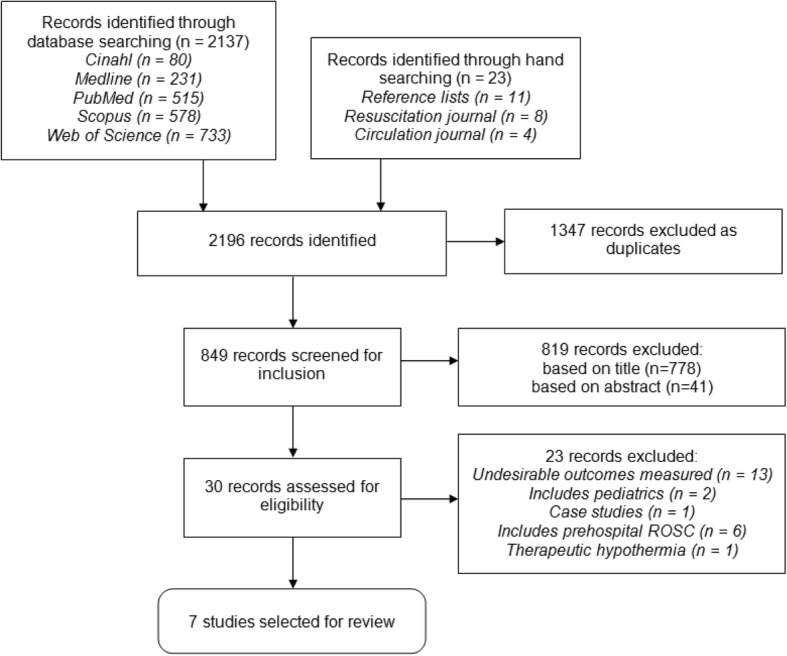
A systematic review was conducted. Five databases were searched in addition to hand searching the journals Resuscitation and Circulation and reference lists, quality of the selected studies was assessed and a narrative summary of the data presented. Studies reporting relevant outcomes were included if the participants were adults achieving return of spontaneous circulation in the hospital setting. Studies looking at additional interventions such as extracorporeal resuscitation and therapeutic hypothermia were not included. Case studies were excluded. The study period was from January 2010 to March 2016.
Seven cohort studies were included for review. Quality scores ranged from eight to 11 out of 12. Five of the studies found a significant association between shorter duration of resuscitation and favourable neurological outcome.
There is generally a better neurological outcome with a shorter duration of CPR in survivors of cardiac arrest however a cut-off beyond which resuscitation is likely to lead to unfavourable outcome could not be determined and is unlikely to exist. The findings of this review could be considered by clinicians making decisions about terminating resuscitation. This review has highlighted many gaps in the knowledge where future research is needed; a validated and reliable measure of neurological outcome following cardiac arrest, more focused research on the effects of duration on neurological outcome and further research into the factors leading to brain damage in cardiac arrest.
心脏骤停后会发生脑损伤,这是由于缺血和再灌注的影响。在严重的情况下,这可能导致永久性残疾。在决定停止复苏时,必须考虑到这种风险。在院前环境中,有非常具体的停止复苏规则,但医院内复苏没有类似的规则。本综述的目的是探讨心肺复苏持续时间对在医院内和院外心脏骤停后恢复自主循环的幸存者的神经功能结局的影响。
进行了系统评价。除了对复苏和循环杂志以及参考文献进行手工搜索外,还对五个数据库进行了搜索,评估了所选研究的质量,并对数据进行了叙述性总结。如果参与者是在医院环境中恢复自主循环的成年人,且报告了相关结局,则纳入研究。未纳入研究其他干预措施(如体外复苏和治疗性低温)的研究。排除病例研究。研究时间为 2010 年 1 月至 2016 年 3 月。
纳入了 7 项队列研究进行综述。质量评分范围为 12 分中的 8 分到 11 分。5 项研究发现,心肺复苏持续时间较短与良好的神经功能结局之间存在显著关联。
心脏骤停幸存者心肺复苏持续时间较短通常会有更好的神经功能结局,但无法确定可能导致不良结局的截止时间,而且可能不存在这样的截止时间。该综述的结果可被考虑终止复苏的临床医生使用。本综述突出了许多知识空白,需要进一步研究;需要一种验证和可靠的心脏骤停后神经功能结局测量方法、更集中地研究持续时间对神经功能结局的影响,以及进一步研究导致心脏骤停时脑损伤的因素。