Comprehensive Cancer Center, The Ohio State University, Columbus, OH, USA.
Department of Surgery, Division of Surgical Oncology, Tzagournis Medical Research Facility, The Ohio State University, Columbus, OH, USA.
Cancer Immunol Immunother. 2021 Sep;70(9):2439-2451. doi: 10.1007/s00262-021-02908-5. Epub 2021 Apr 5.
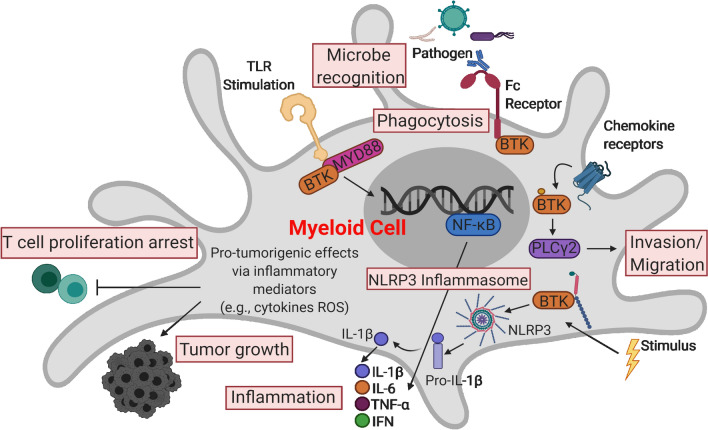
Bruton's tyrosine kinase (BTK) is a non-receptor kinase belonging to the Tec family of kinases. The role of BTK in B cell receptor signaling is well defined and is known to play a key role in the proliferation and survival of malignant B cells. Moreover, BTK has been found to be expressed in cells of the myeloid lineage. BTK has been shown to contribute to a variety of cellular pathways in myeloid cells including signaling in the NLRP3 inflammasome, receptor activation of nuclear factor-κβ and inflammation, chemokine receptor activation affecting migration, and phagocytosis. Myeloid cells are crucial components of the tumor microenvironment and suppressive myeloid cells contribute to cancer progression, highlighting a potential role for BTK inhibition in the treatment of malignancy. The increased interest in BTK inhibition in cancer has resulted in many preclinical studies that are testing the efficacy of using single-agent BTK inhibitors. Moreover, the ability of tumor cells to develop resistance to single-agent checkpoint inhibitors has resulted in clinical studies utilizing BTK inhibitors in combination with these agents to improve clinical responses. Furthermore, BTK regulates the immune response in microbial and viral infections through B cells and myeloid cells such as monocytes and macrophages. In this review, we describe the role that BTK plays in supporting suppressive myeloid cells, including myeloid-derived suppressor cells (MDSC) and tumor-associated macrophages (TAM), while also discussing the anticancer effects of BTK inhibition and briefly describe the role of BTK signaling and BTK inhibition in microbial and viral infections.
布鲁顿酪氨酸激酶(BTK)是非受体激酶,属于 Tec 激酶家族。BTK 在 B 细胞受体信号转导中的作用已得到充分证实,已知其在恶性 B 细胞的增殖和存活中发挥关键作用。此外,BTK 已被发现存在于髓系细胞中。BTK 已被证明在髓系细胞的多种细胞途径中发挥作用,包括 NLRP3 炎症小体信号转导、核因子-κβ受体激活和炎症、趋化因子受体激活影响迁移和吞噬作用。髓系细胞是肿瘤微环境的重要组成部分,抑制性髓系细胞有助于癌症进展,这凸显了 BTK 抑制在治疗恶性肿瘤中的潜在作用。人们对癌症中 BTK 抑制的兴趣增加,导致了许多正在测试单药 BTK 抑制剂疗效的临床前研究。此外,肿瘤细胞对单药检查点抑制剂产生耐药性的能力导致了临床研究中使用 BTK 抑制剂与这些药物联合使用,以提高临床反应。此外,BTK 通过 B 细胞和髓样细胞(如单核细胞和巨噬细胞)调节微生物和病毒感染中的免疫反应。在这篇综述中,我们描述了 BTK 在支持抑制性髓样细胞(包括髓源性抑制细胞(MDSC)和肿瘤相关巨噬细胞(TAM))中的作用,同时还讨论了 BTK 抑制的抗癌作用,并简要描述了 BTK 信号转导和 BTK 抑制在微生物和病毒感染中的作用。