Department of Leukemia, The University of Texas MD Anderson Cancer Center, Houston, Texas.
Cancer. 2021 Jun 15;127(12):2049-2061. doi: 10.1002/cncr.33458. Epub 2021 Apr 5.
Several important treatment and supportive care strategies have been implemented over the past 4 decades in the management of acute myeloid leukemia (AML).
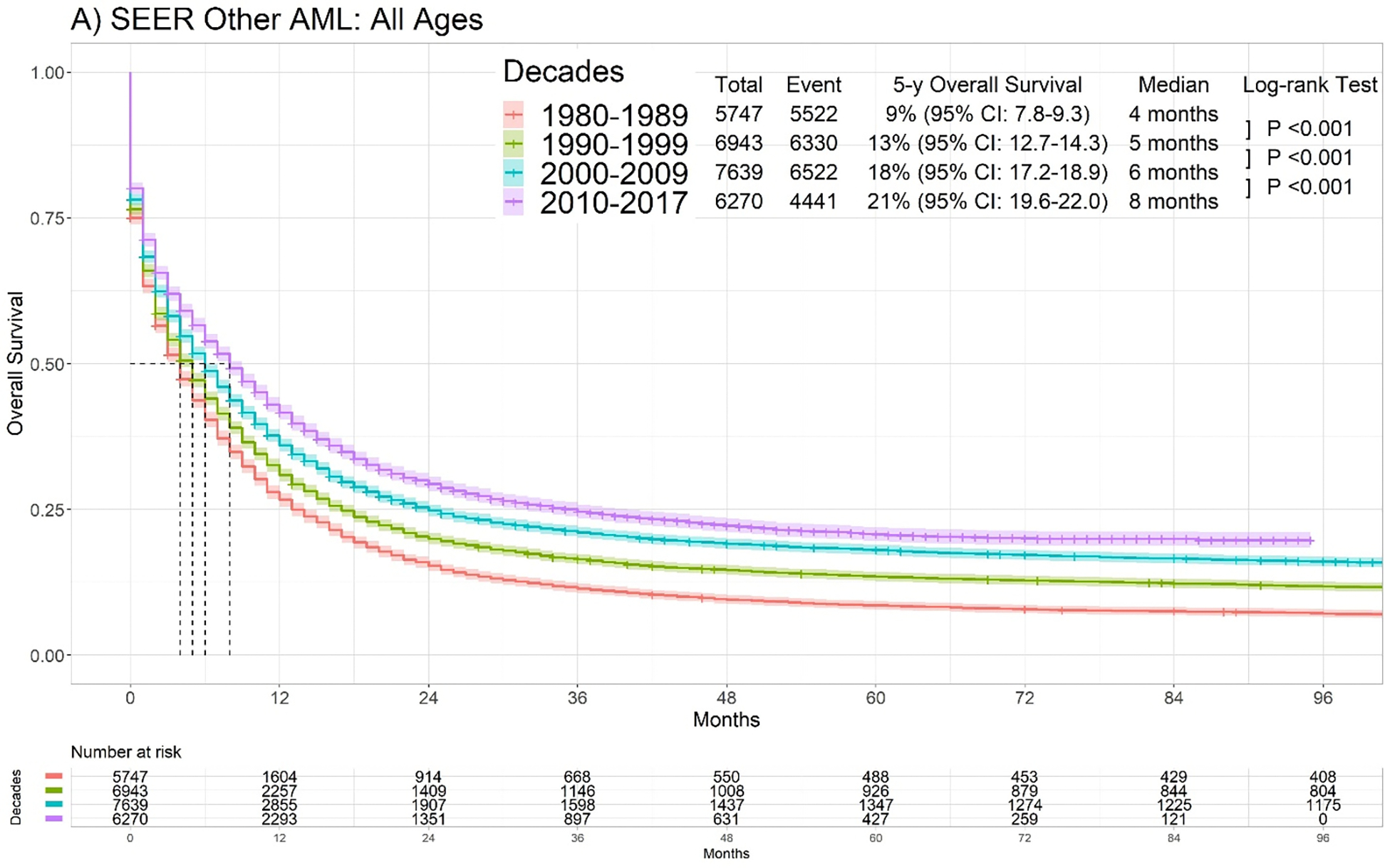
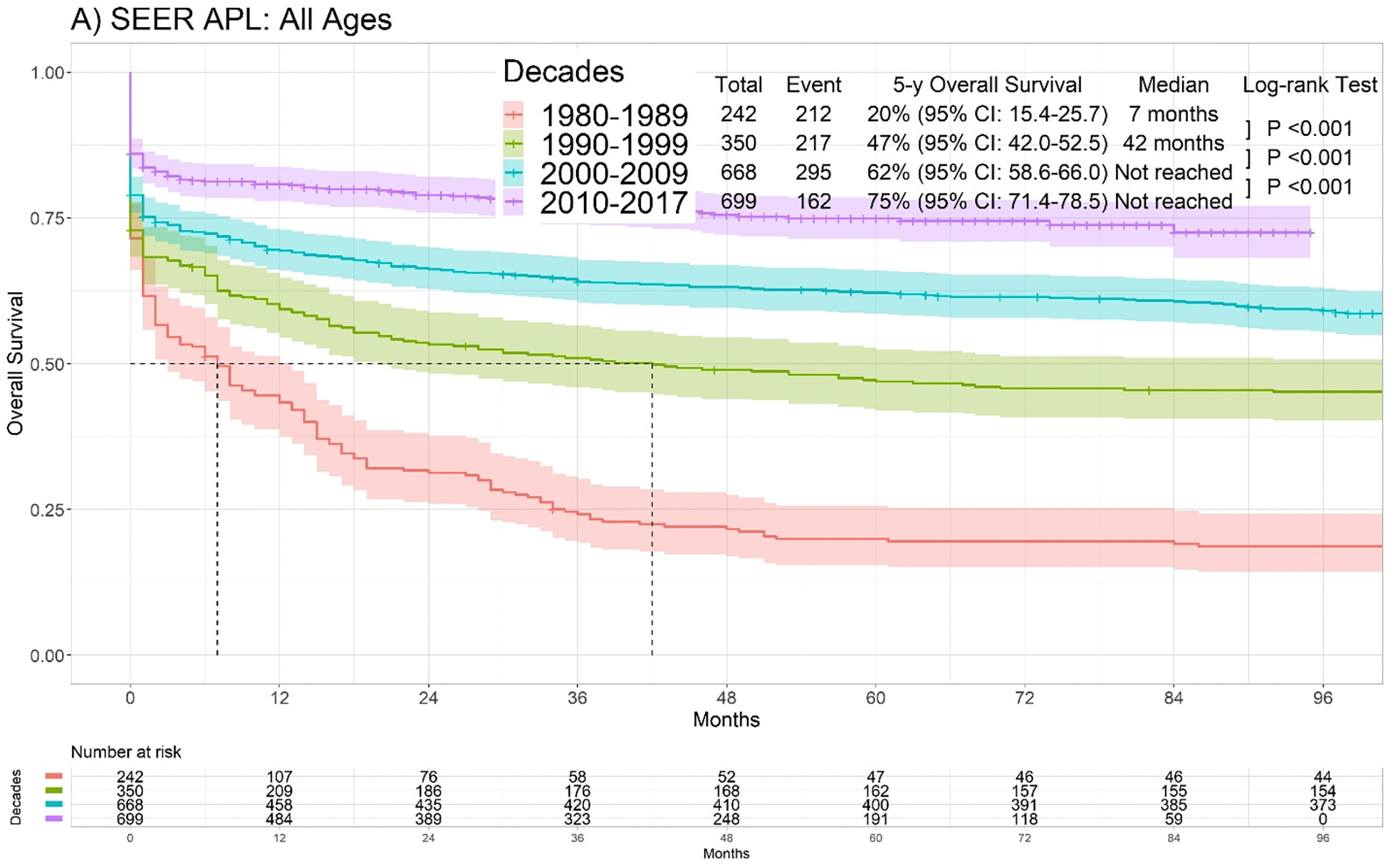
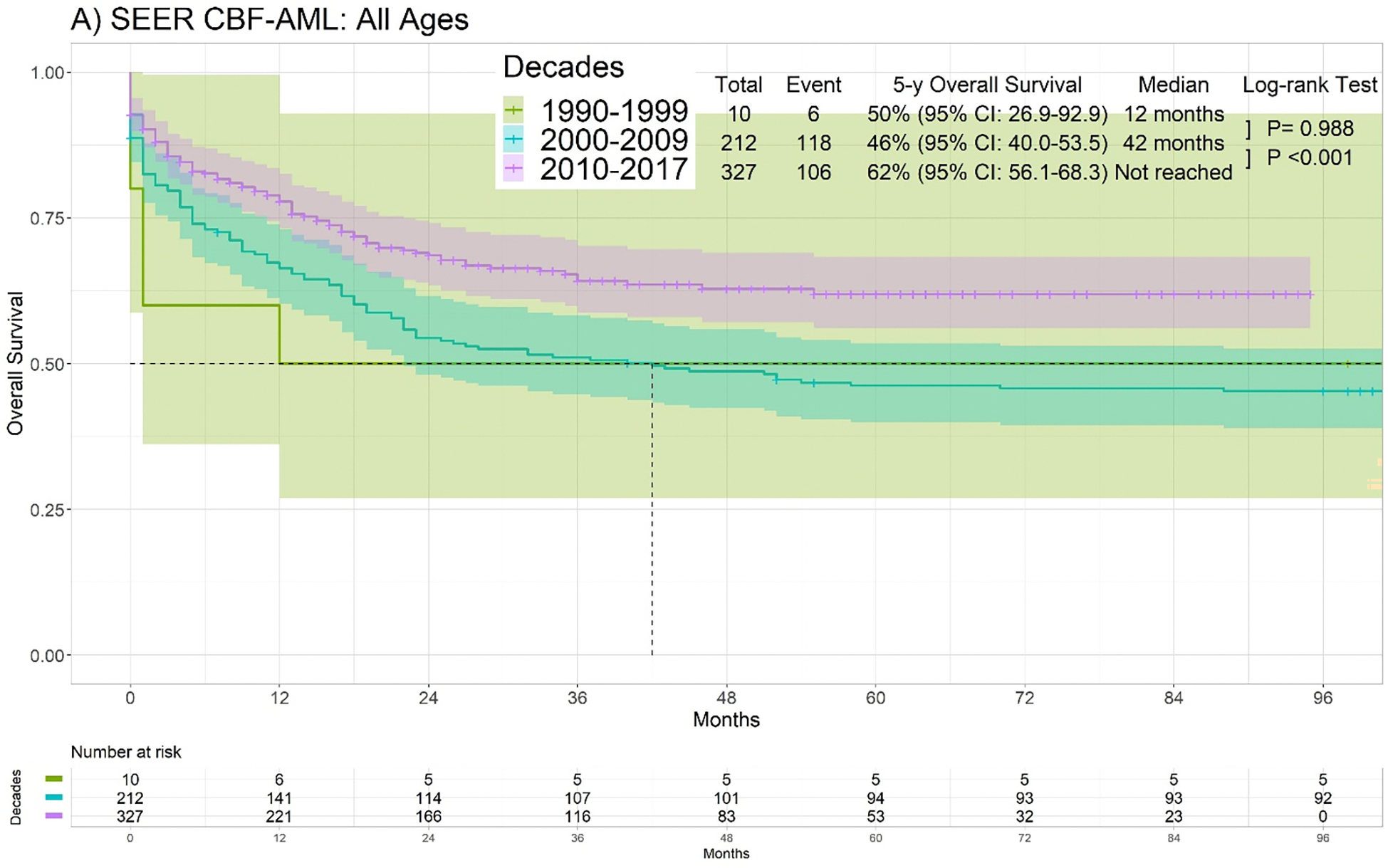
The authors identified 29,107 patients who were diagnosed with de novo AML between 1980 and 2017 in the National Cancer Institute's Surveillance, Epidemiology, and End Results database. Patients were categorized into 5 age groups (ages birth to 14, 15-39, 40-59, 60-69, and ≥70 years) and 4 calendar periods (1980-1989, 1990-1999, 2000-2009, and 2010-2017). The outcomes of patients who had AML within these categories were analyzed.
The overall 5-year survival rates in patients with AML were 9%, 15%, 22%, and 28% in the decades 1980 to 1989, 1990 to 1999, 2000 to 2009, and 2010 to 2017, respectively. Among patients aged 15 to 39 years, the 5-year survival rates were 24%, 41%, 52%, and 63%, respectively; among those aged ≥70 years, the 5-year survival rates were 1%, 2%, 3%, and 5%, respectively. Four-week mortality was surprising high among adults and older patients (range, 20%-45%), even in modern times. Overall, survival continued to improve over the calendar periods and was best in the period from 2010 to 2017. Survival improvement was noticeable across all age groups except patients aged ≥70 years, in whom the estimated 5-year survival rate remained 5% even during the period from 2010 to 2017.
The outcomes of patients with AML showed incremental improvement over time in a population-based study of the Surveillance, Epidemiology, and End Results data. The introduction since 2017 of targeted therapies among older patients and optimizations in supportive care hopefully will continue to improve outcomes in AML, particularly among older patients.
在过去的 40 年中,急性髓系白血病(AML)的治疗和支持性治疗策略得到了多项改进。
作者从美国国家癌症研究所的监测、流行病学和最终结果数据库中确定了 1980 年至 2017 年间诊断为初发性 AML 的 29107 名患者。患者分为 5 个年龄组(出生至 14 岁、15-39 岁、40-59 岁、60-69 岁和≥70 岁)和 4 个日历期(1980-1989 年、1990-1999 年、2000-2009 年和 2010-2017 年)。分析了这些类别中患有 AML 的患者的结局。
在 AML 患者中,1980 年至 1989 年、1990 年至 1999 年、2000 年至 2009 年和 2010 年至 2017 年,患者的 5 年总生存率分别为 9%、15%、22%和 28%。在 15-39 岁的患者中,5 年生存率分别为 24%、41%、52%和 63%;≥70 岁的患者中,5 年生存率分别为 1%、2%、3%和 5%。即使在现代,成年人和老年患者的四周死亡率也高得惊人(20%-45%)。总的来说,随着时间的推移,生存率不断提高,在 2010 年至 2017 年期间效果最佳。除了≥70 岁的患者之外,所有年龄组的生存率都有明显提高,即使在 2010 年至 2017 年期间,这些患者的估计 5 年生存率仍保持在 5%。
在监测、流行病学和最终结果数据的基于人群的研究中,AML 患者的结果随时间呈渐进式改善。自 2017 年以来,针对老年患者的靶向治疗和支持性治疗的优化有望继续改善 AML 的结局,特别是在老年患者中。