Max Planck Institute for Chemical Energy Conversion, Stiftstraße 34-36, 45470 Mülheim an der Ruhr, Germany.
Institut für Technische und Makromolekulare Chemie, RWTH Aachen University, Worringerweg 2, 52074 Aachen, Germany.
Acc Chem Res. 2021 May 4;54(9):2144-2157. doi: 10.1021/acs.accounts.1c00013. Epub 2021 Apr 6.
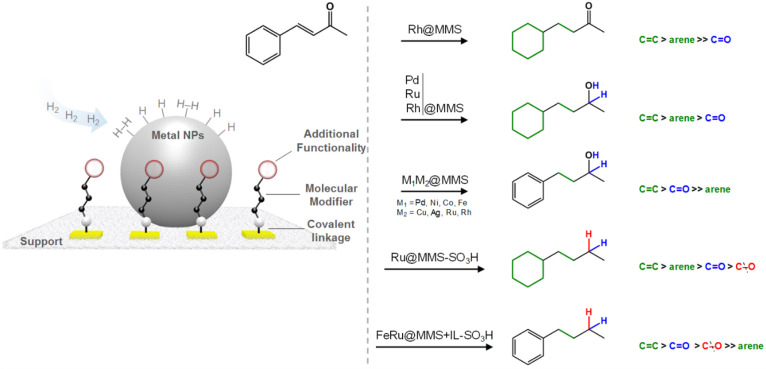
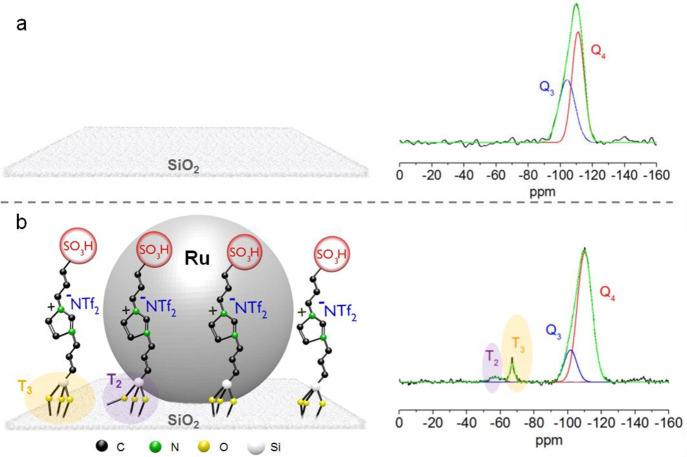
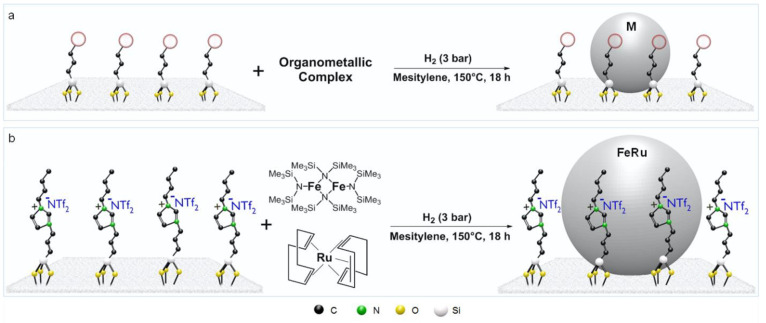
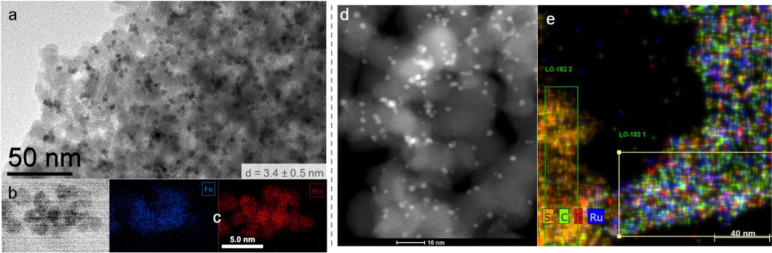
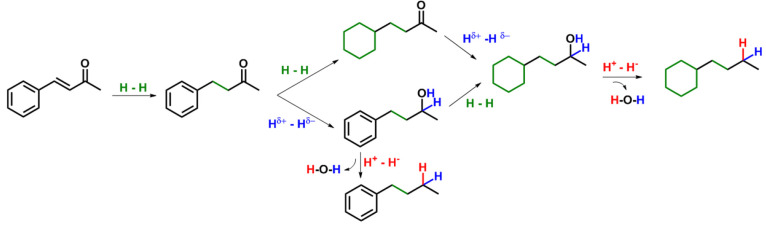
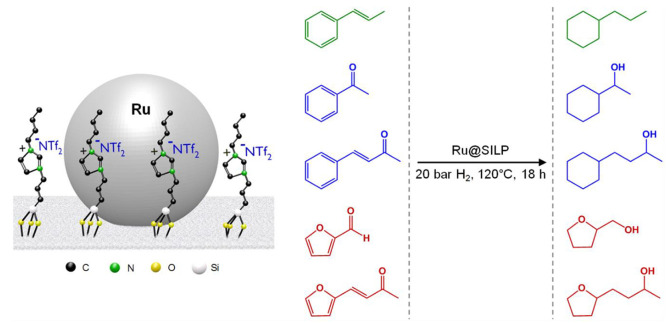
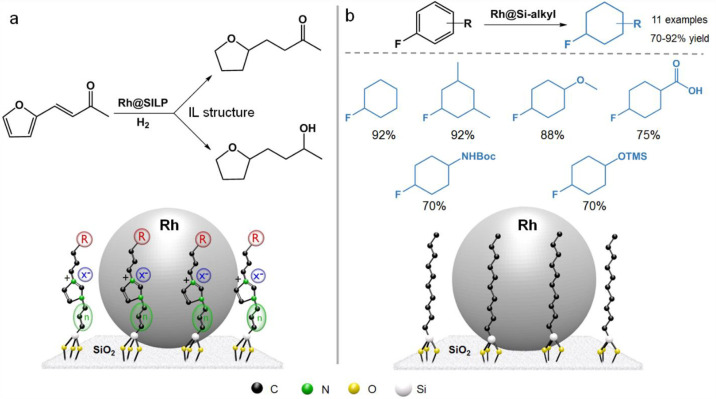
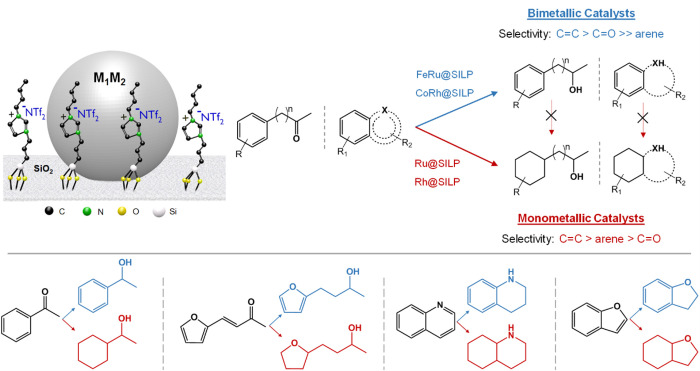
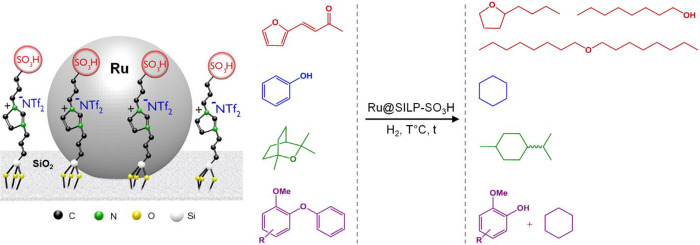
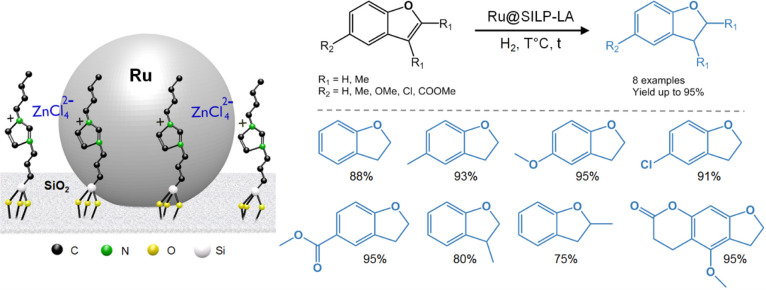
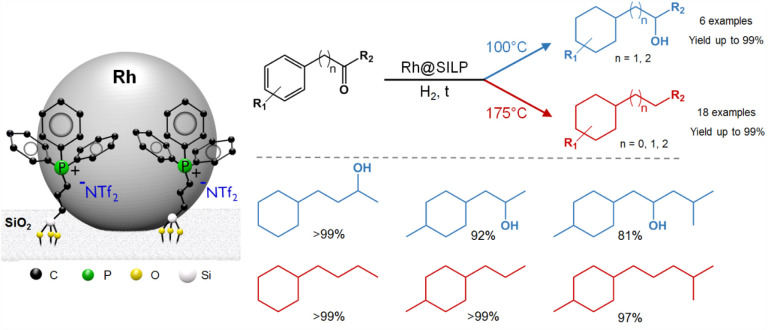
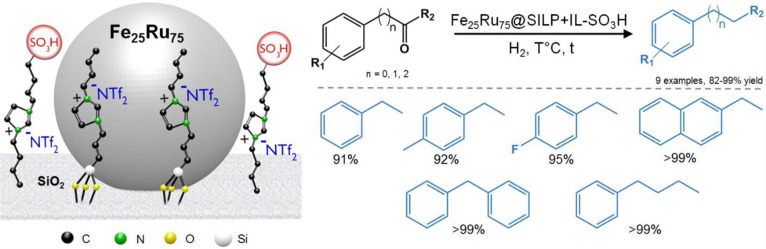
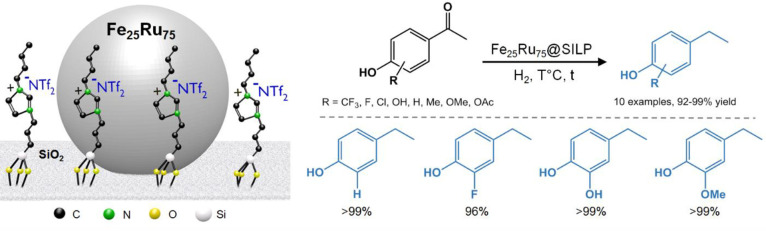
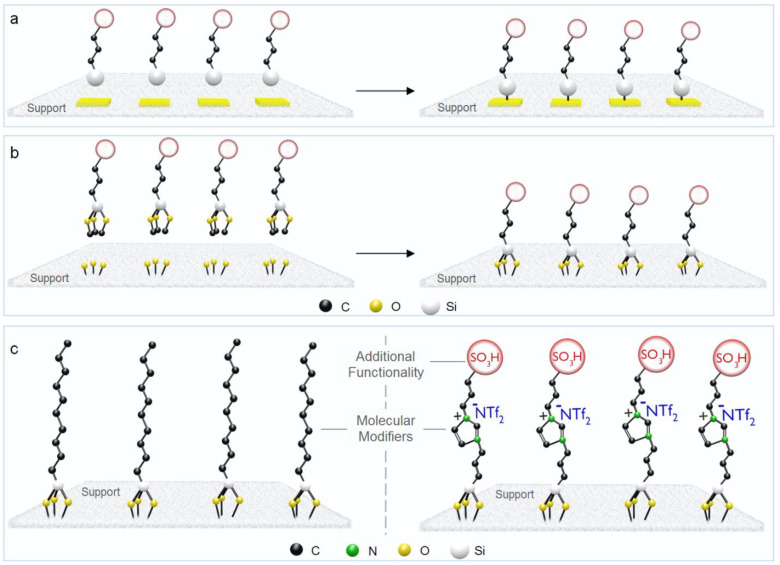
The synthesis and use of supported metal nanoparticle catalysts have a long-standing tradition in catalysis, typically associated with the field of heterogeneous catalysis. More recently, the development and understanding of catalytic systems composed of metal nanoparticles (NPs) that are synthesized from organometallic precursors on molecularly modified surfaces (MMSs) have opened a conceptually new approach to the design of multifunctional catalysts (NPs@MMS). These complex yet fascinating materials bridge molecular ("homogeneous") and material ("heterogeneous") approaches to catalysis and provide access to catalytic systems with tailor-made reactivity through judicious combinations of supports, molecular modifiers, and nanoparticle precursors. A particularly promising field of application is the controlled activation and transfer of dihydrogen, enabling highly selective hydrogenation and hydrogenolysis reactions as relevant for the conversion of biogenic feedstocks and platform chemicals as well as for novel synthetic pathways to fine chemicals and even pharmaceuticals. Consequently, the topic offers an emerging field for interdisciplinary research activities involving organometallic chemists, material scientists, synthetic organic chemists, and catalysis experts.This Account will provide a brief overview of the historical background and cover examples from the most recent developments in the field. A coherent account on the methodological and experimental basis will be given from the long-standing experience in our laboratories. MMSs are widely accessible via chemisorption and physisorption methods for the generation of stable molecular environments on solid surfaces, whereby a special emphasis is given here to ionic liquid-type molecules as modifiers (supported ionic liquid phases, SILPs) and silica as support material. Metal nanoparticles are synthesized following an organometallic approach, allowing the controlled formation of small and uniformly dispersed monometallic or multimetallic NPs in defined composition. A combination of techniques from molecular and material characterization provides a detailed insight into the structure of the resulting materials across various scales (electron microscopy, solid-state NMR, XPS, XAS, etc.).The molecular functionalities grafted on the silica surface have a pronounced influence on the formation, stabilization, and reactivity of the NPs. The complementary and synergistic fine-tuning of the metal and its molecular environment in NPs@MMSs allow in particular the control of the activation of hydrogen and its transfer to substrates. Monometallic (Ru, Rh, Pd) monofunctional NPs@MMSs possess excellent activities for the hydrogenation of alkenes, alkynes, and arenes for which a nonpolarized (homolytic) activation of H is predominant. The incorporation of 3d metals in noble metal NPs to give bimetallic (FeRu, CoRh, etc.) monofunctional NPs@MMSs favors a more polarized H activation and thus its transfer to the C═O bond, while at the same time preventing the arrangement of noble metal atoms necessary for ring hydrogenation. The incorporation of reactive functionalities, such as, for example, a -SOH moiety on NPs@MMSs, results in bifunctional catalysts enabling the heterolytic cleavage corresponding to a formal H/H transfer. Consequently, such catalysts possess excellent deoxygenation activity with strong synergistic effects arising from an intimate contact between the nanoparticles and the molecular functionality.While many more efforts are still required to explore, control, and understand the chemistry of NPs@MMS catalysts fully, the currently available examples already highlight the large potential of this approach for the rational design of multifunctional catalytic systems.
负载型金属纳米粒子催化剂的合成与应用在催化领域有着悠久的历史,通常与多相催化领域相关联。最近,由有机金属前体制备的金属纳米粒子(NPs)在分子修饰表面(MMSs)上的催化体系的发展和理解,为多功能催化剂(NPs@MMS)的设计开辟了一个全新的概念。这些复杂而迷人的材料连接了分子(“均相”)和材料(“多相”)催化方法,并通过合理组合载体、分子修饰剂和纳米粒子前体,为具有定制反应性的催化体系提供了途径。一个特别有前景的应用领域是对氢气的可控激活和转移,从而能够实现高度选择性的加氢和氢解反应,这对于生物原料和平台化学品的转化以及新型精细化学品甚至药物的合成途径都非常重要。因此,该课题为涉及有机金属化学家、材料科学家、合成有机化学家以及催化专家的跨学科研究活动提供了一个新兴的领域。
本综述将简要概述该领域的历史背景,并介绍该领域最近的发展情况。我们实验室长期以来的经验将为读者提供关于方法学和实验基础的连贯描述。MMS 通过化学吸附和物理吸附方法广泛可得,用于在固体表面上生成稳定的分子环境,在此特别强调离子液体型分子作为修饰剂(负载离子液体相,SILPs)和二氧化硅作为支撑材料。金属纳米粒子采用有机金属方法合成,允许在定义的组成中控制形成小而均匀分散的单金属或多金属 NPs。分子和材料特性的组合技术提供了对各种尺度下所得材料结构的详细了解(电子显微镜、固态 NMR、XPS、XAS 等)。
接枝在二氧化硅表面上的分子官能团对 NPs 的形成、稳定和反应性有显著影响。NPs@MMS 中金属及其分子环境的互补和协同微调尤其允许控制氢气的激活及其向底物的转移。单核(Ru、Rh、Pd)单核 NPs@MMS 对烯烃、炔烃和芳烃的加氢具有极好的活性,其中 H 的非极化(均裂)激活占主导地位。将 3d 金属掺入贵金属 NPs 中,形成双金属(FeRu、CoRh 等)单核 NPs@MMS,有利于更极化的 H 激活,从而有利于向 C═O 键转移,同时防止形成贵金属原子排列,从而防止形成用于环加氢的贵金属原子排列。将反应性官能团(例如 NPs@MMS 上的-SOH 部分)引入其中,会得到双功能催化剂,从而实现对应于形式 H/H 转移的异裂裂解。因此,这种催化剂具有出色的脱氧活性,并具有源于纳米粒子与分子官能团之间紧密接触的强大协同效应。
虽然仍需要更多的努力来充分探索、控制和理解 NPs@MMS 催化剂的化学,但目前可用的实例已经突出了这种方法在合理设计多功能催化体系方面的巨大潜力。