Department of Medicine, University of Colorado Denver Anschutz Medical Campus, Aurora, Colorado, USA.
Department of Medicine, University of Colorado Denver Anschutz Medical Campus, Aurora, Colorado, USA; Shenzhen Eye Hospital, Shenzhen, Guangdong, China.
J Biol Chem. 2021 Jan-Jun;296:100630. doi: 10.1016/j.jbc.2021.100630. Epub 2021 Apr 3.
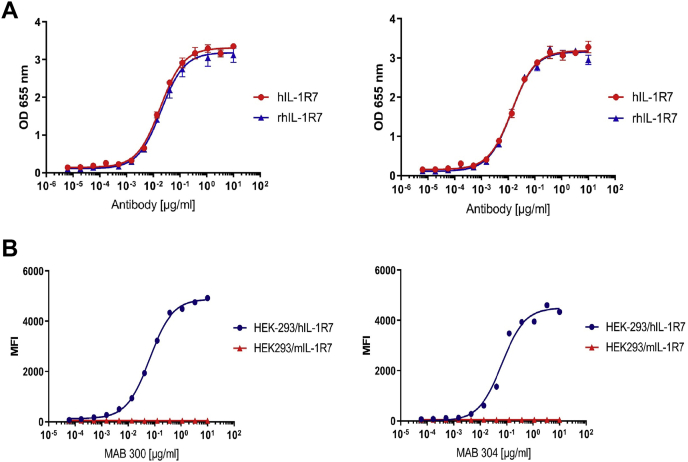
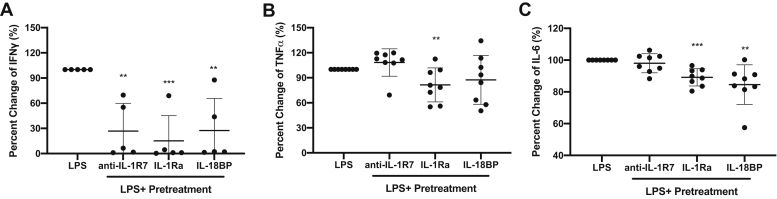
Unchecked inflammation can result in severe diseases with high mortality, such as macrophage activation syndrome (MAS). MAS and associated cytokine storms have been observed in COVID-19 patients exhibiting systemic hyperinflammation. Interleukin-18 (IL-18), a proinflammatory cytokine belonging to the IL-1 family, is elevated in both MAS and COVID-19 patients, and its level is known to correlate with the severity of COVID-19 symptoms. IL-18 binds its specific receptor IL-1 receptor 5 (IL-1R5, also known as IL-18 receptor alpha chain), leading to the recruitment of the coreceptor, IL-1 receptor 7 (IL-1R7, also known as IL-18 receptor beta chain). This heterotrimeric complex then initiates downstream signaling, resulting in systemic and local inflammation. Here, we developed a novel humanized monoclonal anti-IL-1R7 antibody to specifically block the activity of IL-18 and its inflammatory signaling. We characterized the function of this antibody in human cell lines, in freshly obtained peripheral blood mononuclear cells (PBMCs) and in human whole blood cultures. We found that the anti-IL-1R7 antibody significantly suppressed IL-18-mediated NFκB activation, reduced IL-18-stimulated IFNγ and IL-6 production in human cell lines, and reduced IL-18-induced IFNγ, IL-6, and TNFα production in PBMCs. Moreover, the anti-IL-1R7 antibody significantly inhibited LPS- and Candida albicans-induced IFNγ production in PBMCs, as well as LPS-induced IFNγ production in whole blood cultures. Our data suggest that blocking IL-1R7 could represent a potential therapeutic strategy to specifically modulate IL-18 signaling and may warrant further investigation into its clinical potential for treating IL-18-mediated diseases, including MAS and COVID-19.
未得到控制的炎症可能导致死亡率高的严重疾病,例如巨噬细胞活化综合征(MAS)。COVID-19 患者表现出全身性炎症过度活跃,观察到 MAS 和相关的细胞因子风暴。白细胞介素 18(IL-18)是一种属于 IL-1 家族的促炎细胞因子,在 MAS 和 COVID-19 患者中均升高,其水平与 COVID-19 症状的严重程度相关。IL-18 与其特异性受体白细胞介素 1 受体 5(IL-1R5,也称为 IL-18 受体 alpha 链)结合,导致募集共受体白细胞介素 1 受体 7(IL-1R7,也称为 IL-18 受体 beta 链)。这种异三聚体复合物然后启动下游信号转导,导致全身和局部炎症。在这里,我们开发了一种新型的人源化单克隆抗 IL-1R7 抗体,以特异性阻断 IL-18 及其炎症信号转导。我们在人细胞系、新鲜获得的外周血单核细胞(PBMC)和人全血培养物中表征了该抗体的功能。我们发现该抗 IL-1R7 抗体显著抑制了 IL-18 介导的 NFκB 激活,降低了人细胞系中 IL-18 刺激的 IFNγ 和 IL-6 的产生,并减少了 PBMC 中 IL-18 诱导的 IFNγ、IL-6 和 TNFα 的产生。此外,该抗 IL-1R7 抗体显著抑制了 PBMC 中 LPS 和白色念珠菌诱导的 IFNγ 产生,以及全血培养物中 LPS 诱导的 IFNγ 产生。我们的数据表明,阻断 IL-1R7 可能代表一种潜在的治疗策略,可特异性调节 IL-18 信号转导,并可能需要进一步研究其在治疗 IL-18 介导的疾病(包括 MAS 和 COVID-19)中的临床潜力。