Division of Endocrinology and Metabolism, Department of Internal Medicine, Korea University College of Medicine, Seoul, Korea.
Division of Endocrinology and Metabolism, Department of Internal Medicine, Asan Medical Center, University of Ulsan College of Medicine, Seoul, Korea.
Endocrinol Metab (Seoul). 2021 Apr;36(2):365-373. doi: 10.3803/EnM.2020.939. Epub 2021 Apr 7.
Serum calcitonin measurement contains various clinical and methodological aspects. Its reference level is wide and unclear despite sensitive calcitonin kits are available. This study aimed to identify the specific reference range in the healthy Korean adults.
Subjects were ≥20 years with available calcitonin (measured by a two-site immunoradiometric assay) data by a routine health checkup. Three groups were defined as all eligible subjects (group 1, n=10,566); subjects without self or family history of thyroid disease (group 2, n=5,152); and subjects without chronic kidney disease, autoimmune thyroid disease, medication of proton pump inhibitor/H2 blocker/steroid, or other malignancies (group 3, n=4,638).
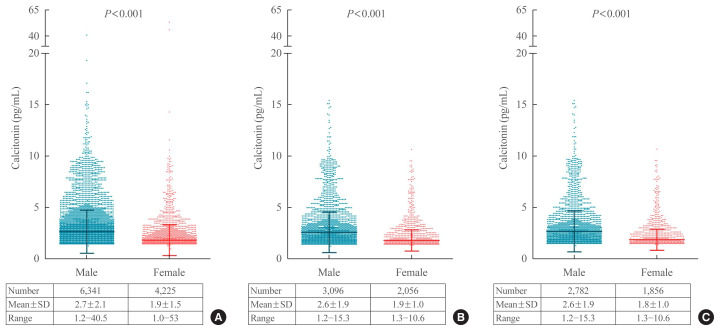
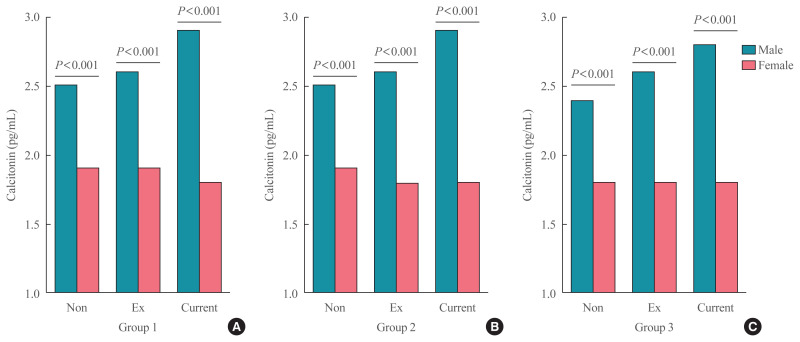
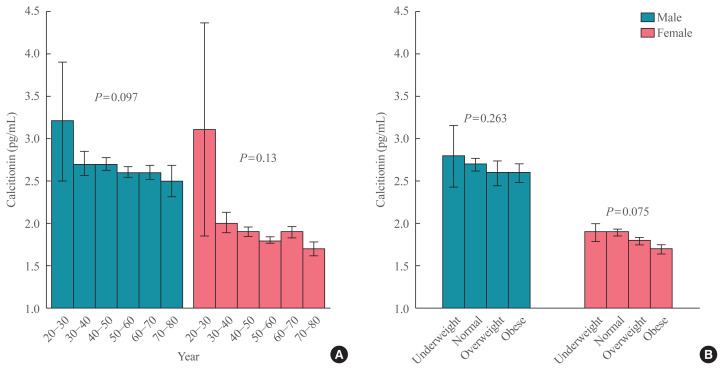
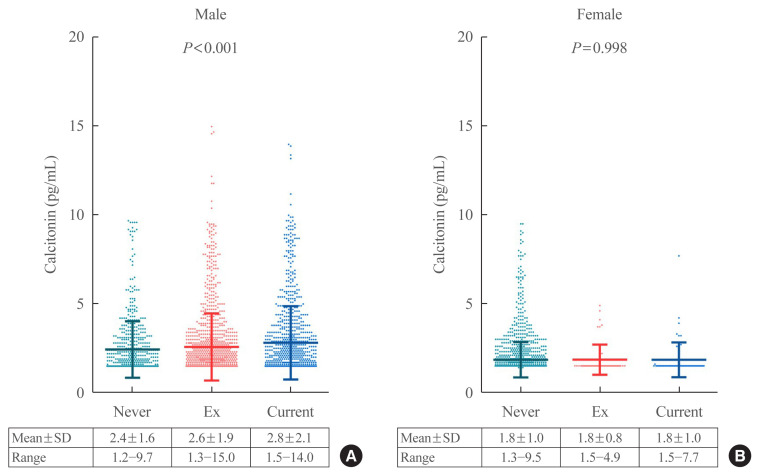
This study included 6,341 male and 4,225 female subjects. Males had higher mean calcitonin than females (2.3 pg/mL vs. 1.9 pg/mL, P<0.001) in group 1. This gender difference remained similar in groups 2 and 3. Calcitonin according to age or body mass index was not significant in both genders. Higher calcitonin in smoking than nonsmoking men was observed but not in women. Sixty-nine subjects had calcitonin higher than the upper reference limit (10 pg/mL) and 64 of them had factors associated with hypercalcitoninemia besides medullary thyroid cancer. Our study suggests the reference intervals for men who were non, ex-, current smokers, and women (irrespective of smoking status) as <5.7, <7.1, <7.9, and <3.6 pg/mL, respectively.
Specific calcitonin reference range should be provided considering for sex and smoking status. Taking account for several factors known to induce hypercalcitoninemia can help interpret the gray zone of moderately elevated calcitonin.
降钙素的血清测量包含了各种临床和方法学方面。尽管有了更敏感的降钙素试剂盒,其参考水平仍然很广泛且不明确。本研究旨在确定韩国健康成年人的具体参考范围。
研究对象为在常规健康检查中接受过降钙素(通过双位点免疫放射测定法测量)检测且年龄≥20 岁的人群。将受试者分为三组:所有符合条件的受试者(组 1,n=10566);无自身或家族甲状腺病史的受试者(组 2,n=5152);无慢性肾脏病、自身免疫性甲状腺疾病、质子泵抑制剂/H2 阻滞剂/类固醇药物治疗或其他恶性肿瘤的受试者(组 3,n=4638)。
本研究共纳入 6341 名男性和 4225 名女性。在组 1 中,男性的降钙素平均值高于女性(2.3pg/mL 比 1.9pg/mL,P<0.001)。这种性别差异在组 2 和组 3 中仍然相似。在男性和女性中,年龄或体重指数与降钙素均无显著相关性。在男性中,与不吸烟相比,吸烟人群的降钙素更高,但在女性中并非如此。69 名受试者的降钙素高于上限(10pg/mL),其中 64 名除了患有甲状腺髓样癌外,还有其他导致高降钙素血症的因素。本研究建议,非、前、现吸烟者男性以及女性(不论吸烟状况)的降钙素参考区间分别为<5.7、<7.1、<7.9 和<3.6pg/mL。
应根据性别和吸烟状况提供特定的降钙素参考范围。考虑到已知可引起高降钙素血症的几个因素有助于解释中度升高的降钙素的灰色区域。