Department of Physiology, Anatomy and Genetics, University of Oxford/Sleep and Circadian Neuroscience Institute, Oxford, UK.
Department of Experimental Psychology, University of Oxford, Oxford, UK.
BMC Biol. 2021 Apr 6;19(1):65. doi: 10.1186/s12915-021-00982-w.
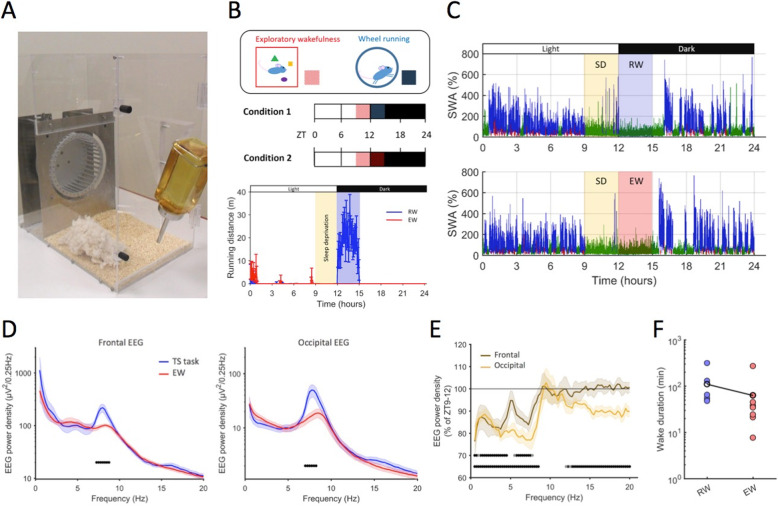
Homeostatic regulation of sleep is reflected in the maintenance of a daily balance between sleep and wakefulness. Although numerous internal and external factors can influence sleep, it is unclear whether and to what extent the process that keeps track of time spent awake is determined by the content of the waking experience. We hypothesised that alterations in environmental conditions may elicit different types of wakefulness, which will in turn influence both the capacity to sustain continuous wakefulness as well as the rates of accumulating sleep pressure. To address this, we compared the effects of repetitive behaviours such as voluntary wheel running or performing a simple touchscreen task, with wakefulness dominated by novel object exploration, on sleep timing and EEG slow-wave activity (SWA) during subsequent NREM sleep.
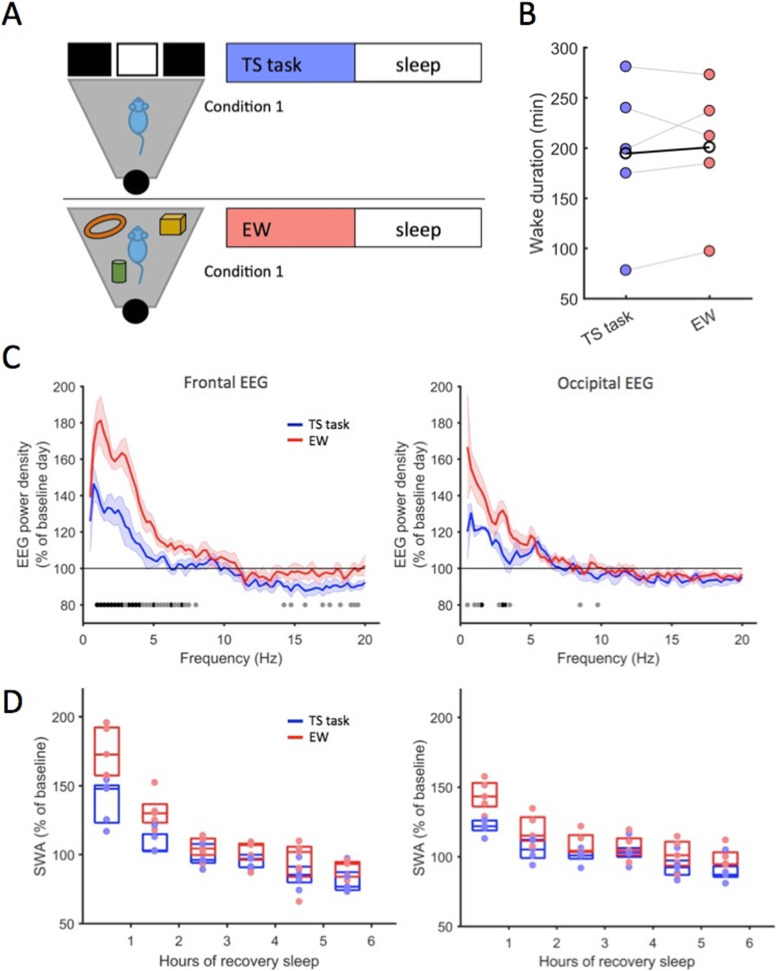
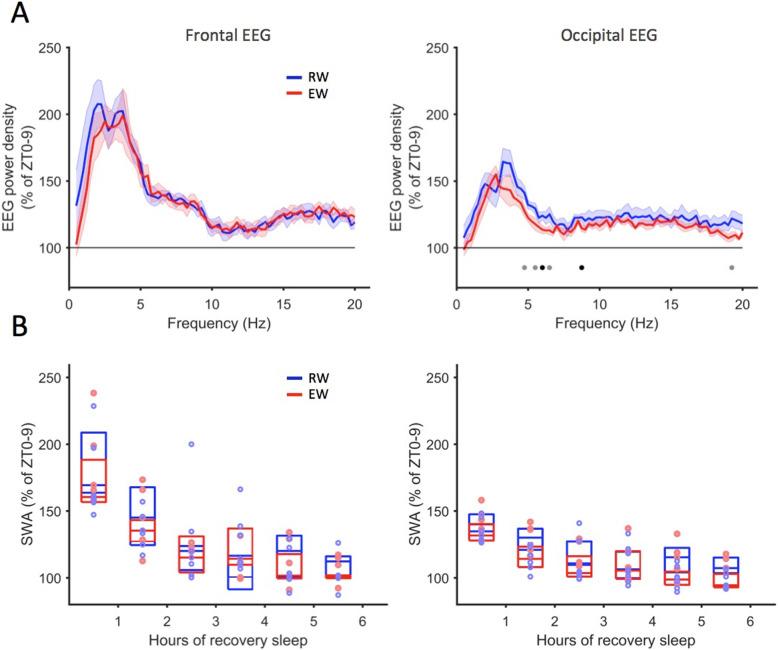
We find that voluntary wheel running is associated with higher wake EEG theta-frequency activity and results in longer wake episodes, as compared with exploratory behaviour; yet, it does not lead to higher levels of EEG SWA during subsequent NREM sleep in either the frontal or occipital derivation. Furthermore, engagement in a touchscreen task, motivated by food reward, results in lower SWA during subsequent NREM sleep in both derivations, as compared to exploratory wakefulness, even though the total duration of wakefulness is similar.
Overall, our study suggests that sleep-wake behaviour is highly flexible within an individual and that the homeostatic processes that keep track of time spent awake are sensitive to the nature of the waking experience. We therefore conclude that sleep dynamics are determined, to a large degree, by the interaction between the organism and the environment.
睡眠的稳态调节反映在维持清醒和睡眠之间的日常平衡上。尽管许多内部和外部因素会影响睡眠,但目前尚不清楚跟踪清醒时间的过程是否以及在何种程度上受到清醒体验的内容的影响。我们假设环境条件的改变可能会引发不同类型的觉醒,而这反过来又会影响持续清醒的能力以及睡眠压力的积累速度。为了解决这个问题,我们比较了重复行为(如自愿轮跑或执行简单的触摸屏任务)与以探索新物体为主导的觉醒对随后的非快速眼动(NREM)睡眠中睡眠时间和脑电图慢波活动(SWA)的影响。
我们发现,与探索行为相比,自愿轮跑与更高的清醒 EEG theta 频率活动相关,并导致更长的觉醒时间;然而,它不会导致随后的 NREM 睡眠中 EEG SWA 水平升高,无论是在前额还是枕部导联。此外,与探索性觉醒相比,在食物奖励的驱动下进行的触摸屏任务会导致随后的 NREM 睡眠中 SWA 水平降低,尽管总清醒时间相似。
总的来说,我们的研究表明,睡眠-觉醒行为在个体中具有高度的灵活性,并且跟踪清醒时间的稳态过程对清醒体验的性质敏感。因此,我们得出结论,睡眠动态在很大程度上取决于生物体和环境之间的相互作用。