
利用每日患者影像进行生物学一致剂量累积。
Biologically consistent dose accumulation using daily patient imaging.
机构信息
Medical Physics in Radiation Oncology, German Cancer Research Center (DKFZ), Heidelberg, Germany.
Heidelberg Institute for Radiooncology (HIRO), National Center for Radiation Research in Oncology (NCRO), Heidelberg, Germany.
出版信息
Radiat Oncol. 2021 Apr 6;16(1):65. doi: 10.1186/s13014-021-01789-3.
BACKGROUND
This work addresses a basic inconsistency in the way dose is accumulated in radiotherapy when predicting the biological effect based on the linear quadratic model (LQM). To overcome this inconsistency, we introduce and evaluate the concept of the total biological dose, bEQD.
METHODS
Daily computed tomography imaging of nine patients treated for prostate carcinoma with intensity-modulated radiotherapy was used to compute the delivered deformed dose on the basis of deformable image registration (DIR). We compared conventional dose accumulation (DA) with the newly introduced bEQD, a new method of accumulating biological dose that considers each fraction dose and tissue radiobiology. We investigated the impact of the applied fractionation scheme (conventional/hypofractionated), uncertainties induced by the DIR and by the assigned α/β-value.
RESULTS
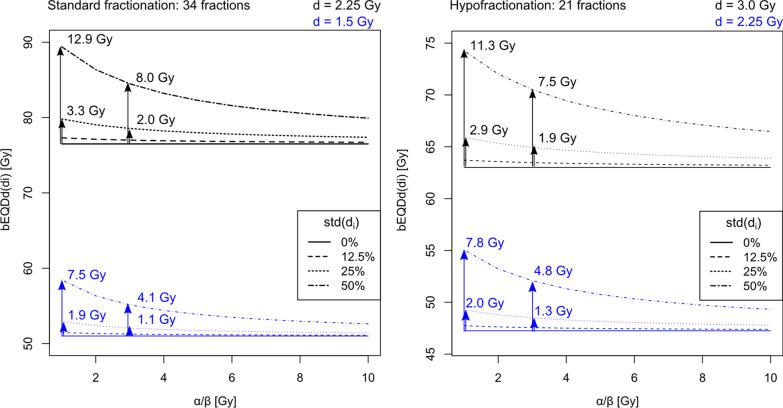
bEQD was systematically higher than the conventionally accumulated dose with difference hot spots of 3.3-4.9 Gy detected in six out of nine patients in regions of high dose gradient in the bladder and rectum. For hypofractionation, differences are up to 8.4 Gy. The difference amplitude was found to be in a similar range to worst-case uncertainties induced by DIR and was higher than that induced by α/β.
CONCLUSION
Using bEQD for dose accumulation overcomes a potential systematic inaccuracy in biological effect prediction based on accumulated dose. Highest impact is found for serial-type late responding organs at risk in dose gradient regions and for hypofractionation. Although hot spot differences are in the order of several Gray, in dose-volume parameters there is little difference compared with using conventional or biological DA. However, when local dose information is used, e.g. dose surface maps, difference hot spots can potentially change outcomes of dose-response modelling and adaptive treatment strategies.
背景
在基于线性二次模型(LQM)预测生物学效应时,放疗中剂量的累积方式存在一个基本的不一致性。为了解决这个不一致性,我们引入并评估了总生物剂量 bEQD 的概念。
方法
我们使用九名前列腺癌调强放疗患者的每日计算机断层扫描成像,基于形变图像配准(DIR)计算传递的变形剂量。我们比较了传统的剂量累积(DA)与新引入的 bEQD,这是一种新的累积生物剂量的方法,考虑了每个分次剂量和组织放射生物学。我们研究了所应用的分割方案(常规/低分割)、DIR 和分配的α/β值引起的不确定性的影响。
结果
bEQD 系统地高于常规累积剂量,在膀胱和直肠高剂量梯度区域的九名患者中的六名中检测到 3.3-4.9 Gy 的热点差异。对于低分割,差异高达 8.4 Gy。发现差异幅度与 DIR 和α/β引起的最坏情况不确定性处于相似范围内,且高于后者。
结论
使用 bEQD 进行剂量累积可克服基于累积剂量的生物学效应预测中潜在的系统性不准确性。在剂量梯度区域和低分割中,对串行型晚期反应器官的影响最大。虽然热点差异在几个 Gy 左右,但与使用传统或生物 DA 相比,在剂量-体积参数中几乎没有差异。然而,当使用局部剂量信息,如剂量表面图时,潜在的热点差异可能会改变剂量-反应模型和自适应治疗策略的结果。




 Zotero 插件