Huus Karina, Schlebusch Liezl, Ramaahlo Maria, Samuels Alecia, Berglund Ingalill Gimbler, Dada Shakila
Department of Nursing, School of Health and Welfare, Jönköping University, Jönköping, Sweden.
CHILD Research Group, School of Health and Welfare, Jönköping University, Jönköping, Sweden.
Afr J Disabil. 2021 Mar 8;10:771. doi: 10.4102/ajod.v10i0.771. eCollection 2021.
Research has shown that all children and adolescents have the right to participate in their everyday life. However, little is known about what impacts the participation of children and adolescents with disabilities living in low-and middle-income countries.
The present study undertakes a scoping review of research to synthesise the current literature about barriers and facilitators to participation in everyday life for children and adolescents with disabilities living in low- and middle-income countries.
A scoping review was conducted. The databases Psyc INFO, MEDLINE, CINAHL, Pubmed, ERIC and African Wide information were searched for studies published between 2001 and April 2018. Data was analysed using deductive content analysis. The barriers and facilitators to participation were categorised into personal factors, social factors, environmental factors, and policy and programme factors.
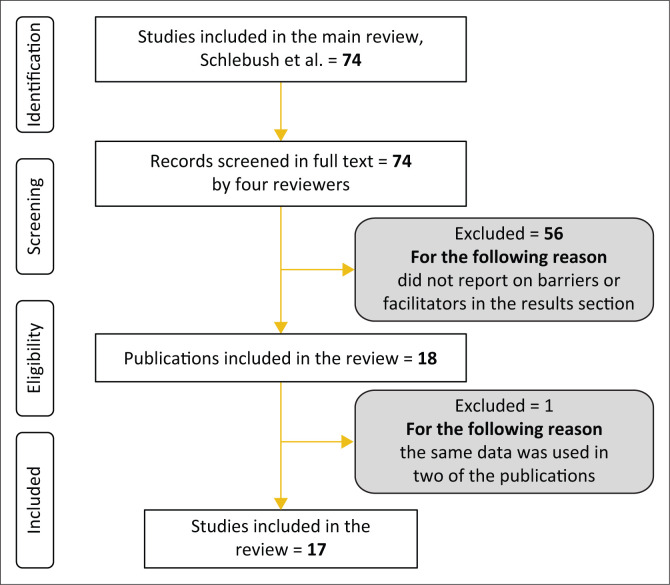
In the end, 17 articles were included for data extraction as they mentioned barriers and facilitators to participation for children and adolescents with disabilities. Most of the reviewed studies reported on barriers to participation. Only one of the studies was performed in a country classified as a low-income country; all other studies were performed in middle-income countries. The results indicate that some factors, especially social factors, could be perceived as both facilitators and barriers to participation.
There is a lack of studies describing barriers and facilitators in low- and middle- income countries. Barriers and facilitators in proximity to the child and family are most frequently described in the literature.
研究表明,所有儿童和青少年都有权参与他们的日常生活。然而,对于生活在低收入和中等收入国家的残疾儿童和青少年的参与受到哪些因素影响,我们知之甚少。
本研究进行了一项范围综述,以综合当前关于生活在低收入和中等收入国家的残疾儿童和青少年参与日常生活的障碍和促进因素的文献。
进行了一项范围综述。在Psyc INFO、MEDLINE、CINAHL、Pubmed、ERIC和非洲全信息数据库中搜索2001年至2018年4月发表的研究。使用演绎性内容分析法对数据进行分析。将参与的障碍和促进因素分为个人因素、社会因素、环境因素以及政策和项目因素。
最终,纳入了17篇文章进行数据提取,因为它们提到了残疾儿童和青少年参与的障碍和促进因素。大多数综述研究报告了参与的障碍。只有一项研究在被归类为低收入国家的国家进行;所有其他研究都在中等收入国家进行。结果表明,一些因素,尤其是社会因素,可能被视为参与的促进因素和障碍。
缺乏描述低收入和中等收入国家障碍和促进因素的研究。文献中最常描述的是与儿童和家庭密切相关的障碍和促进因素。