Montecino-Latorre Diego, Goldstein Tracey, Gilardi Kirsten, Wolking David, Van Wormer Elizabeth, Kazwala Rudovick, Ssebide Benard, Nziza Julius, Sijali Zikankuba, Cranfield Michael, Mazet Jonna A K
One Health Institute, School of Veterinary Medicine, University of California, Davis, CA USA.
Gorilla Doctors, Mountain Gorilla Veterinary Project Inc, Davis, CA USA.
One Health Outlook. 2020 Feb 7;2:2. doi: 10.1186/s42522-019-0008-8. eCollection 2020.
Bats provide important ecosystem services; however, current evidence supports that they host several zoonotic viruses, including species of the family. If bats in close interaction with humans host and shed coronaviruses with zoonotic potential, such as the Severe Acute Respiratory Syndrome virus, spillover may occur. Therefore, strategies aiming to mitigate potential spillover and disease emergence, while supporting the conservation of bats and their important ecological roles are needed. Past research suggests that coronavirus shedding in bats varies seasonally following their reproductive cycle; however, shedding dynamics have been assessed in only a few species, which does not allow for generalization of findings across bat taxa and geographic regions.
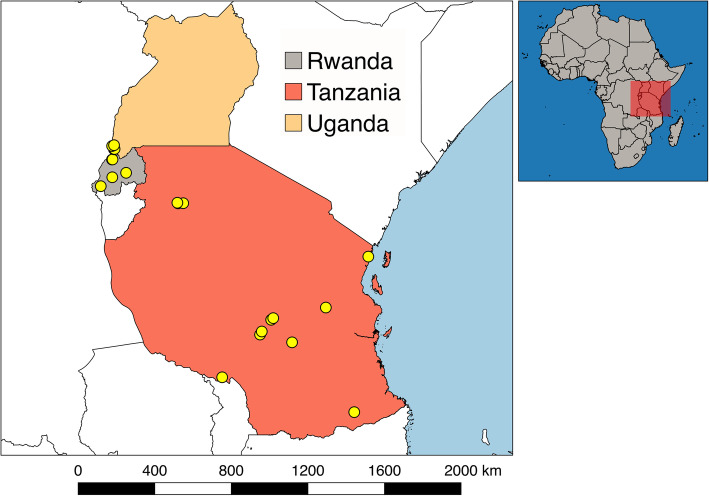
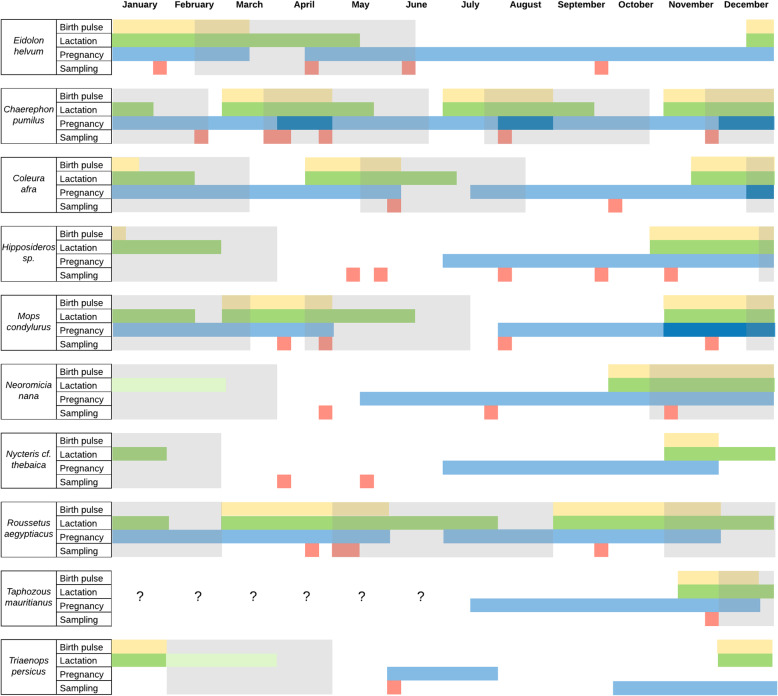
To assess the generalizability of coronavirus shedding seasonality, we sampled hundreds of bats belonging to several species with different life history traits across East Africa at different times of the year. We assessed, via Bayesian modeling, the hypothesis that chiropterans, across species and spatial domains, experience seasonal trends in coronavirus shedding as a function of the reproductive cycle.
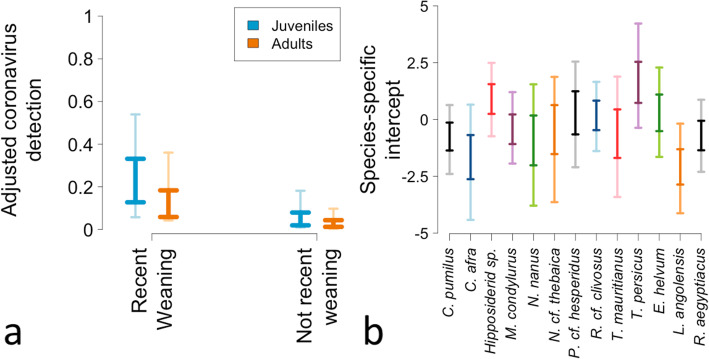
We found that, beyond spatial, taxonomic, and life history differences, coronavirus shedding is more expected when pups are becoming independent from the dam and that juvenile bats are prone to shed these viruses.
These findings could guide policy aimed at the prevention of spillover in limited-resource settings, where longitudinal surveillance is not feasible, by identifying high-risk periods for coronavirus shedding. In these periods, contact with bats should be avoided (for example, by impeding or forbidding people access to caves). Our proposed strategy provides an alternative to culling - an ethically questionable practice that may result in higher pathogen levels - and supports the conservation of bats and the delivery of their key ecosystem services.
蝙蝠提供重要的生态系统服务;然而,目前的证据支持它们携带多种人畜共患病毒,包括该科的一些物种。如果与人类密切接触的蝙蝠携带并排出具有人畜共患潜力的冠状病毒,如严重急性呼吸综合征病毒,就可能发生病毒外溢。因此,需要制定战略,在支持蝙蝠保护及其重要生态作用的同时,减轻潜在的病毒外溢和疾病出现。过去的研究表明,蝙蝠体内冠状病毒的排出量会随着其繁殖周期季节性变化;然而,仅在少数物种中评估了排出动态,这使得无法在蝙蝠类群和地理区域中对研究结果进行概括。
为了评估冠状病毒排出季节性的普遍性,我们在一年中的不同时间对东非数百只属于几个具有不同生活史特征物种的蝙蝠进行了采样。我们通过贝叶斯模型评估了这样一个假设,即跨物种和空间区域的翼手目动物,冠状病毒排出存在随繁殖周期变化的季节性趋势。
我们发现,除了空间、分类学和生活史差异外,当幼崽开始独立于母蝠时,冠状病毒排出的可能性更大,并且幼年蝙蝠容易排出这些病毒。
这些发现可以指导在资源有限、无法进行纵向监测的环境中预防病毒外溢的政策制定,通过识别冠状病毒排出的高风险时期。在这些时期,应避免与蝙蝠接触(例如,通过阻止或禁止人们进入洞穴)。我们提出的策略提供了一种替代捕杀的方法——捕杀是一种在伦理上有问题的做法,可能会导致更高的病原体水平——并支持蝙蝠保护及其关键生态系统服务的提供。