He Shanshan, Shao Wenyuan, Han Jie
Department of Environmental Science and Engineering, Xi'an Jiaotong University, Xi'an, 710049 People's Republic of China.
School of Life Sciences and Technology, Xi'an Jiaotong University, Xi'an, 710049 People's Republic of China.
Environ Chem Lett. 2021;19(6):4021-4030. doi: 10.1007/s10311-021-01291-y. Epub 2021 Jul 31.
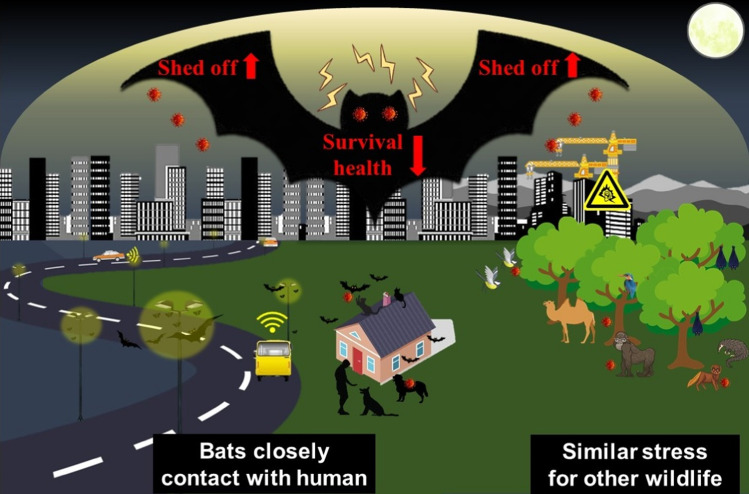
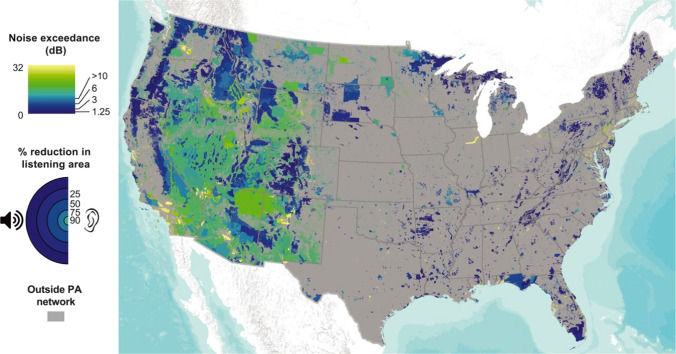
Where did the severe acute respiratory syndrome coronavirus 2 (SARS-CoV-2) come from? Did it spread to 'patient zero' through proactive human-animal contact? Why did humans faced an increasing number of zoonotic diseases in the past few decades? In this article, we propose a new theory by which human pollution such as artificial lighting and noise accentuate pathogen shedding from bats and other wild habitants in urban environments. This theory differs from the current hypothesis that wildlife trades and bushmeat consumption largely contribute to the spillover of zoonotic pathogens to humans. As natural reservoirs, bats harbor the greatest number of zoonotic viruses among all mammalian orders, while they also have a unique immune system to maintain functioning. Some bat species roost in proximity with human settlements, including urban communities and surrounding areas that are potentially most impacted by anthropogenic activities. We review the behavioral changes of wild habitants, including bats and other species, caused by environmental pollution such as artificial lighting and noise pollution, with focus on the spillover of zoonotic pathogens to humans. We found that there is a strong positive correlation between environmental stress and the behavior and health conditions of wild species, including bats. Specifically, artificial lighting attracts insectivorous bats to congregate around streetlights, resulting in changes in their diets and improved likelihood of close contact with humans and animals. Moreover, many bat species avoid lit areas by expending more energies on commuting and foraging. Noise pollution has similar effects on bat behavior. Bats exposed to chronic noise pollution have weakened immune functions, increased viral shedding, and declined immunity during pregnancy, lactation, and vulnerable periods due to noised-induced stress. Other wild species exposed to artificial lighting and noise pollution also show stress-induced behaviors and deteriorated health. Overall, evidence supports our hypothesis that artificial lighting and noise pollution have been overlooked as long-term contributors to the spillover of zoonotic pathogens to humans in urban environments.
严重急性呼吸综合征冠状病毒2(SARS-CoV-2)源自何处?它是通过主动的人畜接触传播给“零号病人”的吗?为何在过去几十年间人类面临的人畜共患病数量不断增加?在本文中,我们提出了一种新理论,即人工照明和噪音等人为污染加剧了蝙蝠及其他野生动物在城市环境中的病原体传播。这一理论不同于当前的假说,即野生动物贸易和食用野味在很大程度上导致了人畜共患病原体向人类的溢出。作为天然宿主,蝙蝠在所有哺乳动物目中携带的人畜共患病毒数量最多,同时它们还拥有独特的免疫系统来维持功能。一些蝙蝠物种在靠近人类住区的地方栖息,包括城市社区以及可能受人为活动影响最大的周边地区。我们回顾了由人工照明和噪音污染等环境污染导致的野生动物(包括蝙蝠和其他物种)行为变化,重点关注人畜共患病原体向人类的溢出。我们发现,环境压力与包括蝙蝠在内的野生动物的行为和健康状况之间存在很强的正相关。具体而言,人工照明吸引食虫蝙蝠聚集在路灯周围,导致它们的饮食发生变化,并增加了与人类和动物密切接触的可能性。此外,许多蝙蝠物种通过在通勤和觅食上消耗更多能量来避开光照区域。噪音污染对蝙蝠行为也有类似影响。暴露于慢性噪音污染的蝙蝠免疫功能减弱,病毒传播增加,并且在怀孕、哺乳和因噪音引起的压力导致的脆弱时期免疫力下降。其他暴露于人工照明和噪音污染的野生动物也表现出应激行为和健康恶化。总体而言,有证据支持我们的假设,即人工照明和噪音污染作为城市环境中导致人畜共患病原体向人类溢出的长期因素一直被忽视。