Department of Obstetrics and Gynecology, Peking Union Medical College Hospital, Shuaifuyuan No. 1, Dongcheng District, Beijing, 100730, China.
Department of Obstetrics and Gynecology, the Second People's Hospital of Jingdezhen, Jingdezhen, 333099, China.
Orphanet J Rare Dis. 2021 Apr 7;16(1):160. doi: 10.1186/s13023-021-01802-8.
The prognosis of recurrent low-grade endometrial stromal sarcoma (LGESS) is little known. This study was to investigate the survival outcomes of a cohort of patients with recurrent LGESS.
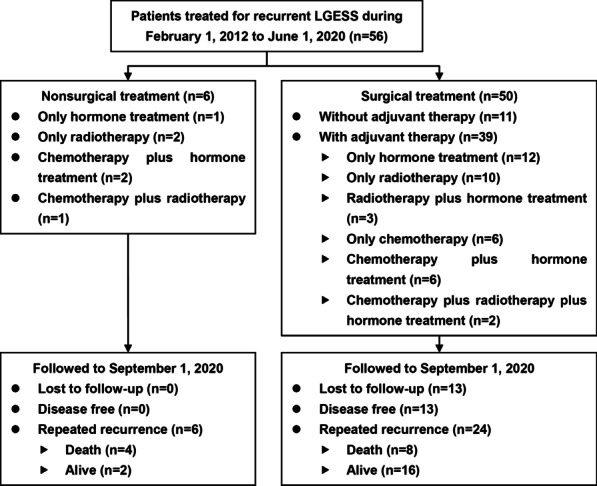
Patients with primary LGESS diagnosed and treated for first recurrence confirmed by histology in the study center from February 2012 to June 2019 were retrospectively included. The progression-free interval (PFI) after the last treatment for first recurrence and overall survival (OS) since the diagnosis of first recurrence, which were followed up to June 1, 2020, were compared between groups of various therapy modalities.
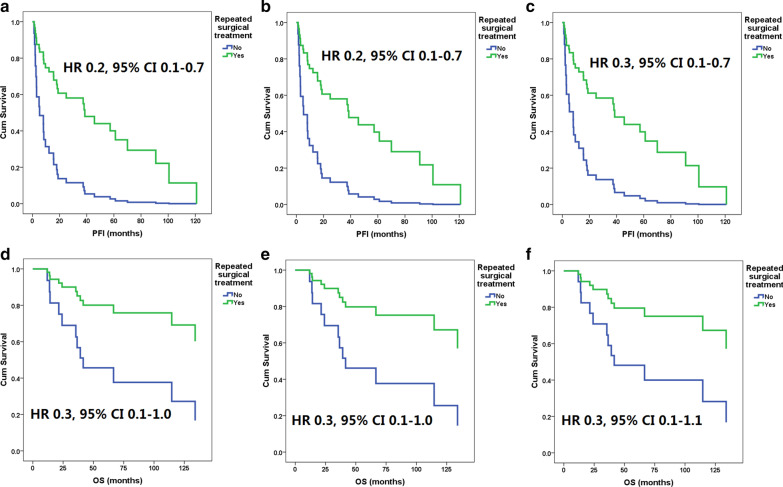
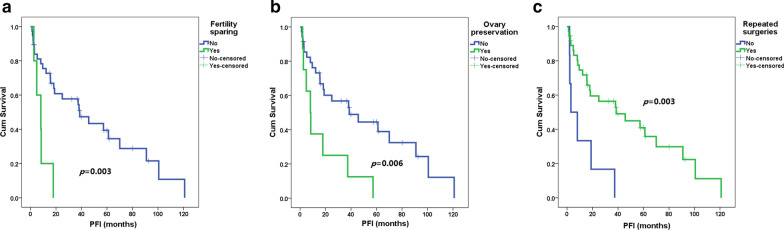
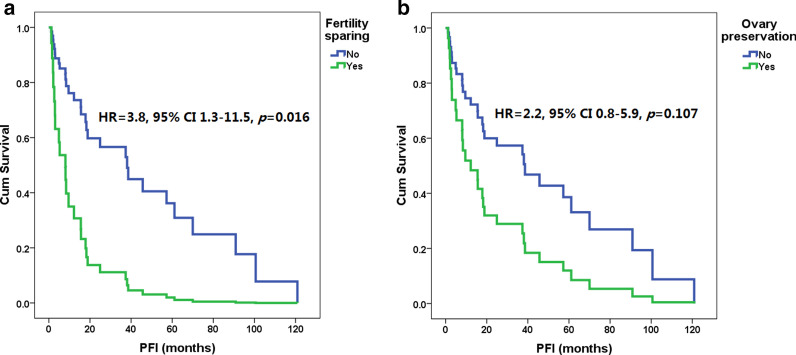
Fifty-six patients were included, and 43 patients (76.8%) had definite follow-up outcomes. The 5-year PFI and OS rates were 30.0% (95% confidence interval [95% CI] 29.2-30.8) and 75.0% (68.0-82.0), respectively. In univariate analysis, only fertility-sparing treatment, ovarian preservation and surgical treatment had a significant impact on the PFI (hazard ratio [HR] 4.5, 3.1, and 0.2; 95% CI 1.5-13.1, 1.3-7.3, and 0.1-0.7; and p = 0.006, 0.009 and 0.006, respectively), but no factor was found to be associated with increased mortality risk. After adjusted with hormone treatment or chemotherapy, surgical treatment had significant effectiveness on OS (HR 0.3 and 0.3, 95% CI 0.1-1.0 and 0.1-1.0, p = 0.045 and 0.049, respectively). None of the patients with fertility-sparing treatment had successful conception, and all experienced repeated relapse.
For patients with recurrent LGESS, fertility-sparing treatment or ovarian preservation should not be provided. Surgery is the treatment of choice, and hormone treatment and/or chemotherapy was effective for the survival benefits of surgical treatment.
复发性低度子宫内膜间质肉瘤(LGESS)的预后鲜为人知。本研究旨在探讨一组复发性 LGESS 患者的生存结果。
本研究回顾性纳入 2012 年 2 月至 2019 年 6 月期间在研究中心通过组织学证实诊断为复发性 LGESS 且接受首次复发治疗的患者。比较不同治疗方式组患者末次治疗后无进展生存期(PFI)和首次复发后总生存期(OS),随访至 2020 年 6 月 1 日。
共纳入 56 例患者,43 例(76.8%)患者有明确的随访结局。5 年 PFI 和 OS 率分别为 30.0%(95%可信区间[95%CI]:29.2-30.8)和 75.0%(68.0-82.0)。单因素分析中,仅保留生育功能治疗、卵巢保留和手术治疗对 PFI 有显著影响(风险比[HR]:4.5、3.1 和 0.2;95%CI:1.5-13.1、1.3-7.3 和 0.1-0.7;p=0.006、0.009 和 0.006),但未发现任何因素与死亡率增加相关。调整激素治疗或化疗后,手术治疗对 OS 有显著疗效(HR:0.3 和 0.3;95%CI:0.1-1.0 和 0.1-1.0;p=0.045 和 0.049)。保留生育功能治疗的患者均未成功受孕,且均经历了复发。
对于复发性 LGESS 患者,不应提供保留生育功能治疗或卵巢保留。手术是首选治疗方法,激素治疗和/或化疗可提高手术治疗的生存获益。