Zhou Xiaorong, Li Chenchen, Zhang Zhao, Li Daniel Y, Du Jinwei, Ding Ping, Meng Haiyan, Xu Hui, Li Ronglei, Ho Effie, Zhang Aiguo, Okunieff Paul, Lu Jianwei, Sha Michael Y
Jiangsu Cancer Hospital, Institute of Cancer Research, The Affiliated Cancer Hospital of Nanjing Medical University, Nanjing, 210009, Jiangsu, China.
DiaCarta, Inc., 2600 Hilltop Drive, Richmond, CA, 94806, USA.
Sci Rep. 2021 Apr 7;11(1):7633. doi: 10.1038/s41598-021-85797-z.
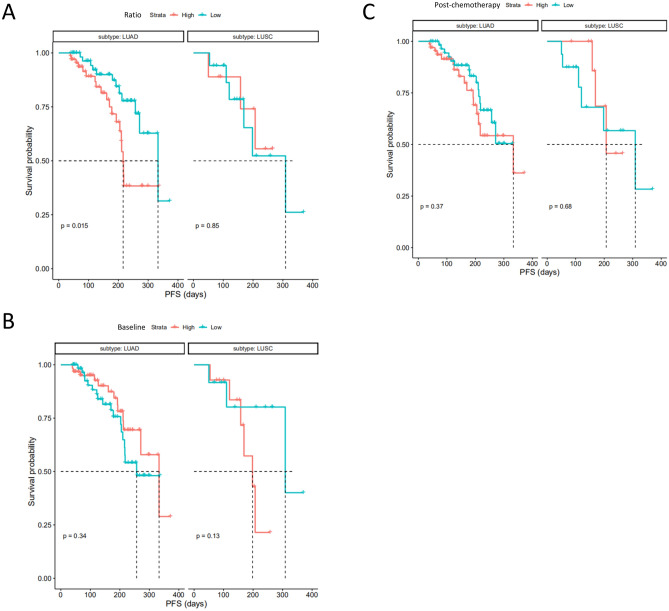
Tyrosine kinase inhibitors (TKIs), VEGF/VEGF receptor inhibitors (VEGFIs) and immune checkpoint inhibitors (ICIs) have revolutionized the treatment of advanced cancers including non-small-cell lung cancer (NSCLC). This study aims to evaluate the utility of plasma cell-free DNA (cfDNA) as a prognostic biomarker and efficacy predictor of chemotherapy (CT) with or without these precision therapies in NSCLC patients. Peripheral cfDNA levels in 154 NSCLC patients were quantified before and after the first target cycle of chemotherapy. The correlations of cfDNA with tumor burden, clinical characteristics, progression-free survival (PFS)/disease-free survival (DFS), objective response ratio (ORR), and therapy regimens were analyzed respectively. Baseline cfDNA, but not post-chemotherapeutic cfDNA, positively correlates with tumor burden. Notably, cfDNA kinetics (cfDNA Ratio, the ratio of post-chemotherapeutic cfDNA to baseline cfDNA) well distinguished responsive individuals (CR/PR) from the non-responsive (PD/SD). Additionally, cfDNA Ratio was found negatively correlated with PFS in lung adenocarcinoma (LUAD), but not lung squamous-cell carcinoma (LUSC) which may be due to a limited number of LUSC patients in this cohort. LUAD patients with low cfDNA Ratio have prolonged PFS and improved ORR, compared to those with high cfDNA Ratio. When stratified by therapy regimen, the predictive value of cfDNA Ratio is significant in patients with chemotherapy plus VEGFIs, while more patients need be included to validate the value of cfDNA Ratio in other regimens. Thus, the kinetics of plasma cfDNA during chemotherapy may function as a prognostic biomarker and efficacy predictor for NSCLC patients.
酪氨酸激酶抑制剂(TKIs)、血管内皮生长因子/血管内皮生长因子受体抑制剂(VEGFIs)和免疫检查点抑制剂(ICIs)彻底改变了包括非小细胞肺癌(NSCLC)在内的晚期癌症的治疗方式。本研究旨在评估血浆游离DNA(cfDNA)作为NSCLC患者预后生物标志物以及化疗(CT)联合或不联合这些精准疗法时疗效预测指标的效用。在154例NSCLC患者化疗的首个靶向周期前后,对其外周血cfDNA水平进行定量分析。分别分析cfDNA与肿瘤负荷、临床特征、无进展生存期(PFS)/无病生存期(DFS)、客观缓解率(ORR)及治疗方案之间的相关性。基线cfDNA与肿瘤负荷呈正相关,而化疗后cfDNA则不然。值得注意的是,cfDNA动力学(cfDNA比值,即化疗后cfDNA与基线cfDNA的比值)能很好地区分有反应的个体(CR/PR)和无反应的个体(PD/SD)。此外,发现cfDNA比值与肺腺癌(LUAD)的PFS呈负相关,但与肺鳞状细胞癌(LUSC)无关,这可能是由于该队列中LUSC患者数量有限。与cfDNA比值高的LUAD患者相比,cfDNA比值低的患者PFS延长,ORR提高。按治疗方案分层时,cfDNA比值在化疗联合VEGFIs的患者中具有显著的预测价值,而在其他方案中则需要纳入更多患者来验证cfDNA比值的价值。因此,化疗期间血浆cfDNA的动力学可能作为NSCLC患者的预后生物标志物和疗效预测指标。