Pan Yuteng, Sheng Wei, Shi Liting, Jing Di, Jiang Wei, Chen Jyh-Cheng, Wang Haiyan, Qiu Jianfeng
Medical Science and Technology Innovation Center, Shandong First Medical University and Shandong Academy of Medical Sciences, Jinan, China.
Medical Engineering and Technology Research Center, School of Radiology, Shandong First Medical University and Shandong Academy of Medical Sciences, Tai'an, China.
Quant Imaging Med Surg. 2023 Jun 1;13(6):3547-3555. doi: 10.21037/qims-22-1098. Epub 2023 Apr 6.
This study developed and validated a deep learning (DL) model based on whole slide imaging (WSI) for predicting the treatment response to chemotherapy and radiotherapy (CRT) among patients with non-small cell lung cancer (NSCLC).
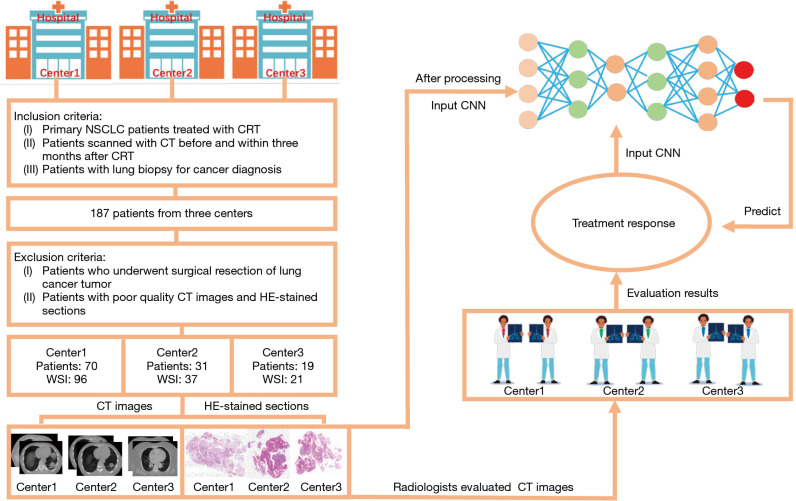
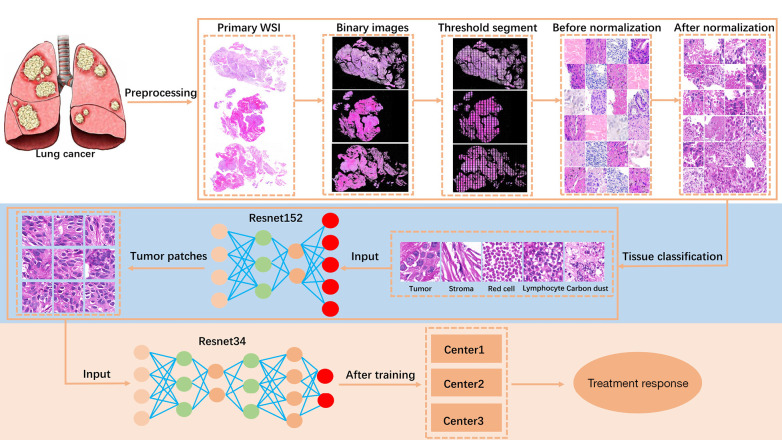
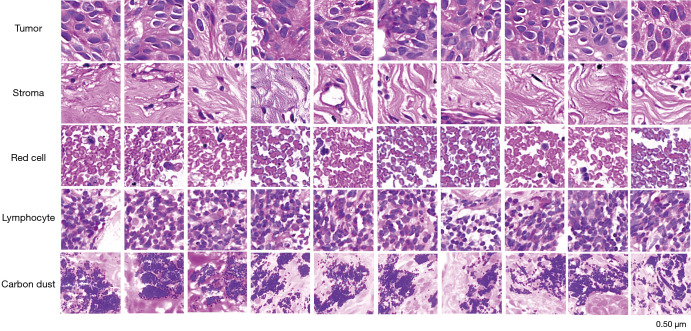
We collected the WSI of 120 nonsurgical patients with NSCLC treated with CRT from three hospitals in China. Based on the processed WSI, two DL models were established: a tissue classification model which was used to select tumor-tiles, and another model which predicted the treatment response of the patients based on the tumor-tiles (predicting the treatment response of each tile). A voting method was employed, by which the label of tiles with the greatest quantity from 1 patient would be used as the label of the patient.
The tissue classification model had a great performance (accuracy in the training set/internal validation set =0.966/0.956). Based on 181,875 tumor-tiles selected by the tissue classification model, the model for predicting the treatment response demonstrated strong predictive ability (accuracy of patient-level prediction in the internal validation set/external validation set 1/external validation set 2 =0.786/0.742/0.737).
A DL model was constructed based on WSI to predict the treatment response of patients with NSCLC. This model can help doctors to formulate personalized CRT plans and improve treatment outcomes.
本研究开发并验证了一种基于全切片成像(WSI)的深度学习(DL)模型,用于预测非小细胞肺癌(NSCLC)患者对化疗和放疗(CRT)的治疗反应。
我们收集了来自中国三家医院的120例接受CRT治疗的非手术NSCLC患者的WSI。基于处理后的WSI,建立了两个DL模型:一个组织分类模型,用于选择肿瘤切片;另一个模型基于肿瘤切片预测患者的治疗反应(预测每个切片的治疗反应)。采用投票方法,将1名患者中数量最多的切片标签用作该患者的标签。
组织分类模型表现出色(训练集/内部验证集的准确率=0.966/0.956)。基于组织分类模型选择的181,875个肿瘤切片,预测治疗反应的模型显示出强大的预测能力(内部验证集/外部验证集1/外部验证集2中患者水平预测的准确率=0.786/0.742/0.737)。
构建了基于WSI的DL模型来预测NSCLC患者的治疗反应。该模型可帮助医生制定个性化的CRT方案并改善治疗效果。