Shahmirzadi Solaleh, Sharaf Rana A, Saadat Sarang, Moore William S, Geha Hassem, Tamimi Dania, Demirturk Kocasarac Husniye
Department of Diagnostic Sciences, Division of Oral and Maxillofacial Radiology, Texas A&M College of Dentistry, Dallas, TX, USA.
Department of Comprehensive Dentistry, Division of Oral and Maxillofacial Radiology, University of Texas Health Science Center, San Antonio, TX, USA.
Imaging Sci Dent. 2021 Mar;51(1):1-7. doi: 10.5624/isd.20200094. Epub 2021 Jan 28.
The aim of this study was to assess artifacts generated in cone-beam computed tomography (CBCT) of 3 types of dental implants using 3 metal artifact reduction (MAR) algorithm conditions (pre-acquisition MAR, postacquisition MAR, and no MAR), and 2 peak kilovoltage (kVp) settings.
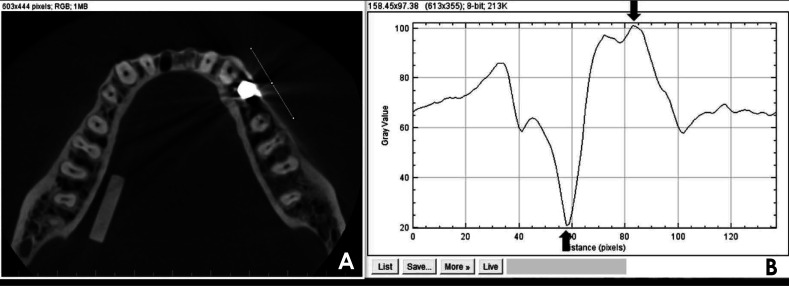
Titanium-zirconium, titanium, and zirconium alloy implants were placed in a dry mandible. CBCT images were acquired using 84 and 90 kVp and at normal resolution for all 3 MAR conditions. The images were analyzed using ImageJ software (National Institutes of Health, Bethesda, MD) to calculate the intensity of artifacts for each combination of material and settings. A 3-factor analysis of variance model with up to 3-way interactions was used to determine whether there was a statistically significant difference in the mean intensity of artifacts associated with each factor.
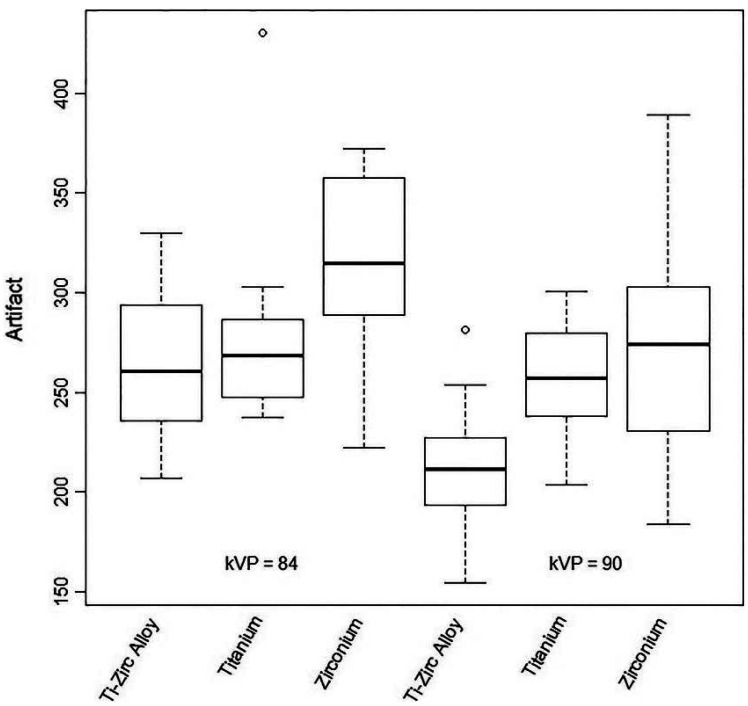
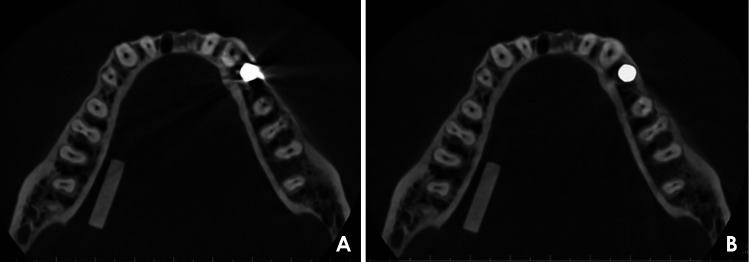
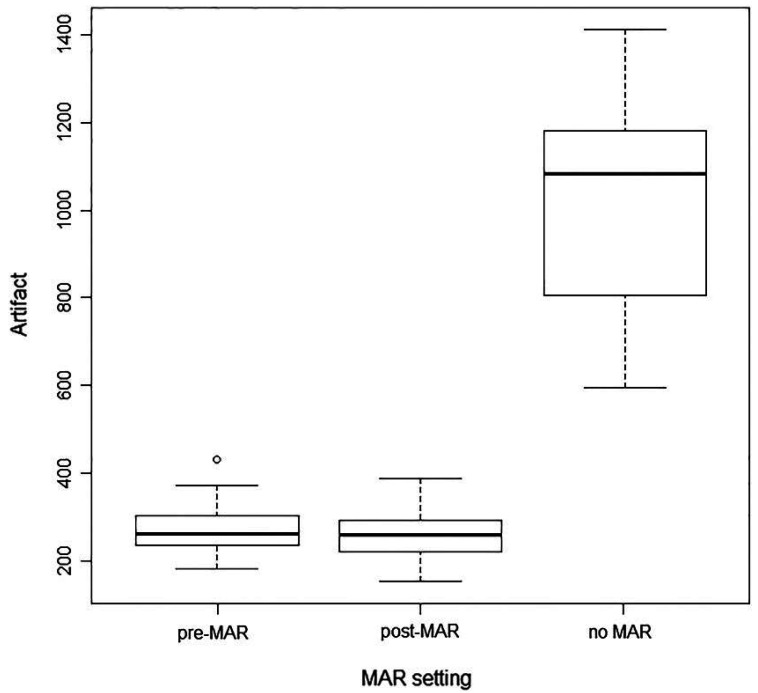
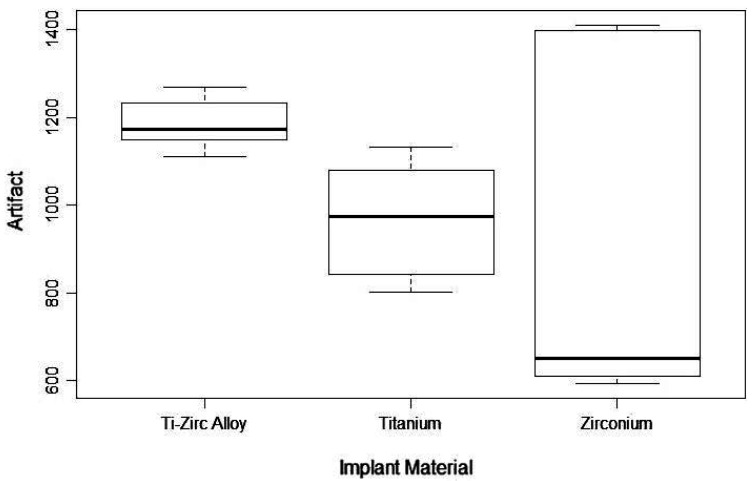
The analysis of all 3 MAR conditions showed that using no MAR resulted in substantially more severe artifacts than either of the 2 MAR algorithms for the 3 implant materials; however, there were no significant differences between pre- and post-acquisition MAR. The 90 kVp setting generated less intense artifacts on average than the 84 kVp setting. The titanium-zirconium alloy generated significantly less intense artifacts than zirconium. Titanium generated artifacts at an intermediate level relative to the other 2 implant materials, but was not statistically significantly different from either.
This in vitro study suggests that artifacts can be minimized by using a titanium-zirconium alloy at the 90 kVp setting, with either MAR setting.
本研究旨在评估在三种金属伪影减少(MAR)算法条件(采集前MAR、采集后MAR和无MAR)以及两种峰值千伏(kVp)设置下,三种类型牙种植体的锥形束计算机断层扫描(CBCT)中产生的伪影。
将钛锆合金、钛和锆合金种植体植入干燥的下颌骨中。使用84和90 kVp并以正常分辨率采集所有三种MAR条件下的CBCT图像。使用ImageJ软件(美国国立卫生研究院,马里兰州贝塞斯达)对图像进行分析,以计算每种材料和设置组合的伪影强度。使用具有高达三向交互作用的三因素方差分析模型来确定与每个因素相关的伪影平均强度是否存在统计学上的显著差异。
对所有三种MAR条件的分析表明,对于三种种植体材料,不使用MAR产生的伪影比两种MAR算法中的任何一种都要严重得多;然而,采集前和采集后MAR之间没有显著差异。90 kVp设置平均产生的伪影比84 kVp设置少。钛锆合金产生的伪影强度明显低于锆。钛产生的伪影相对于其他两种种植体材料处于中等水平,但与两者均无统计学上的显著差异。
这项体外研究表明,在90 kVp设置下,使用钛锆合金并结合任何一种MAR设置,可将伪影最小化。