Narkhede Yogesh B, Gautam Avneesh K, Hsu Rohaine V, Rodriguez Wilson, Zewde Nehemiah T, Harrison Reed E S, Arantes Pablo R, Gaieb Zied, Gorham Ronald D, Kieslich Chris, Morikis Dimitrios, Sahu Arvind, Palermo Giulia
Department of Bioengineering, University of California, Riverside, CA.
National Centre for Cell Science, Pune University Campus, Ganeshkhind, India.
Front Mol Biosci. 2021 Mar 16;8:618068. doi: 10.3389/fmolb.2021.618068. eCollection 2021.
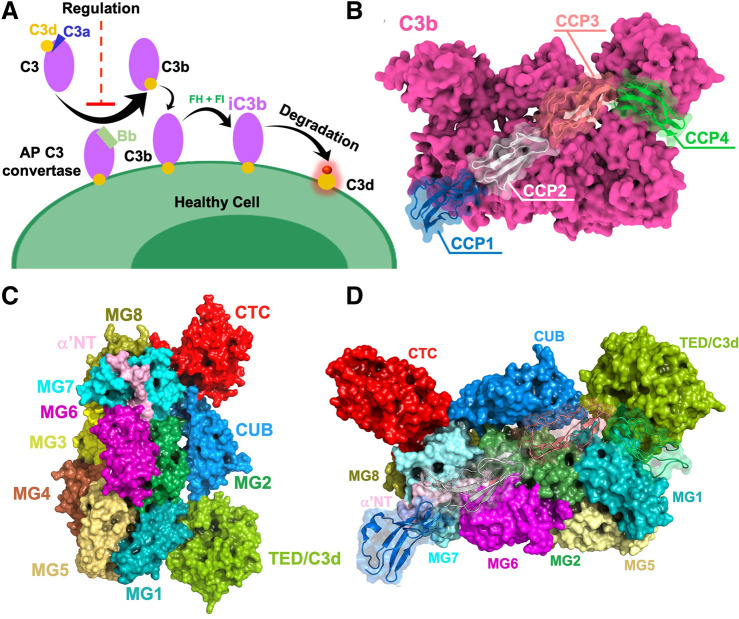
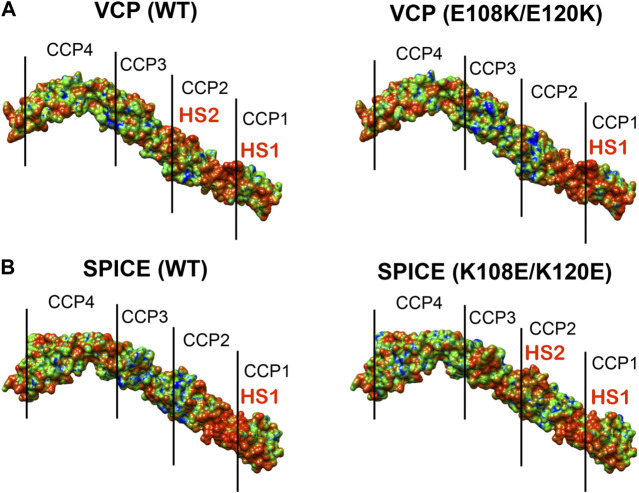
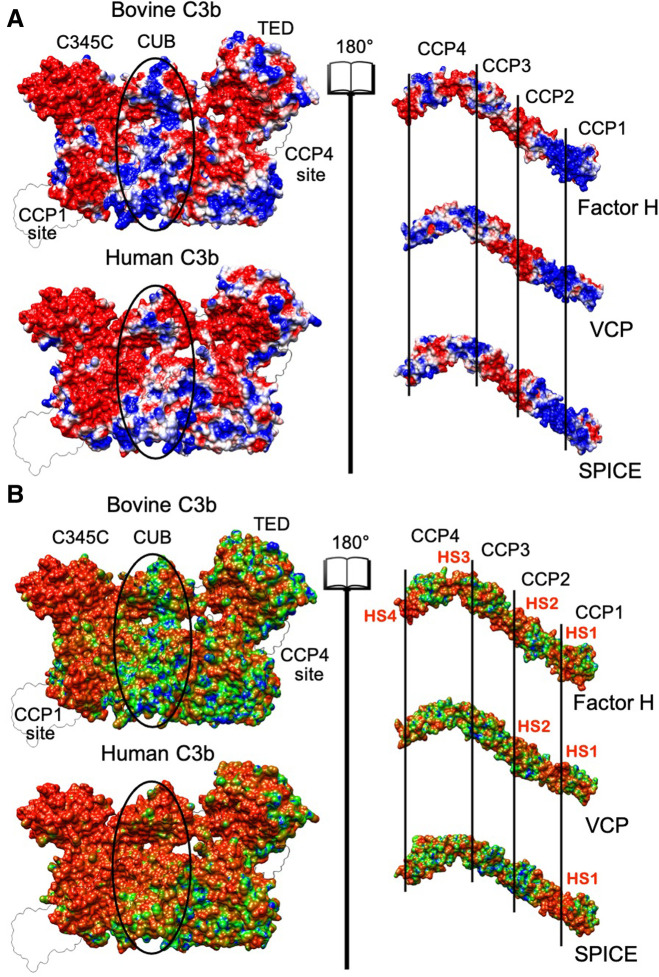
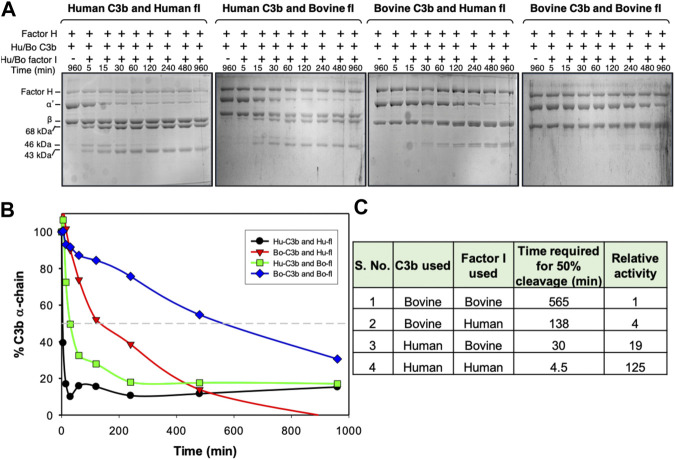
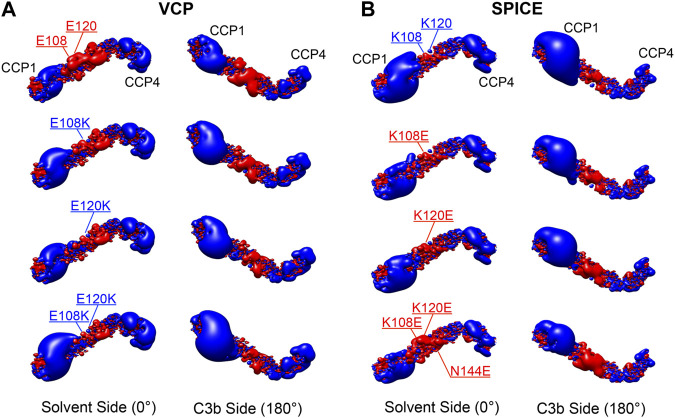
Poxviruses are dangerous pathogens, which can cause fatal infection in unvaccinated individuals. The causative agent of smallpox in humans, , is closely related to the bovine , yet the molecular basis of their selectivity is currently incompletely understood. Here, we examine the role of the electrostatics in the selectivity of the smallpox protein SPICE and vaccinia protein VCP toward the human and bovine complement protein C3b, a key component of the complement immune response. Electrostatic calculations, in-silico alanine-scan and electrostatic hotspot analysis, as introduced by Kieslich and Morikis (. 2012), are used to assess the electrostatic complementarity and to identify sites resistant to local perturbation where the electrostatic potential is likely to be evolutionary conserved. The calculations suggest that the bovine C3b is electrostatically prone to selectively bind its VCP ligand. On the other hand, the human isoform of C3b exhibits a lower electrostatic complementarity toward its SPICE ligand. Yet, the human C3b displays a highly preserved electrostatic core, which suggests that this isoform could be less selective in binding different ligands like SPICE and the human Factor H. This is supported by experimental cofactor activity assays revealing that the human C3b is prone to bind both SPICE and Factor H, which exhibit diverse electrostatic properties. Additional investigations considering mutants of SPICE and VCP that revert their selectivity reveal an "electrostatic switch" into the central modules of the ligands, supporting the critical role of the electrostatics in the selectivity. Taken together, these evidences provide insights into the selectivity mechanism of the complement regulator proteins encoded by the and to circumvent the complement immunity and exert their pathogenic action. These fundamental aspects are valuable for the development of novel vaccines and therapeutic strategies.
痘病毒是危险的病原体,可在未接种疫苗的个体中引起致命感染。人类天花的病原体 与牛痘病毒密切相关,但其选择性的分子基础目前尚不完全清楚。在这里,我们研究了静电作用在天花蛋白SPICE和痘苗病毒蛋白VCP对人及牛补体蛋白C3b(补体免疫反应的关键成分)的选择性中的作用。如Kieslich和Morikis(2012年)所介绍的,静电计算、计算机模拟丙氨酸扫描和静电热点分析被用于评估静电互补性,并识别对局部扰动具有抗性的位点,这些位点的静电势可能在进化过程中保守。计算结果表明,牛C3b在静电作用下易于选择性结合其VCP配体。另一方面,人源C3b异构体对其SPICE配体的静电互补性较低。然而,人C3b显示出高度保守的静电核心,这表明该异构体在结合不同配体(如SPICE和人源因子H)时可能选择性较低。实验性辅因子活性测定支持了这一点,该测定表明人C3b易于结合SPICE和因子H,而它们具有不同的静电特性。对SPICE和VCP突变体的进一步研究恢复了它们的选择性,揭示了配体中心模块中的“静电开关”,支持了静电在选择性中的关键作用。综上所述,这些证据为 和 编码的补体调节蛋白规避补体免疫并发挥其致病作用的选择性机制提供了见解。这些基本方面对新型疫苗和治疗策略的开发具有重要价值。