Agrawal Palak, Nawadkar Renuka, Ojha Hina, Kumar Jitendra, Sahu Arvind
Complement Biology Laboratory, National Centre for Cell Science, Savitribai Phule Pune UniversityPune, India.
Front Microbiol. 2017 Jun 16;8:1117. doi: 10.3389/fmicb.2017.01117. eCollection 2017.
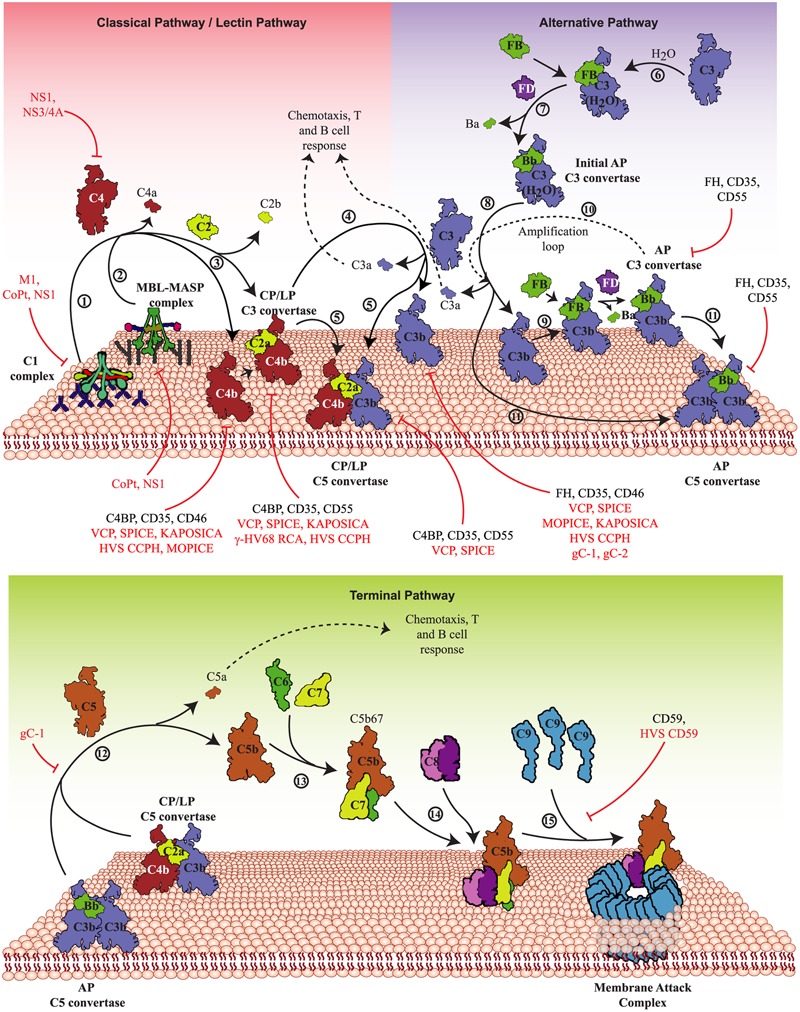
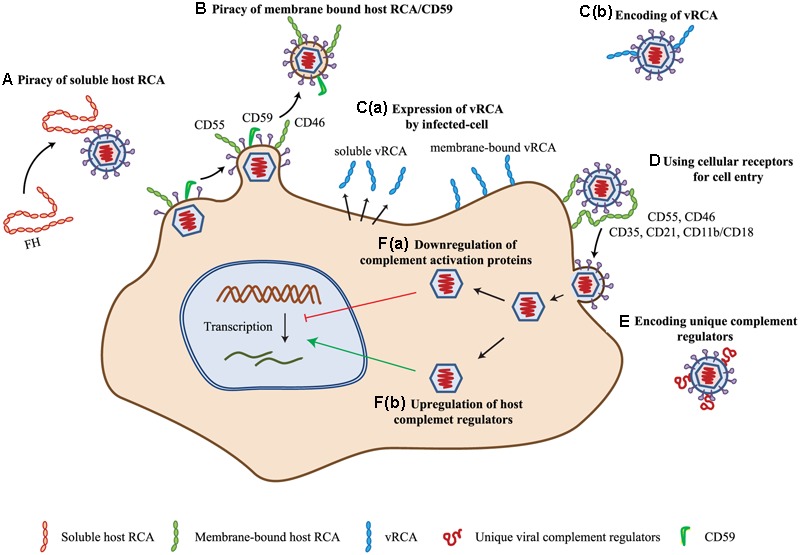
Being a major first line of immune defense, the complement system keeps a constant vigil against viruses. Its ability to recognize large panoply of viruses and virus-infected cells, and trigger the effector pathways, results in neutralization of viruses and killing of the infected cells. This selection pressure exerted by complement on viruses has made them evolve a multitude of countermeasures. These include targeting the recognition molecules for the avoidance of detection, targeting key enzymes and complexes of the complement pathways like C3 convertases and C5b-9 formation - either by encoding complement regulators or by recruiting membrane-bound and soluble host complement regulators, cleaving complement proteins by encoding protease, and inhibiting the synthesis of complement proteins. Additionally, viruses also exploit the complement system for their own benefit. For example, they use complement receptors as well as membrane regulators for cellular entry as well as their spread. Here, we provide an overview on the complement subversion mechanisms adopted by the members of various viral families including and .
作为免疫防御的主要第一道防线,补体系统时刻警惕着病毒。它识别大量病毒和病毒感染细胞并触发效应途径的能力,导致病毒中和以及感染细胞的杀伤。补体对病毒施加的这种选择压力促使它们进化出多种应对措施。这些措施包括靶向识别分子以避免被检测到,靶向补体途径的关键酶和复合物,如C3转化酶和C5b - 9的形成——要么通过编码补体调节因子,要么通过招募膜结合和可溶性宿主补体调节因子,通过编码蛋白酶切割补体蛋白,以及抑制补体蛋白的合成。此外,病毒还利用补体系统为自身谋利。例如,它们利用补体受体以及膜调节因子进行细胞进入和传播。在此,我们概述了包括……和……在内的各种病毒家族成员所采用的补体颠覆机制。