Department of Obstetrics and Gynecology, Beijing Youan Hospital, Capital Medical University, Beijing, China.
Department of Clinical Care Medicine of Liver Diseases, Beijing Youan Hospital, Capital Medical University, Beijing, China.
BMC Pregnancy Childbirth. 2021 Apr 8;21(1):280. doi: 10.1186/s12884-021-03756-y.
We aimed to describe the characteristics and outcomes in pregnant women with liver cirrhosis, and identify the predictors of adverse events of mother and fetus.
Retrospectively collected mothers with liver cirrhosis in our center from 6/2010 to 6/2019. Women without liver cirrhosis were selected as a control in a 1:2 ratio. The primary assessment was the frequency of maternal and fetal adverse events. The secondary assessment was the adverse events in patients continuing pregnancy or not and the factors to predict the severe adverse events.
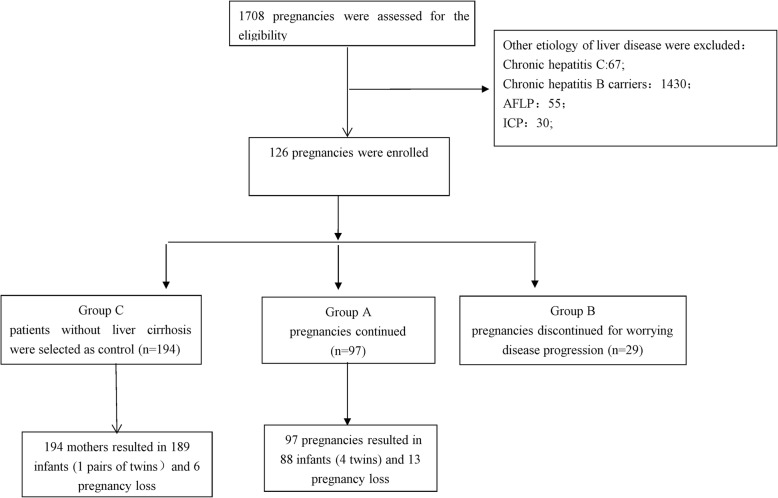
Of 126 pregnancies enrolled, 29 pregnancies were terminated for worrying disease progression and 97 pregnancies continued. One hundred ninety-four pregnancies without liver cirrhosis were selected as control. At baseline, patients with liver cirrhosis have a lower level of platelet, hemoglobin, prothrombin activity, and a higher level of ALT, total Bilirubin, creatinine. Compared to control, patients with liver cirrhosis had a higher frequency of adverse events, including bleeding gums (7.2%vs. 1.0%), TBA elevation (18.6%vs.3.1%), infection (10.3%vs.0.5%), cesarean section (73.6%vs.49.5%), postpartum hemorrhage (13.8% vs 2.1%), blood transfusion (28.9% vs 2.1%), new ascites or aggravating ascites (6.2% vs.0%), MODS (7.2% vs.0.5%) and intensive care unit admissions (24.1% vs 1.1%). The incidence of severe maternal adverse events was also higher (32.0% vs 1.5%). Women who chose to terminated the pregnancy had less severe adverse events (3.4% vs.32.0%). A higher frequency of fetal/infants' complications was observed in liver cirrhosis population than control, including newborn asphyxia (10.2% vs1.1%), low birth weight infant (13.6% vs. 2.6%). In patients who progressed into the third trimester, multivariable regression analysis demonstrated that severe adverse events were associated with a higher CTP score (OR 2.128, 95% CI [1.002, 4.521], p = 0.049). Wilson's disease related liver cirrhosis has a better prognosis (OR = 0.009, 95% CI [0, 0.763], p = 0.038).
The incidence of the adverse events was significantly increased in pregnancies complicated by cirrhosis. The predictor of severe adverse events is higher CTP score. Wilson's disease induced liver cirrhosis have a better prognosis. Timely termination of pregnancy during the first trimester may avoid the incidence of severe adverse events.
本研究旨在描述肝硬化孕妇的临床特征及结局,并识别母胎不良事件的预测因素。
回顾性收集我院 2010 年 6 月至 2019 年 6 月期间患有肝硬化的孕妇。按照 1:2 的比例选择无肝硬化的孕妇作为对照。主要评估指标为母婴不良事件的发生频率。次要评估指标为继续妊娠与终止妊娠患者的不良事件以及预测严重不良事件的因素。
本研究共纳入 126 例妊娠,29 例因担心疾病进展而终止妊娠,97 例继续妊娠。选择 194 例无肝硬化的孕妇作为对照。与对照组相比,肝硬化患者血小板、血红蛋白、凝血酶原活动度水平较低,ALT、总胆红素和肌酐水平较高。与对照组相比,肝硬化患者不良事件发生率较高,包括牙龈出血(7.2% vs. 1.0%)、TBA 升高(18.6% vs. 3.1%)、感染(10.3% vs. 0.5%)、剖宫产(73.6% vs. 49.5%)、产后出血(13.8% vs. 2.1%)、输血(28.9% vs. 2.1%)、新发腹水或腹水加重(6.2% vs. 0.6%)、MODS(7.2% vs. 0.5%)和入住 ICU(24.1% vs. 1.1%)。严重母胎不良事件的发生率也较高(32.0% vs. 1.5%)。选择终止妊娠的患者不良事件较轻(3.4% vs. 32.0%)。肝硬化患者胎儿/婴儿并发症发生率高于对照组,包括新生儿窒息(10.2% vs. 1.1%)、低出生体重儿(13.6% vs. 2.6%)。在进展至孕晚期的患者中,多变量回归分析显示,严重不良事件与较高的 CTP 评分相关(OR 2.128,95%CI [1.002,4.521],p=0.049)。Wilson 病相关肝硬化的预后较好(OR=0.009,95%CI [0,0.763],p=0.038)。
与无肝硬化的孕妇相比,合并肝硬化的孕妇不良事件发生率显著增加。严重不良事件的预测因素是较高的 CTP 评分。Wilson 病相关肝硬化的预后较好。在孕早期及时终止妊娠可避免严重不良事件的发生。