Hagström Hannes, Höijer Jonas, Marschall Hanns-Ulrich, Williamson Catherine, Heneghan Michael A, Westbrook Rachel H, Ludvigsson Jonas F, Stephansson Olof
Center for Digestive Diseases, Division of Hepatology Karolinska University Hospital Stockholm Sweden.
Clinical Epidemiology Unit, Department of Medicine Solna, Karolinska Institute Stockholm Sweden.
Hepatol Commun. 2018 Sep 25;2(11):1299-1305. doi: 10.1002/hep4.1255. eCollection 2018 Nov.
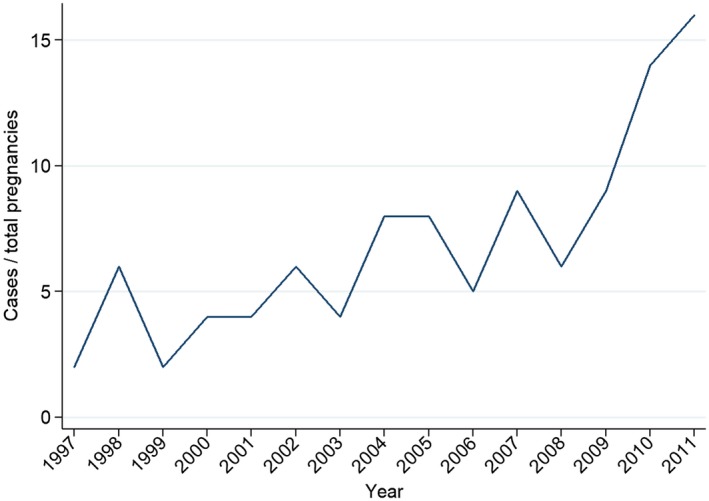
There are limited data on pregnancy outcomes in women with cirrhosis. To address this gap, we examined the records of singleton births from Sweden's National Patient Register (NPR), Cause of Death Register (CDR), and Medical Birth Register (MBR) between 1997 and 2011 to assess exposure and pregnancy-related and liver-related outcomes of pregnant women with cirrhosis. Exposure status was defined as having an International Classification of Diseases (ICD) code for cirrhosis obtained prior to or during pregnancy. Poisson regression with cluster-robust standard errors was used to estimate relative risks (RRs) adjusted for maternal age, smoking, and body mass index (BMI). We identified 103 pregnancies in women with cirrhosis and compared these to 1,361,566 pregnancies in women without cirrhosis. Pregnancies in women with cirrhosis were at increased risk of caesarean delivery (36% versus 16%, respectively; adjusted RR [aRR], 2.00; 95% confidence interval [CI], 1.47-2.73), low birth weight (15% versus 3%; aRR, 3.87; 95% CI, 2.11-7.06), and preterm delivery (19% versus 5%; aRR, 3.51; 95% CI, 2.16-5.72). Rates of maternal mortality during pregnancy (no cases), gestational diabetes, preeclampsia, small for gestational age, congenital malformations, and stillbirth were not increased when compared to the pregnant women without cirrhosis. There were 12 hospitalizations during pregnancy due to liver-related events, including one case with bleeding esophageal varices Women with cirrhosis are at increased risk for adverse pregnancy outcomes. However, severe maternal and fetal adverse events were rare in our study, and most pregnancies in women with cirrhosis ended without complications.
关于肝硬化女性的妊娠结局数据有限。为填补这一空白,我们查阅了瑞典国家患者登记处(NPR)、死因登记处(CDR)和医疗出生登记处(MBR)1997年至2011年期间的单胎分娩记录,以评估肝硬化孕妇的暴露情况以及与妊娠和肝脏相关的结局。暴露状态定义为在妊娠前或妊娠期间获得国际疾病分类(ICD)肝硬化编码。采用具有聚类稳健标准误的泊松回归来估计经产妇年龄、吸烟和体重指数(BMI)调整后的相对风险(RRs)。我们确定了103例肝硬化女性的妊娠情况,并将其与1361566例非肝硬化女性的妊娠情况进行比较。肝硬化女性的妊娠剖宫产风险增加(分别为36%和16%;调整后RR[aRR],2.00;95%置信区间[CI],1.47 - 2.73)、低出生体重风险增加(15%和3%;aRR,3.87;95%CI,2.11 - 7.06)以及早产风险增加(19%和5%;aRR,3.51;95%CI,2.16 - 5.72)。与非肝硬化孕妇相比,妊娠期间的孕产妇死亡率(无病例)、妊娠期糖尿病、先兆子痫、小于胎龄儿、先天性畸形和死产率并未增加。妊娠期间有12次因肝脏相关事件住院,包括1例食管静脉曲张出血病例。肝硬化女性不良妊娠结局的风险增加。然而,在我们的研究中,严重的母婴不良事件很少见,大多数肝硬化女性的妊娠结局无并发症。