Abad-Sazatornil María Reyes, Arenaza Ainhoa, Bayo Juan, García Mata Jesus, Guinea De Castro José María, León Josefa, Letellez Javier, Reguero Virginia, Martínez Chamorro Carmen, Salar Antonio
Hospital Pharmacy, Hospital Universitario Miguel Servet, P/ Isabel la Católica 1-3, 50009, Zaragoza, Spain.
Hospital Pharmacy, Hospital Clínico San Carlos, Madrid, Spain.
BMC Health Serv Res. 2021 Apr 8;21(1):320. doi: 10.1186/s12913-021-06277-8.
Subcutaneous (SC) versus intravenous (IV) administration is advantageous in terms of patient convenience and hospital efficiency. This study aimed to compare the effect of optimizing the processes involved in SC versus IV administration of rituximab and trastuzumab on hospital capacity and service quality.
This cross-sectional resource utilization study interviewed oncologists, hematologists, nurses, and pharmacists from 10 hospitals in Spain to estimate changes in processes associated with conversion from IV to SC rituximab and trastuzumab, based on clinical experience and healthcare use from administrative databases.
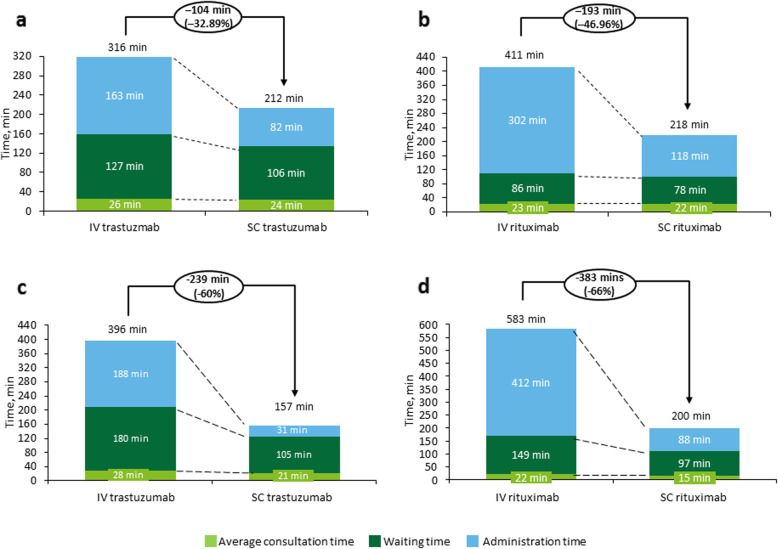
Efficient use of SC formulations increased the monthly capacity for parenteral administration by 3.35% (potentially increasable by 5.75% with maximum possible conversion according to the product label). The weekly capacity for hospital pharmacy treatment preparation increased by 7.13% due to conversion to SC formulation and by 9.33% due to transferring SC preparation to the cancer treatment unit (potentially increasable by 12.16 and 14.10%, respectively). Monthly hospital time decreased by 33% with trastuzumab and 47% with rituximab. In a hypothetical hospital, in which all processes for efficient use of SC rituximab and/or trastuzumab were implemented and all eligible patients received SC formulations, the estimated monthly capacity for preparation and administration increased by 23.1% and estimated hospital times were reduced by 60-66%.
Conversion of trastuzumab and rituximab to SC administration could improve the efficiency of hospitals and optimize internal resource management processes, potentially increasing care capacity and improving the quality of care by reducing time spent by patients at hospitals.
皮下注射(SC)与静脉注射(IV)给药相比,在患者便利性和医院效率方面具有优势。本研究旨在比较优化利妥昔单抗和曲妥珠单抗皮下注射与静脉注射过程对医院容量和服务质量的影响。
这项横断面资源利用研究采访了西班牙10家医院的肿瘤学家、血液学家、护士和药剂师,根据行政数据库中的临床经验和医疗使用情况,估计与利妥昔单抗和曲妥珠单抗从静脉注射转换为皮下注射相关的流程变化。
高效使用皮下注射制剂使每月胃肠外给药能力提高了3.35%(根据产品标签,最大可能转换时潜在可提高5.75%)。由于转换为皮下注射制剂,医院药房治疗准备的每周能力提高了7.13%,由于将皮下注射制剂准备工作转移到癌症治疗单元,提高了9.33%(分别潜在可提高12.16%和14.10%)。使用曲妥珠单抗时,每月医院时间减少了33%,使用利妥昔单抗时减少了47%。在一家假设的医院中,如果实施了所有高效使用皮下注射利妥昔单抗和/或曲妥珠单抗的流程,并且所有符合条件的患者都接受皮下注射制剂,则估计的每月准备和给药能力提高了23.1%,估计的医院时间减少了60 - 66%。
曲妥珠单抗和利妥昔单抗转换为皮下注射给药可提高医院效率,优化内部资源管理流程,潜在地增加护理能力,并通过减少患者在医院的停留时间来提高护理质量。