Max Planck Institute for Evolutionary Anthropology, Deutscher Platz 6, 04103, Leipzig, Germany.
Goethe Universität Frankfurt Am Main, Frankfurt, Germany.
Sci Rep. 2021 Apr 8;11(1):6879. doi: 10.1038/s41598-021-86261-8.
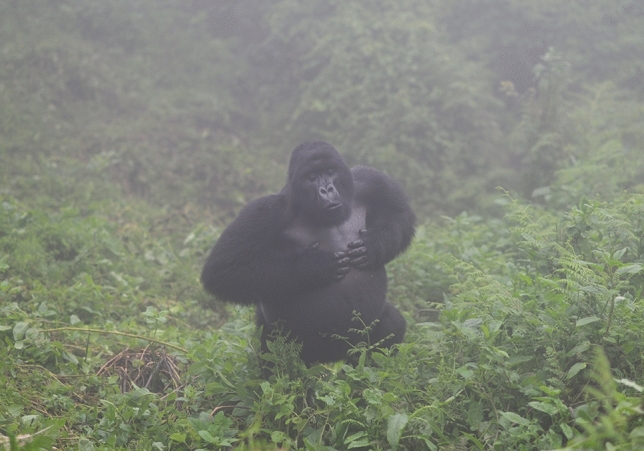
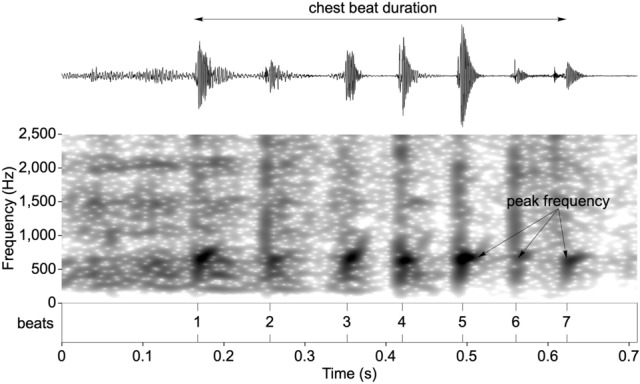
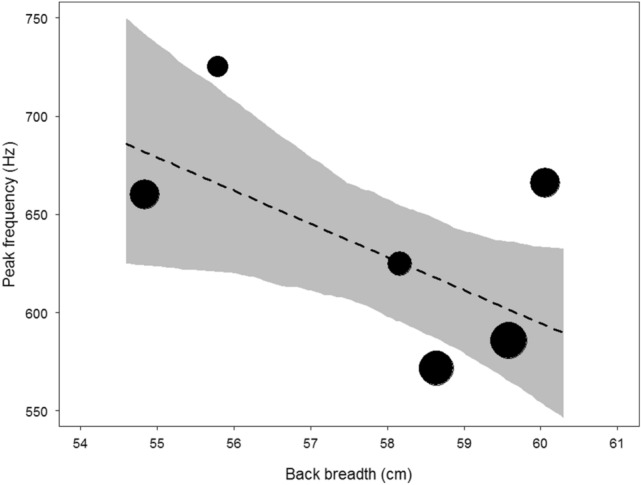
Acoustic signals that reliably indicate body size, which usually determines competitive ability, are of particular interest for understanding how animals assess rivals and choose mates. Whereas body size tends to be negatively associated with formant dispersion in animal vocalizations, non-vocal signals have received little attention. Among the most emblematic sounds in the animal kingdom is the chest beat of gorillas, a non-vocal signal that is thought to be important in intra and inter-sexual competition, yet it is unclear whether it reliably indicates body size. We examined the relationship among body size (back breadth), peak frequency, and three temporal characteristics of the chest beat: duration, number of beats and beat rate from sound recordings of wild adult male mountain gorillas. Using linear mixed models, we found that larger males had significantly lower peak frequencies than smaller ones, but we found no consistent relationship between body size and the temporal characteristics measured. Taken together with earlier findings of positive correlations among male body size, dominance rank and reproductive success, we conclude that the gorilla chest beat is an honest signal of competitive ability. These results emphasize the potential of non-vocal signals to convey important information in mammal communication.
声音信号能够可靠地反映动物的体型,而体型通常决定了竞争能力,因此,研究声音信号对于了解动物如何评估对手和选择配偶具有特别的意义。虽然动物发声中的声道形状通常与共振峰频率分散程度呈负相关,但非发声信号却很少受到关注。在动物王国中,最具代表性的声音之一是大猩猩的胸音,这是一种非发声信号,被认为在种内和种间竞争中很重要,但目前尚不清楚它是否能可靠地反映体型。我们通过对野生雄性山地大猩猩的胸音进行录音,研究了体型(背部宽度)、峰值频率以及胸音的三个时间特征(持续时间、搏动次数和搏动率)之间的关系。通过线性混合模型,我们发现体型较大的雄性大猩猩的峰值频率显著低于体型较小的雄性,但是我们没有发现体型与所测时间特征之间存在一致的关系。综合先前关于雄性体型、支配地位和繁殖成功率之间存在正相关关系的研究结果,我们得出结论,大猩猩的胸音是竞争能力的一个诚实信号。这些结果强调了非发声信号在哺乳动物通讯中传递重要信息的潜力。