Servicio de Hematología y Oncología Médica, Hospital General Universitario Morales Meseguer, Centro Regional de Hemodonación, Universidad de Murcia, IMIB-Arrixaca, CIBERER, Avda. Marqués de Los Vélez, s/n, 30008, Murcia, Spain.
Servicio de Enfermedades Infecciosas, Hospital Reina Sofía, Murcia, Spain.
Sci Rep. 2021 Apr 8;11(1):7792. doi: 10.1038/s41598-021-85906-y.
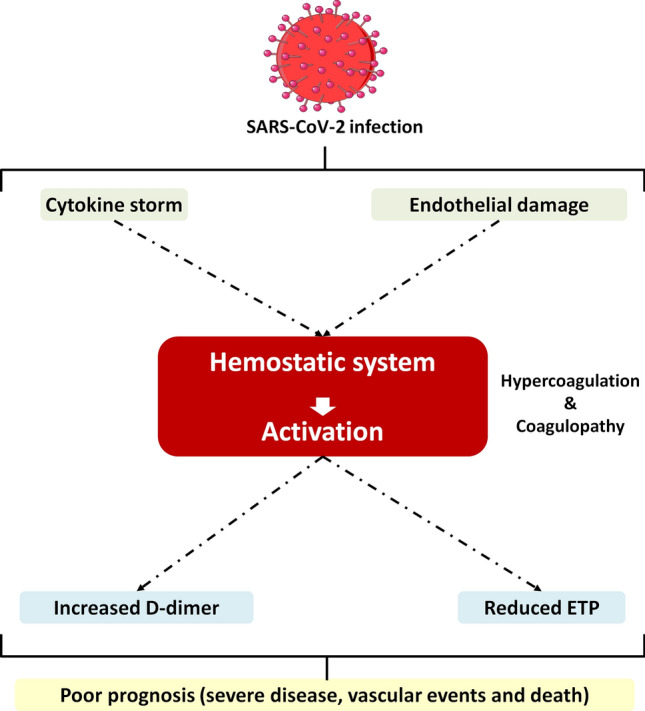
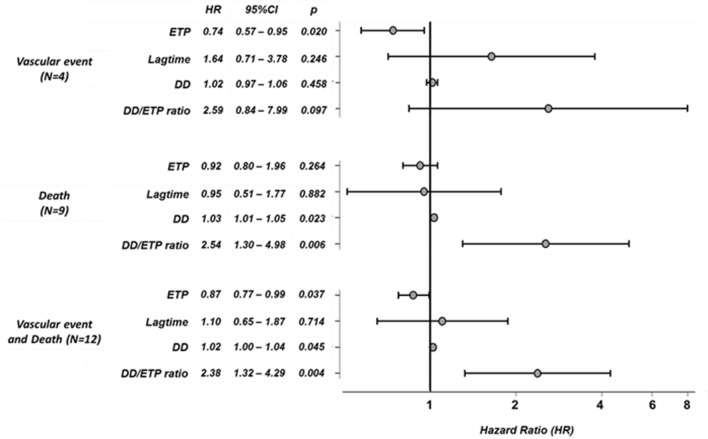
SARS-CoV-2 infection increases the risk of thrombosis by different mechanisms not fully characterized. Although still debated, an increase in D-dimer has been proposed as a first-line hemostasis test associated with thromboembolic risk and unfavorable prognosis. We aim to systematically and comprehensively evaluate the association between thrombin generation parameters and the inflammatory and hypercoagulable state, as well as their prognostic value in COVID-19 patients. A total of 127 hospitalized patients with confirmed COVID-19, 24 hospitalized patients with SARS-CoV-2-negative pneumonia and 12 healthy subjects were included. Clinical characteristics, thrombin generation triggered by tissue factor with and without soluble thrombomodulin, and also by silica, as well as other biochemical parameters were assessed. Despite the frequent use of heparin, COVID-19 patients had similar thrombin generation to healthy controls. In COVID-19 patients, the thrombin generation lag-time positively correlated with markers of cell lysis (LDH), inflammation (CRP, IL-6) and coagulation (D-dimer), while the endogenous thrombin potential (ETP) inversely correlated with D-dimer and LDH, and positively correlated with fibrinogen levels. Patients with more prolonged lag-time and decreased ETP had higher peak ISTH-DIC scores, and had more severe disease (vascular events and death). The ROC curve and Kaplan Meier estimate indicated that the D-dimer/ETP ratio was associated with in-hospital mortality (HR 2.5; p = 0.006), and with the occurrence of major adverse events (composite end-point of vascular events and death) (HR 2.38; p = 0.004). The thrombin generation ETP and lag-time variables correlate with thromboinflammatory markers, and the D-dimer/ETP ratio can predict major adverse events in COVID-19.
SARS-CoV-2 感染通过不同的机制增加血栓形成的风险,这些机制尚未完全阐明。尽管仍存在争议,但 D-二聚体的增加被认为是与血栓栓塞风险和不良预后相关的一线止血测试。我们旨在系统全面地评估血栓生成参数与炎症和高凝状态之间的关系,以及它们在 COVID-19 患者中的预后价值。共纳入 127 例确诊 COVID-19 的住院患者、24 例 SARS-CoV-2 阴性肺炎住院患者和 12 名健康对照者。评估了临床特征、组织因子触发的血栓生成以及有无可溶性血栓调节蛋白和二氧化硅的血栓生成,以及其他生化参数。尽管经常使用肝素,但 COVID-19 患者的血栓生成与健康对照组相似。在 COVID-19 患者中,血栓生成潜伏期与细胞溶解标志物(LDH)、炎症标志物(CRP、IL-6)和凝血标志物(D-二聚体)呈正相关,而内源性血栓生成潜力(ETP)与 D-二聚体和 LDH 呈负相关,与纤维蛋白原水平呈正相关。潜伏期较长和 ETP 降低的患者 ISTH-DIC 评分较高,疾病更严重(血管事件和死亡)。ROC 曲线和 Kaplan-Meier 估计表明,D-二聚体/ETP 比值与住院死亡率相关(HR 2.5;p=0.006),与主要不良事件(血管事件和死亡的复合终点)相关(HR 2.38;p=0.004)。血栓生成 ETP 和潜伏期变量与血栓炎症标志物相关,D-二聚体/ETP 比值可预测 COVID-19 的主要不良事件。