Morgan Jessica E, Phillips Bob, Haeusler Gabrielle M, Chisholm Julia C
Centre for Reviews and Dissemination, University of York, Heslington, YO10 5DD, UK.
Department of Paediatric Oncology, Leeds Teaching Hospitals NHS Trust, Leeds, LS1 3EX, UK.
Infect Drug Resist. 2021 Mar 30;14:1283-1293. doi: 10.2147/IDR.S238567. eCollection 2021.
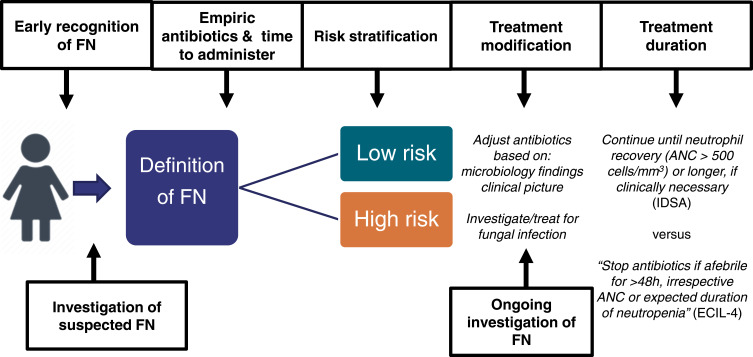
Febrile neutropenia (FN) is a frequent complication of cancer treatment in children. Owing to the potential for overwhelming bacterial sepsis, the recognition and management of FN requires rapid implementation of evidenced-based management protocols. Treatment paradigms have progressed from hospitalisation with broad spectrum antibiotics for all patients, through to risk adapted approaches to management. Such risk adapted approaches aim to provide safe care through incorporating antimicrobial stewardship (AMS) principles such as implementation of comprehensive clinical pathways incorporating de-escalation strategies with the imperative to reduce hospital stay and antibiotic exposure where possible in order to improve patient experience, reduce costs and diminish the risk of nosocomial infection. This review summarises the principles of risk stratification in FN, the current key considerations for optimising empiric antimicrobial selection including knowledge of antimicrobial resistance patterns and emerging technologies for rapid diagnosis of specific infections and summarises existing evidence on time to treatment, investigations required and duration of treatment. To aid treating physicians we suggest the key features based on current evidence that should be part of any FN management guideline and highlight areas for future research. The focus is on treatment of bacterial infections although fungal and viral infections are also important in this patient group.
发热性中性粒细胞减少症(FN)是儿童癌症治疗中常见的并发症。由于存在发生严重细菌性败血症的可能性,FN的识别和管理需要迅速实施循证管理方案。治疗模式已从对所有患者使用广谱抗生素住院治疗,发展到根据风险调整管理方法。这种根据风险调整的方法旨在通过纳入抗菌药物管理(AMS)原则来提供安全的治疗,例如实施综合临床路径,结合降阶梯策略,同时必须尽可能缩短住院时间和减少抗生素暴露,以改善患者体验、降低成本并减少医院感染风险。本综述总结了FN风险分层的原则、优化经验性抗菌药物选择的当前关键考虑因素,包括对抗菌药物耐药模式的了解以及快速诊断特定感染的新兴技术,并总结了关于治疗时间、所需检查和治疗持续时间的现有证据。为帮助治疗医生,我们根据当前证据提出了任何FN管理指南应具备的关键特征,并强调了未来研究的领域。重点是细菌感染的治疗,尽管真菌感染和病毒感染在该患者群体中也很重要。