Haeusler Gabrielle M, Dashti S Ghazaleh, James Fiona, Babl Franz E, Borland Meredith L, Clark Julia E, Padhye Bhavna, Tapp Heather, Alvaro Frank, Raj Trisha Soosay, Walwyn Thomas, Ziegler David S, Super Leanne, Hall Lisa, Yeoh Daniel K, Butters Coen, McMullan Brendan, Hanna Diane M T, De Abreu Lourenco Richard, Slavin Monica A, Phillips Bob, Thursky Karin A
Department of Infectious Diseases, Royal Children's Hospital, Parkville, Victoria, Australia.
Murdoch Children's Research Institute, Parkville, Victoria, Australia.
Lancet Reg Health West Pac. 2024 Nov 2;53:101226. doi: 10.1016/j.lanwpc.2024.101226. eCollection 2024 Dec.
Prompt antibiotic administration for febrile neutropenia (FN) is standard of care, and targets of time to antibiotics (TTA) <60 min are common. We sought to determine the effect of TTA ≥60 versus <60 min on adverse outcomes (intensive care unit (ICU) admission or death) in children with cancer and FN. Effect modification by a decision rule that predicts infection (AUS-rule) and bacteraemia were also investigated.
The prospective, multi-centre (n = 8), Australian PICNICC study dataset was analysed. To control for confounding, we used outcome regression adjusted for propensity score modelled as restricted cubic spline with two degrees of freedom. The propensity score was estimated from a logistic regression model for the exposure on the confounders, identified (age, sex, severely unwell, disease, chemotherapy intensity and site). TTA was defined as time from from emergency triage to first antibiotic dose.
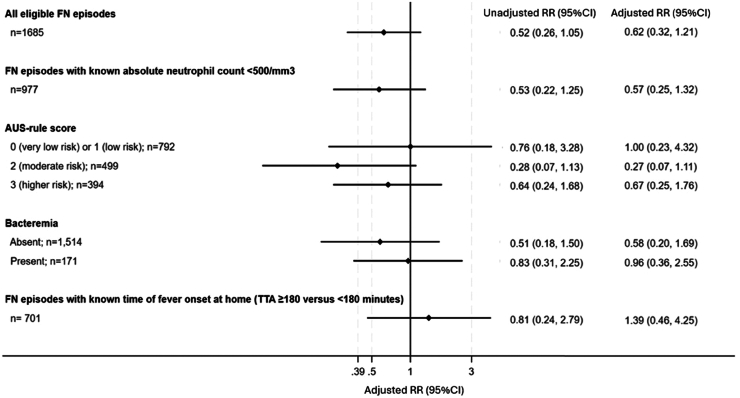
1685 FN episodes in 976 patients were included. Median TTA was 53 min (IQR 37-77 min, 1542 (92%) <120 min). An adverse outcome occurred in 43 (2.6%) episodes (39 ICU; 5 deaths). The confounder-adjusted point estimate suggested a lower risk for adverse outcome associated with TTA ≥60 min (RR 0.62, 95% CI 0.32-1.21), but the wide 95% CI precluded definitive judgement about strength and direction of the effect (unadjusted RR 0.52; 95% CI 0.26, 1.05). Similarly, although the point estimates were suggestive of a null association or reduced risk for adverse outcome associated with TTA ≥60 min for all comparisons across bacteraemia or AUS-rule strata, the 95% CIs were imprecise.
For children with FN, there was no definite evidence that TTA ≥60 min from hospital triage (but within 2 h), increased risk of adverse outcome or prolonged hospital admission. This study has important implications for FN TTA mandates, suggesting a more nuanced approach is required.
National Health and Medical Research Council and Medical Research Future Fund.
对于发热性中性粒细胞减少症(FN),及时给予抗生素治疗是标准治疗方案,抗生素给药时间(TTA)目标<60分钟很常见。我们试图确定癌症合并FN患儿中TTA≥60分钟与<60分钟对不良结局(重症监护病房(ICU)入院或死亡)的影响。还研究了通过预测感染的决策规则(AUS规则)和菌血症进行的效应修正。
分析了前瞻性、多中心(n = 8)的澳大利亚PICNICC研究数据集。为控制混杂因素,我们使用了对倾向得分进行调整的结局回归,倾向得分建模为具有两个自由度的受限立方样条。倾向得分由暴露于混杂因素(年龄、性别、病情严重、疾病、化疗强度和部位)的逻辑回归模型估计。TTA定义为从急诊分诊到首次使用抗生素剂量的时间。
纳入了976例患者的1685次FN发作。TTA中位数为53分钟(四分位间距37 - 77分钟,1542例(92%)<120分钟)。43例(2.6%)发作出现不良结局(39例入住ICU;5例死亡)。经混杂因素调整的点估计表明,TTA≥60分钟与不良结局风险较低相关(风险比0.62,95%置信区间0.32 - 1.21),但95%置信区间较宽,无法对效应的强度和方向做出明确判断(未调整风险比0.52;95%置信区间0.26,1.05)。同样,尽管对于菌血症或AUS规则各层的所有比较,点估计表明TTA≥60分钟与不良结局无关联或风险降低,但95%置信区间并不精确。
对于FN患儿,没有明确证据表明从医院分诊起TTA≥60分钟(但在2小时内)会增加不良结局风险或延长住院时间。这项研究对FN的TTA要求具有重要意义,表明需要一种更细致入微的方法。
国家卫生与医学研究委员会和医学研究未来基金。