Marco Jose H, Cañabate Montserrat, Martinez Cristina, Baños Rosa M, Guillen Verónica, Perez Sandra
Personality, Assessment and Psychological Treatment, University of Valencia, Valencia, Spain.
CIBER Fisiopatología Obesidad y Nutrición (CIBEROBN), Madrid, Spain.
Front Psychol. 2021 Mar 23;12:635742. doi: 10.3389/fpsyg.2021.635742. eCollection 2021.
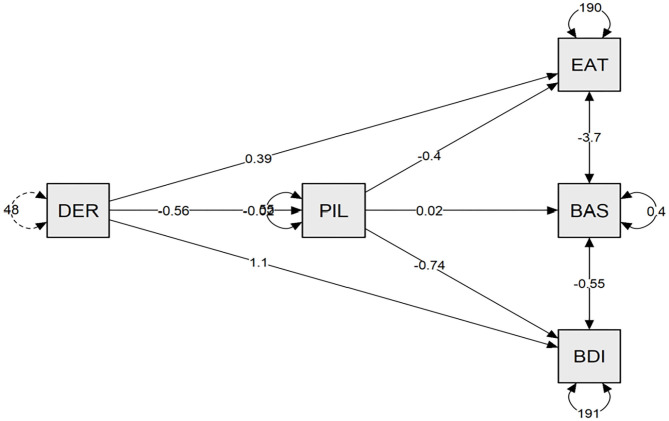
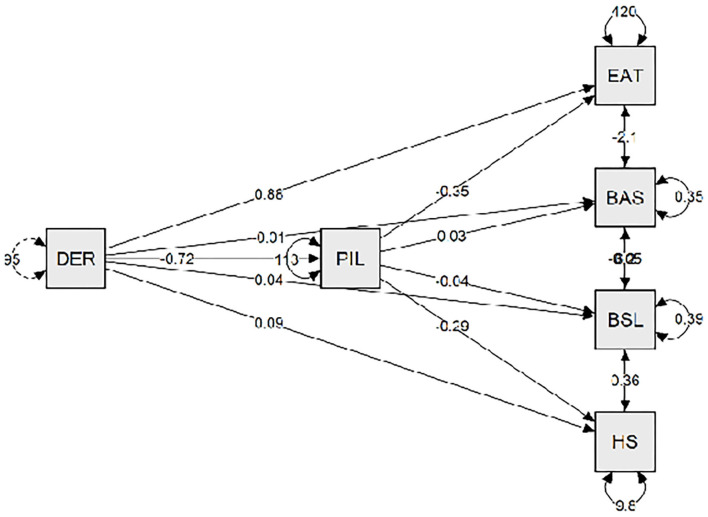
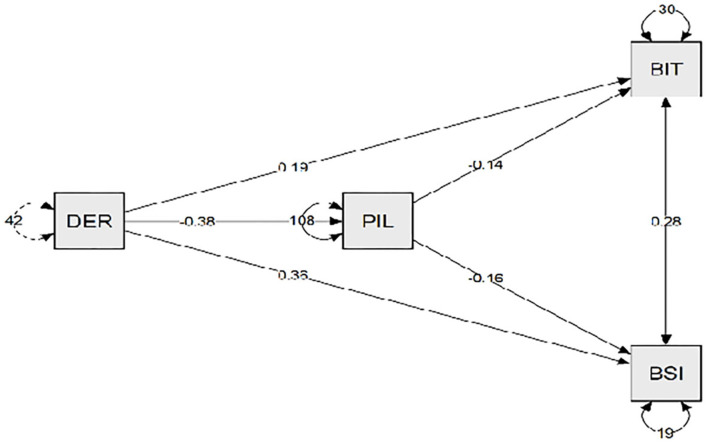
Emotional dysregulation, age, gender, and obesity are transdiagnostic risk factors for the development and maintenance of eating disorders (EDs). Previous studies found that patients with ED had less meaning in life than the non-clinical population, and that meaning in life acted as a buffer in the course of ED; however, to the data, there are no studies about the mediator role of meaning in life in association between the emotional dysregulation and the ED psychopathology. To analyze the mediating role of meaning in life in the relationship between emotional dysregulation and the ED psychopathology in three samples with diverse risk factors for ED. Sample 1, = 153 undergraduate young women; sample 2, = 122 participants with obesity; and sample 3, = 292 participants with ED. Multiple mediation analysis was performed. Sample 1: meaning in life showed a mediation effect between emotional dysregulation and the ED psychopathology (direct effect β = 0.390, < 0.05) (indirect effect β = 0.227, < 0.05), body satisfaction (direct effect β = -0.017, < 0.05) (indirect effect β = -0.013, < 0.01), and depression symptoms (direct effect β = 1.112, < 0.001) (indirect effect β = 0.414, < 0.001); sample 2: meaning in life showed a mediation effect between emotional dysregulation and binge eating and purging behaviors (direct effect β = 0.194, < 0.01) (indirect effect β = 0.054, < 0.05) and depression symptoms (direct effect β = 0.357, < 0.001) (indirect effect β = 0.063, < 0.05); sample 3: meaning in life showed a mediation effect between emotional dysregulation and the ED psychopathology (direct effect β = 0.884, < 0.001) (indirect effect β = 0.252, < 0.007), body satisfaction (direct effect β = -0.033, < 0.05) (indirect effect β = -0.021, < 0.001), borderline symptoms (direct effect β = 0.040, < 0.001) (indirect effect β = 0.025, < 0.001), and hopelessness (direct effect β = 0.211, < 0.001) (indirect effect β = 0.087, < 0.001). These studies suggest the importance of considering meaning in life as a variable in the onset and maintenance of ED.
情绪调节障碍、年龄、性别和肥胖是饮食失调(EDs)发生和维持的跨诊断风险因素。先前的研究发现,饮食失调患者的生活意义感低于非临床人群,且生活意义感在饮食失调过程中起到缓冲作用;然而,就现有数据而言,尚无关于生活意义感在情绪调节障碍与饮食失调精神病理学之间关联中的中介作用的研究。为分析生活意义感在具有不同饮食失调风险因素的三个样本中,情绪调节障碍与饮食失调精神病理学之间关系的中介作用。样本1,n = 153名本科年轻女性;样本2,n = 122名肥胖参与者;样本3,n = 292名饮食失调参与者。进行了多重中介分析。样本1:生活意义感在情绪调节障碍与饮食失调精神病理学之间显示出中介作用(直接效应β = 0.390,p < 0.05)(间接效应β = 0.227,p < 0.05),身体满意度(直接效应β = -0.017,p < 0.05)(间接效应β = -0.013,p < 0.01),以及抑郁症状(直接效应β = 1.112,p < 0.001)(间接效应β = 0.414,p < 0.001);样本2:生活意义感在情绪调节障碍与暴饮暴食及清除行为之间显示出中介作用(直接效应β = 0.194,p < 0.01)(间接效应β = 0.054,p < 0.05)以及抑郁症状(直接效应β = 0.357,p < 0.001)(间接效应β = 0.063,p < 0.05);样本3:生活意义感在情绪调节障碍与饮食失调精神病理学之间显示出中介作用(直接效应β = 0.884,p < 0.001)(间接效应β = 0.252,p < 0.007),身体满意度(直接效应β = -0.033,p < 0.05)(间接效应β = -0.021,p < 0.001),边缘性症状(直接效应β = 0.040,p < 0.001)(间接效应β = 0.