• 文献检索
  • 文档翻译
  • 深度研究
  • 学术资讯
  • Suppr Zotero 插件Zotero 插件
  • 邀请有礼
  • 套餐&价格
  • 历史记录
应用&插件
Suppr Zotero 插件Zotero 插件浏览器插件Mac 客户端Windows 客户端微信小程序
定价
高级版会员购买积分包购买API积分包
服务
文献检索文档翻译深度研究API 文档MCP 服务
关于我们
关于 Suppr公司介绍联系我们用户协议隐私条款
关注我们

Suppr 超能文献

核心技术专利:CN118964589B侵权必究
粤ICP备2023148730 号-1Suppr @ 2026

文献检索

告别复杂PubMed语法,用中文像聊天一样搜索,搜遍4000万医学文献。AI智能推荐,让科研检索更轻松。

立即免费搜索

文件翻译

保留排版,准确专业,支持PDF/Word/PPT等文件格式,支持 12+语言互译。

免费翻译文档

深度研究

AI帮你快速写综述,25分钟生成高质量综述,智能提取关键信息,辅助科研写作。

立即免费体验

机器人和腹腔镜肝切除术——德国一家高容量学术中心的比较经验。

Robotic and laparoscopic liver resection-comparative experiences at a high-volume German academic center.

机构信息

Department of General, Visceral, Vascular, and Transplant Surgery, University Hospital Magdeburg, Leipziger Strasse 44, 39120, Magdeburg, Germany.

Centre Hospitalier Intercommunal de Poissy/Saint-Germain-En-Laye, 10 Rue du Champ Gaillard, 78300, Poissy, France.

出版信息

Langenbecks Arch Surg. 2021 May;406(3):753-761. doi: 10.1007/s00423-021-02152-6. Epub 2021 Apr 8.

DOI:10.1007/s00423-021-02152-6
PMID:33834295
原文链接:https://pmc.ncbi.nlm.nih.gov/articles/PMC8106606/
Abstract

PURPOSE

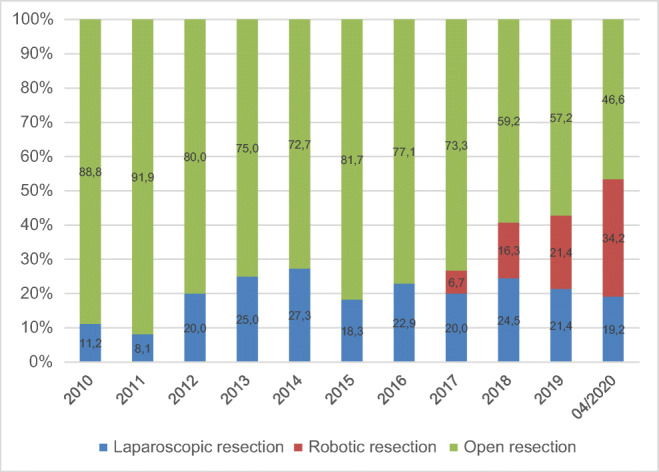
Minimally invasive liver surgery (MILS) is a feasible and safe procedure for benign and malignant tumors. There has been an ongoing debate on whether conventional laparoscopic liver resection (LLR) or robotic liver resection (RLR) is superior and if one approach should be favored over the other. We started using LLR in 2010, and introduced RLR in 2013. In the present paper, we report on our experiences with these two techniques as early adopters in Germany.

METHODS

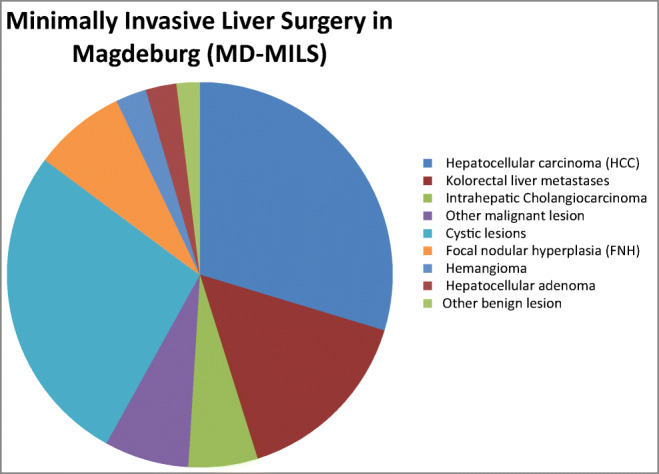
The data of patients who underwent MILS between 2010 and 2020 were collected prospectively in the Magdeburg Registry for Minimally Invasive Liver Surgery (MD-MILS). A retrospective analysis was performed regarding patient demographics, tumor characteristics, and perioperative parameters.

RESULTS

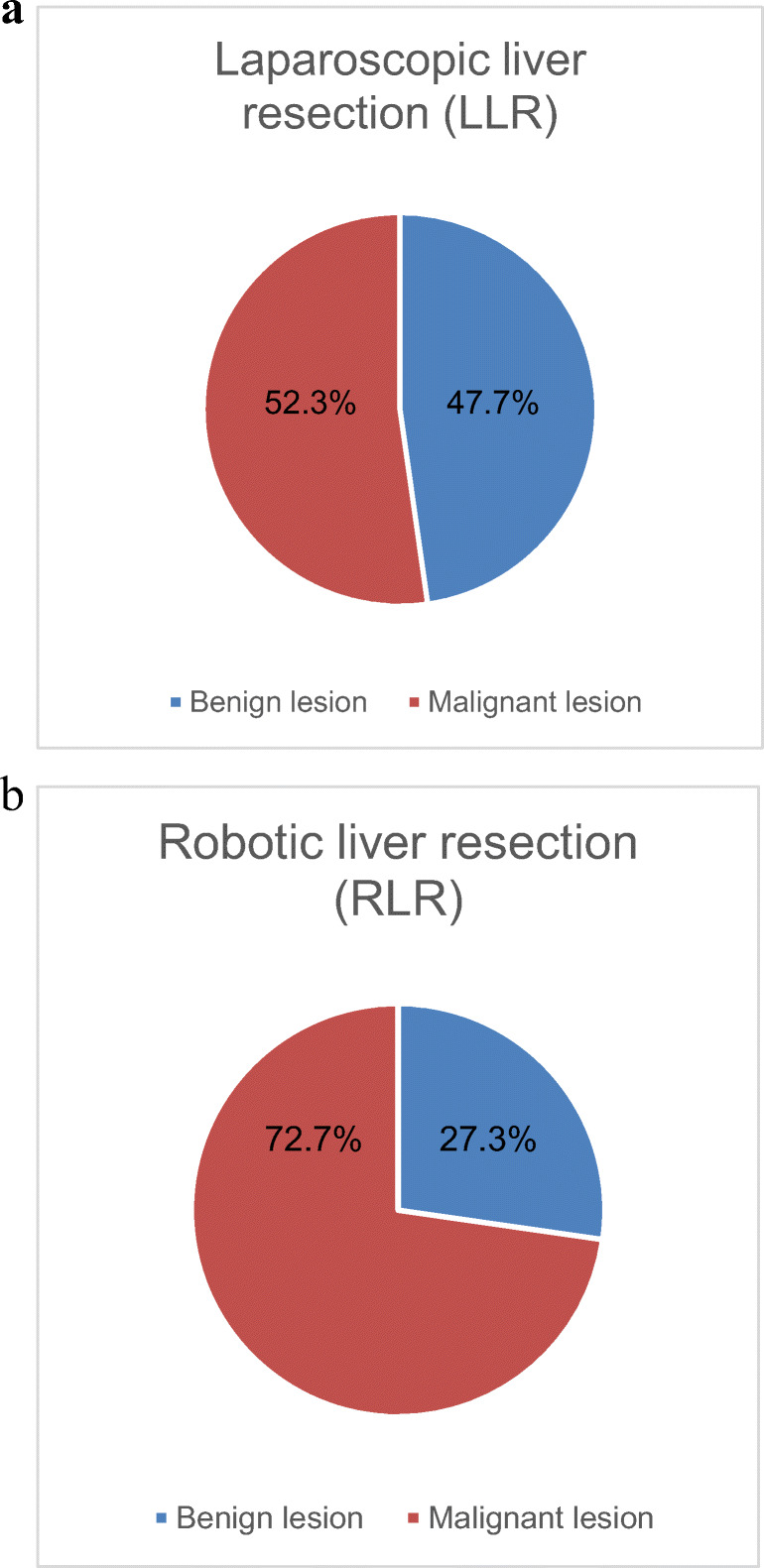
We identified 155 patients fulfilling the inclusion criteria. Of these, 111 (71.6%) underwent LLR and 44 (29.4%) received RLR. After excluding cystic lesions, 113 cases were used for the analysis of perioperative parameters. Resected specimens were significantly bigger in the RLR vs. the LLR group (405 g vs. 169 g, p = 0.002); in addition, the tumor diameter was significantly larger in the RLR vs. the LLR group (5.6 cm vs. 3.7 cm, p = 0.001). Hence, the amount of major liver resections (three or more segments) was significantly higher in the RLR vs. the LLR group (39.0% vs. 16.7%, p = 0.005). The mean operative time was significantly longer in the RLR vs. the LLR group (331 min vs. 181 min, p = 0.0001). The postoperative hospital stay was significantly longer in the RLR vs. the LLR group (13.4 vs. LLR 8.7 days, p = 0.03). The R0 resection rate for solid tumors was higher in the RLR vs. the LLR group but without statistical significance (93.8% vs. 87.9%, p = 0.48). The postoperative morbidity ≥ Clavien-Dindo grade 3 was 5.6% in the LLR vs. 17.1% in the RLR group (p = 0.1). No patient died in the RLR but two patients (2.8%) died in the LLR group, 30 and 90 days after surgery (p = 0.53).

CONCLUSION

Minimally invasive liver surgery is safe and feasible. Robotic and laparoscopic liver surgery shows similar and adequate perioperative oncological results for selected patients. RLR might be advantageous for more advanced and technically challenging procedures.

摘要

目的

微创肝切除术(MILS)是治疗良性和恶性肿瘤的一种可行且安全的方法。对于传统腹腔镜肝切除术(LLR)和机器人肝切除术(RLR)哪种更优越,以及是否应该优先选择其中一种方法,一直存在争议。我们于 2010 年开始使用 LLR,并于 2013 年引入 RLR。在本文中,我们作为德国的早期采用者,报告了这两种技术的经验。

方法

前瞻性地收集了 2010 年至 2020 年间接受 MILS 的患者数据,并将其纳入 Magdeburg 微创肝外科登记处(MD-MILS)。回顾性分析了患者的人口统计学、肿瘤特征和围手术期参数。

结果

我们确定了 155 名符合纳入标准的患者。其中,111 名(71.6%)接受了 LLR,44 名(29.4%)接受了 RLR。在排除囊性病变后,对 113 例患者的围手术期参数进行了分析。RLR 组的切除标本明显大于 LLR 组(405 克比 169 克,p = 0.002);此外,RLR 组的肿瘤直径明显大于 LLR 组(5.6 厘米比 3.7 厘米,p = 0.001)。因此,RLR 组的主要肝切除术(三个或更多节段)明显高于 LLR 组(39.0%比 16.7%,p = 0.005)。RLR 组的手术时间明显长于 LLR 组(331 分钟比 181 分钟,p = 0.0001)。RLR 组的术后住院时间明显长于 LLR 组(13.4 天比 LLR 组的 8.7 天,p = 0.03)。RLR 组的实体瘤 R0 切除率高于 LLR 组,但无统计学意义(93.8%比 87.9%,p = 0.48)。LR 组的术后发病率≥Clavien-Dindo 3 级为 5.6%,而 RLR 组为 17.1%(p = 0.1)。RLR 组无患者死亡,但 LLR 组有 2 例患者(2.8%)死亡,分别在术后 30 天和 90 天(p = 0.53)。

结论

微创肝切除术是安全可行的。机器人和腹腔镜肝切除术对选定患者的围手术期肿瘤学结果相似且足够。RLR 可能对更先进和技术更具挑战性的手术有益。
https://cdn.ncbi.nlm.nih.gov/pmc/blobs/f8b0/8106606/bc23b264d36c/423_2021_2152_Fig3_HTML.jpg
https://cdn.ncbi.nlm.nih.gov/pmc/blobs/f8b0/8106606/8dde29690bfe/423_2021_2152_Fig1_HTML.jpg
https://cdn.ncbi.nlm.nih.gov/pmc/blobs/f8b0/8106606/728fbf223bff/423_2021_2152_Fig2_HTML.jpg
https://cdn.ncbi.nlm.nih.gov/pmc/blobs/f8b0/8106606/bc23b264d36c/423_2021_2152_Fig3_HTML.jpg
https://cdn.ncbi.nlm.nih.gov/pmc/blobs/f8b0/8106606/8dde29690bfe/423_2021_2152_Fig1_HTML.jpg
https://cdn.ncbi.nlm.nih.gov/pmc/blobs/f8b0/8106606/728fbf223bff/423_2021_2152_Fig2_HTML.jpg
https://cdn.ncbi.nlm.nih.gov/pmc/blobs/f8b0/8106606/bc23b264d36c/423_2021_2152_Fig3_HTML.jpg

相似文献

1
Robotic and laparoscopic liver resection-comparative experiences at a high-volume German academic center.机器人和腹腔镜肝切除术——德国一家高容量学术中心的比较经验。
Langenbecks Arch Surg. 2021 May;406(3):753-761. doi: 10.1007/s00423-021-02152-6. Epub 2021 Apr 8.
2
Robotic versus laparoscopic liver resection in posterosuperior region: a retrospective study of consecutive cases.机器人与腹腔镜肝后上区切除术:连续病例的回顾性研究。
Surg Endosc. 2023 Jun;37(6):4728-4736. doi: 10.1007/s00464-023-09952-5. Epub 2023 Mar 8.
3
An international multicenter propensity-score matched and coarsened-exact matched analysis comparing robotic versus laparoscopic partial liver resections of the anterolateral segments.国际多中心倾向评分匹配和粗糙精确匹配分析比较机器人与腹腔镜前外侧肝段部分切除术。
J Hepatobiliary Pancreat Sci. 2022 Aug;29(8):843-854. doi: 10.1002/jhbp.1149. Epub 2022 Apr 27.
4
Outcomes after 3D laparoscopic and robotic liver resection for hepatocellular carcinoma: a multicenter comparative study.3D 腹腔镜与机器人辅助肝切除术治疗肝细胞癌的疗效比较:一项多中心研究。
Surg Endosc. 2021 Jul;35(7):3258-3266. doi: 10.1007/s00464-020-07762-7. Epub 2020 Jul 2.
5
Robotic versus laparoscopic liver resections for hepatolithiasis: an international multicenter propensity score matched analysis.机器人与腹腔镜肝切除术治疗肝胆管结石病:国际多中心倾向评分匹配分析。
Surg Endosc. 2023 Aug;37(8):5855-5864. doi: 10.1007/s00464-023-10051-8. Epub 2023 Apr 17.
6
Efficacy and safety of robotic versus laparoscopic liver resection for hepatocellular carcinoma: a propensity score-matched retrospective cohort study.机器人与腹腔镜肝切除术治疗肝细胞癌的疗效和安全性:倾向评分匹配回顾性队列研究。
Hepatol Int. 2024 Aug;18(4):1271-1285. doi: 10.1007/s12072-024-10658-6. Epub 2024 May 13.
7
Short- and Long-term Outcomes after Robotic and Laparoscopic Liver Resection for Malignancies: A Propensity Score-Matched Study.机器人和腹腔镜肝切除术治疗恶性肿瘤的短期和长期结果:倾向评分匹配研究。
World J Surg. 2019 Jun;43(6):1594-1603. doi: 10.1007/s00268-019-04927-x.
8
Initial Experience With Robotic Liver Resection in the United States.美国机器人肝切除术的初步经验。
Am Surg. 2024 Nov;90(11):2933-2939. doi: 10.1177/00031348241259043. Epub 2024 Jun 5.
9
Comparative study of operative expenses: robotic vs. laparoscopic vs. open liver resections at a university hospital in the UK.英国某大学医院的机器人辅助、腹腔镜辅助与开腹肝切除术的手术费用比较研究。
J Robot Surg. 2024 Jan 12;18(1):12. doi: 10.1007/s11701-023-01778-6.
10
Robotic versus laparoscopic liver resections: propensity-matched comparison of two-center experience.机器人与腹腔镜肝切除术:两中心经验的倾向匹配比较。
Surg Endosc. 2023 Oct;37(10):8123-8132. doi: 10.1007/s00464-023-10358-6. Epub 2023 Sep 18.

引用本文的文献

1
Application of Robotic Surgery in Hepatocellular Carcinoma.机器人手术在肝细胞癌中的应用
J Hepatocell Carcinoma. 2025 Jun 19;12:1217-1220. doi: 10.2147/JHC.S515987. eCollection 2025.
2
The impact of indocyanine green on tumor visualization and procedural adjustment in minimally invasive liver surgery.吲哚菁绿对微创肝脏手术中肿瘤可视化及手术操作调整的影响
Langenbecks Arch Surg. 2025 Apr 23;410(1):143. doi: 10.1007/s00423-025-03712-w.
3
An updated meta-analysis of the efficacy and safety of robot-assisted laparoscopy hepatectomy and laparoscopic hepatectomy in the treatment of liver tumors.

本文引用的文献

1
Impact of previous abdominal surgery on robot-assisted radical cystectomy.既往腹部手术对机器人辅助根治性膀胱切除术的影响。
JSLS. 2009 Jul-Sep;13(3):398-405.
机器人辅助腹腔镜肝切除术与腹腔镜肝切除术治疗肝肿瘤的疗效及安全性的最新荟萃分析
Medicine (Baltimore). 2025 Jan 3;104(1):e40866. doi: 10.1097/MD.0000000000040866.
4
Robotic sectionectomy versus robotic hemihepatectomy for anatomic liver resection: a comparative analysis of perioperative outcomes.机器人解剖性肝段切除术与机器人半肝切除术用于解剖性肝切除的比较:围手术期结果的分析。
J Robot Surg. 2024 May 4;18(1):197. doi: 10.1007/s11701-023-01751-3.
5
Concomitant training in robotic and laparoscopic liver resections of low-to-intermediate difficulty score: a retrospective analysis of the learning curve.同期进行低-中难度评分的机器人和腹腔镜肝切除术训练:学习曲线的回顾性分析。
Sci Rep. 2024 Feb 13;14(1):3595. doi: 10.1038/s41598-024-54253-z.
6
Robotic versus laparoscopic liver resections: propensity-matched comparison of two-center experience.机器人与腹腔镜肝切除术:两中心经验的倾向匹配比较。
Surg Endosc. 2023 Oct;37(10):8123-8132. doi: 10.1007/s00464-023-10358-6. Epub 2023 Sep 18.
7
International experts consensus guidelines on robotic liver resection in 2023.2023 年国际专家机器人肝切除术共识指南。
World J Gastroenterol. 2023 Aug 28;29(32):4815-4830. doi: 10.3748/wjg.v29.i32.4815.
8
Robotic versus laparoscopic liver resection in posterosuperior region: a retrospective study of consecutive cases.机器人与腹腔镜肝后上区切除术:连续病例的回顾性研究。
Surg Endosc. 2023 Jun;37(6):4728-4736. doi: 10.1007/s00464-023-09952-5. Epub 2023 Mar 8.
9
Positioning of Minimally Invasive Liver Surgery for Hepatocellular Carcinoma: From Laparoscopic to Robot-Assisted Liver Resection.肝细胞癌微创肝脏手术的定位:从腹腔镜肝脏切除到机器人辅助肝脏切除
Cancers (Basel). 2023 Jan 12;15(2):488. doi: 10.3390/cancers15020488.
10
Robotic major and minor hepatectomy: critical appraisal of learning curve and its impact on outcomes.机器人辅助肝大部切除术和肝小部切除术:学习曲线的批判性评估及其对手术结果的影响
Surg Endosc. 2023 Apr;37(4):2915-2922. doi: 10.1007/s00464-022-09809-3. Epub 2022 Dec 12.