Department of Urology, Ulsan University Hospital, University of Ulsan College of Medicine, Ulsan, Korea.
Investig Clin Urol. 2021 May;62(3):317-323. doi: 10.4111/icu.20200380. Epub 2021 Mar 19.
To compare the efficacy and tolerability of mirabegron and solifenacin in pediatric patients with idiopathic overactive bladder (OAB) and to identify factors affecting OAB symptom improvement after treatment.
We retrospectively reviewed 103 patients (5-15 years old) who visited our hospital with OAB symptoms between July 2017 and March 2019. All participants had received solifenacin or mirabegron. Those who had secondary OAB or who did not complete the frequency-volume chart either before or after treatment were excluded. The age-adjusted bladder capacity ratio was used to evaluate bladder capacity. Efficacy was assessed on the basis of patient reports and changes in the frequency-volume chart, and ≥90% reduction was regarded as "responding to medication." Tolerability was assessed by obtaining reports from patients about the adverse effects of the drug.
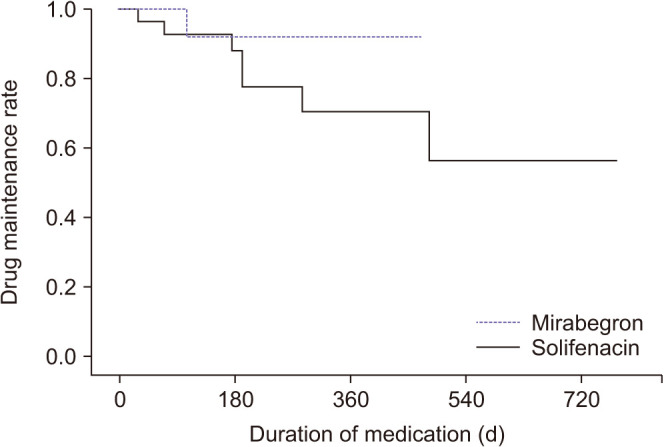
After the exclusion of 58 patients, 45 patients (29 in solifenacin-group and 16 in mirabegron-group) were included in the primary analysis. The age-adjusted bladder capacity ratio increased from 0.71 to 0.96 (p<0.001) and from 0.57 to 0.97 (p=0.002) after solifenacin and mirabegron use, respectively. Decreased bladder capacity before medication was associated with responding to medication (odds ratio, 7.41; p=0.044). There was no significant difference in efficacy between the two drugs. Drug-induced adverse effects were reported in only 3 (10.3%) of the solifenacin-treated patients.
Mirabegron showed comparable efficacy to solifenacin in pediatric patients with idiopathic OAB. Additionally, only few adverse effects were reported, suggesting that mirabegron can be a safe alternative for the treatment of idiopathic pediatric OAB.
比较米拉贝隆和索利那新在小儿特发性膀胱过度活动症(OAB)患者中的疗效和耐受性,并确定治疗后影响 OAB 症状改善的因素。
我们回顾性分析了 2017 年 7 月至 2019 年 3 月期间因 OAB 症状就诊于我院的 103 例(5-15 岁)患儿。所有患者均接受了索利那新或米拉贝隆治疗。排除有继发性 OAB 或在治疗前后均未完成尿频量图的患者。采用年龄调整后的膀胱容量比评估膀胱容量。根据患者报告和尿频量图的变化评估疗效,认为>90%的缓解率为“药物反应”。通过患者对药物不良反应的报告评估耐受性。
排除 58 例患者后,45 例患者(索利那新组 29 例,米拉贝隆组 16 例)纳入主要分析。与治疗前相比,索利那新和米拉贝隆治疗后年龄调整后的膀胱容量比分别从 0.71 增加到 0.96(p<0.001)和从 0.57 增加到 0.97(p=0.002)。用药前膀胱容量减少与药物反应有关(比值比,7.41;p=0.044)。两种药物的疗效无显著差异。仅 3 例(10.3%)索利那新治疗的患者报告有药物引起的不良反应。
米拉贝隆在小儿特发性 OAB 患者中的疗效与索利那新相当。此外,报告的不良反应很少,表明米拉贝隆可能是治疗特发性小儿 OAB 的安全替代药物。