Liu Tianyun, Han Lichy, Tilley Mera, Afzelius Lovisa, Maciejewski Mateusz, Jelinsky Scott, Tian Chao, McIntyre Matthew, Bing Nan, Hung Kenneth, Altman Russ B
Department of Bioengineering, Stanford University, Shriram Room 209, MC: 4245, 443 Via Ortega Drive, Stanford, CA, 94305-4145, USA.
Biomedical Informatics Training Program, Stanford University, Stanford, CA, USA.
BMC Gastroenterol. 2021 Apr 9;21(1):160. doi: 10.1186/s12876-021-01740-6.
Defining clinical phenotypes provides opportunities for new diagnostics and may provide insights into early intervention and disease prevention. There is increasing evidence that patient-derived health data may contain information that complements traditional methods of clinical phenotyping. The utility of these data for defining meaningful phenotypic groups is of great interest because social media and online resources make it possible to query large cohorts of patients with health conditions.
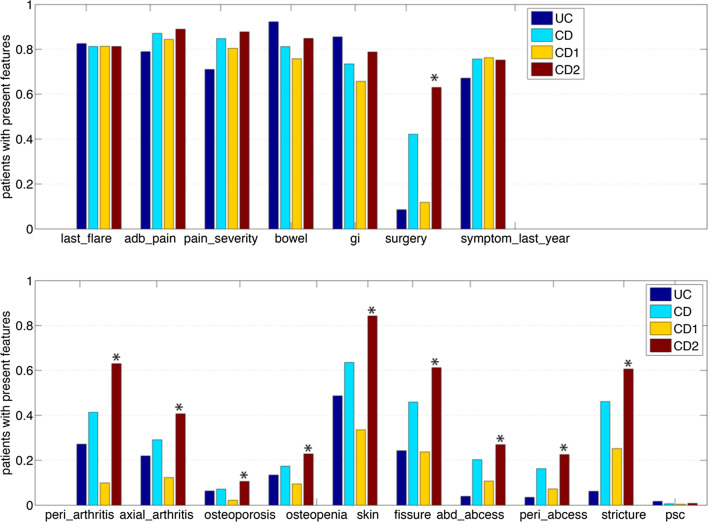
We evaluated the degree to which patient-reported categorical data is useful for discovering subclinical phenotypes and evaluated its utility for discovering new measures of disease severity, treatment response and genetic architecture. Specifically, we examined the responses of 1961 patients with inflammatory bowel disease to questionnaires in search of sub-phenotypes. We applied machine learning methods to identify novel subtypes of Crohn's disease and studied their associations with drug responses.
Using the patients' self-reported information, we identified two subpopulations of Crohn's disease; these subpopulations differ in disease severity, associations with smoking, and genetic transmission patterns. We also identified distinct features of drug response for the two Crohn's disease subtypes. These subtypes show a trend towards differential genotype signatures.
Our findings suggest that patient-defined data can have unplanned utility for defining disease subtypes and may be useful for guiding treatment approaches.
定义临床表型为新的诊断方法提供了机会,也可能为早期干预和疾病预防提供见解。越来越多的证据表明,患者来源的健康数据可能包含补充传统临床表型分析方法的信息。这些数据在定义有意义的表型组方面的效用备受关注,因为社交媒体和在线资源使查询大量患有健康状况的患者队列成为可能。
我们评估了患者报告的分类数据在发现亚临床表型方面的有用程度,并评估了其在发现疾病严重程度、治疗反应和遗传结构新指标方面的效用。具体而言,我们检查了1961例炎症性肠病患者对问卷的回答,以寻找亚表型。我们应用机器学习方法识别克罗恩病的新亚型,并研究它们与药物反应的关联。
利用患者的自我报告信息,我们识别出了克罗恩病的两个亚群;这些亚群在疾病严重程度、与吸烟的关联以及遗传传递模式方面存在差异。我们还确定了两种克罗恩病亚型药物反应的不同特征。这些亚型显示出不同基因型特征的趋势。
我们的研究结果表明,患者定义的数据在定义疾病亚型方面可能具有意外的效用,并且可能有助于指导治疗方法。