Department of Protozoology, Faculty of Tropical Medicine, Mahidol University, Bangkok, Thailand.
Department of Medical Technology, Institute of Arts and Sciences, Far Eastern University-Manila, Manila, Philippines.
Malar J. 2021 Apr 9;20(1):179. doi: 10.1186/s12936-021-03714-1.
Plasmodium knowlesi is recognized as the fifth Plasmodium species causing malaria in humans. It is morphologically similar to the human malaria parasite Plasmodium malariae, so molecular detection should be used to clearly discriminate between these Plasmodium species. This study aimed to quantify the rate at which P. knowlesi is misidentified as P. malariae by microscopy in endemic and non-endemic areas.
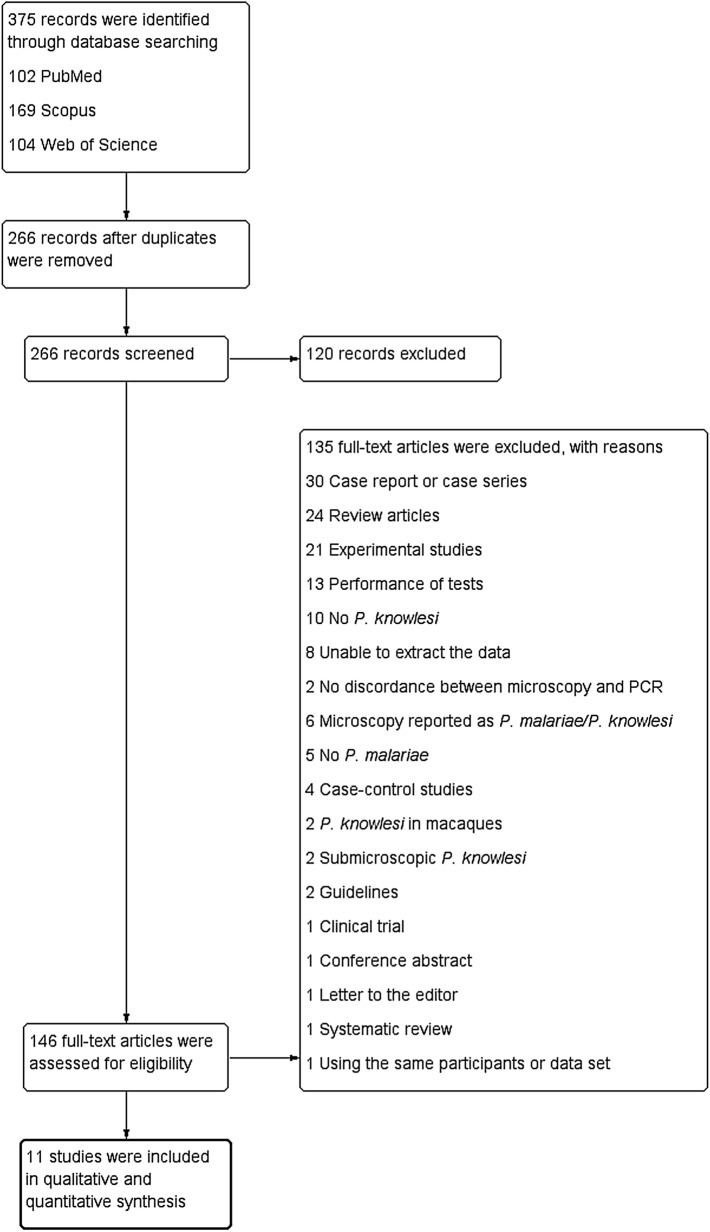
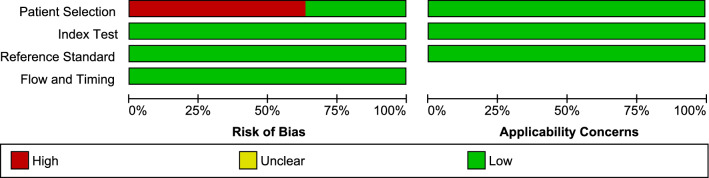
The protocol of this systematic review was registered in the PROSPERO International Prospective Register of Systematic Reviews (ID = CRD42020204770). Studies reporting the misidentification of P. knowlesi as P. malariae by microscopy and confirmation of this by molecular methods in MEDLINE, Web of Science and Scopus were reviewed. The risk of bias in the included studies was assessed using the Quality Assessment of Diagnostic Accuracy Studies (QUADAS). The pooled prevalence and 95% confidence interval (CI) of the misidentification of P. knowlesi as P. malariae by microscopy were estimated using a random effects model. Subgroup analysis of the study sites was performed to demonstrate any differences in the misidentification rates in different areas. Heterogeneity across the included studies was assessed and quantified using Cochran's Q and I statistics, respectively. Publication bias in the included studies was assessed using the funnel plot, Egger's test and contour-enhanced funnel plot.
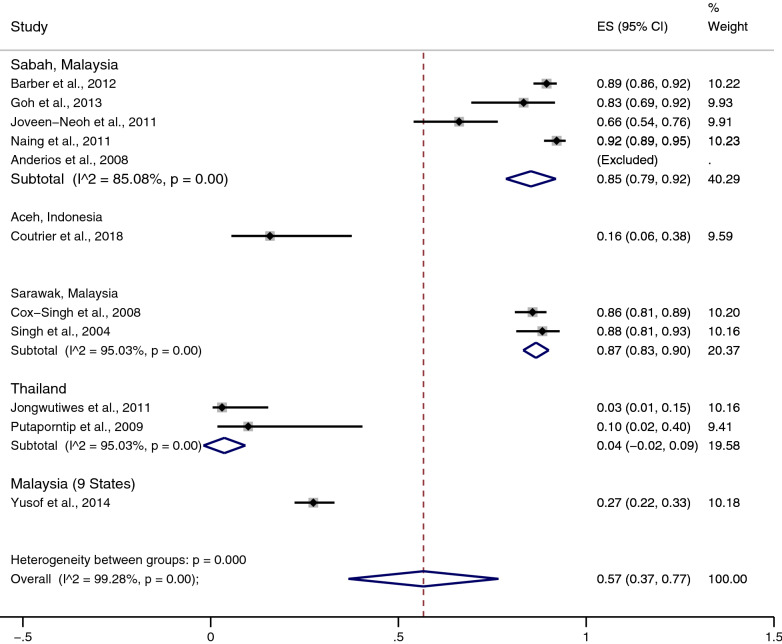
Among 375 reviewed studies, 11 studies with a total of 1569 confirmed P. knowlesi cases in humans were included. Overall, the pooled prevalence of the misidentification of P. knowlesi as P. malariae by microscopy was estimated at 57% (95% CI 37-77%, I: 99.3%). Subgroup analysis demonstrated the highest rate of misidentification in Sawarak, Malaysia (87%, 95% CI 83-90%, I: 95%), followed by Sabah, Malaysia (85%, 95% CI 79-92%, I: 85.1%), Indonesia (16%, 95% CI 6-38%), and then Thailand (4%, 95% CI 2-9%, I: 95%).
Although the World Health Organization (WHO) recommends that all P. malariae-positive diagnoses made by microscopy in P. knowlesi endemic areas be reported as P. malariae/P. knowlesi malaria, the possibility of microscopists misidentifying P. knowlesi as P. malariae is a diagnostic challenge. The use of molecular techniques in cases with malariae-like Plasmodium with high parasite density as determined by microscopy could help identify human P. knowlesi cases in non-endemic countries.
间日疟原虫(Plasmodium knowlesi)已被确认为第五种导致人类疟疾的疟原虫。它在形态上与人类疟原虫(Plasmodium malariae)相似,因此应使用分子检测方法明确区分这两种疟原虫。本研究旨在量化在流行地区和非流行地区,通过显微镜检查将间日疟原虫错误识别为三日疟原虫的比例。
本系统评价的方案已在 PROSPERO 国际前瞻性系统评价登记处(ID=CRD42020204770)注册。我们对通过显微镜检查将间日疟原虫错误识别为三日疟原虫并通过分子方法确认的 MEDLINE、Web of Science 和 Scopus 中的研究进行了综述。使用诊断准确性研究质量评估工具(QUADAS)评估纳入研究的偏倚风险。使用随机效应模型估计显微镜检查将间日疟原虫错误识别为三日疟原虫的合并患病率和 95%置信区间(CI)。对研究地点进行亚组分析,以证明不同地区的错误识别率存在差异。使用 Cochran's Q 和 I 统计量分别评估纳入研究的异质性并进行量化。使用漏斗图、Egger 检验和轮廓增强漏斗图评估纳入研究的发表偏倚。
在 375 项综述研究中,纳入了 11 项共涉及 1569 例确诊人间日疟原虫感染病例的研究。总体而言,显微镜检查将间日疟原虫错误识别为三日疟原虫的合并患病率估计为 57%(95%CI 37-77%,I:99.3%)。亚组分析显示,在马来西亚的沙捞越(Sawarak)地区,错误识别率最高(87%,95%CI 83-90%,I:95%),其次是马来西亚的沙巴(Sabah)地区(85%,95%CI 79-92%,I:85.1%)、印度尼西亚(16%,95%CI 6-38%),然后是泰国(4%,95%CI 2-9%,I:95%)。
尽管世界卫生组织(WHO)建议在间日疟原虫流行地区通过显微镜检查诊断为三日疟原虫的所有病例均报告为三日疟原虫/间日疟原虫,但显微镜检查师将间日疟原虫错误识别为三日疟原虫的可能性仍然是一个诊断挑战。在寄生虫密度高、具有三日疟原虫样形态的疟疾病例中,使用分子技术可以帮助识别非流行地区的人类间日疟原虫感染病例。