Global and Tropical Health Division, Menzies School of Health Research and Charles Darwin University, Darwin, Northern Territory, Australia.
Infectious Diseases Society Sabah-Menzies School of Health Research Clinical Research Unit, Malaysia.
Clin Infect Dis. 2018 Jul 18;67(3):350-359. doi: 10.1093/cid/ciy065.
Plasmodium knowlesi is increasingly reported in Southeast Asia, but prospective studies of its clinical spectrum in children and comparison with autochthonous human-only Plasmodium species are lacking.
Over 3.5 years, we prospectively assessed patients of any age with molecularly-confirmed Plasmodium monoinfection presenting to 3 district hospitals in Sabah, Malaysia.
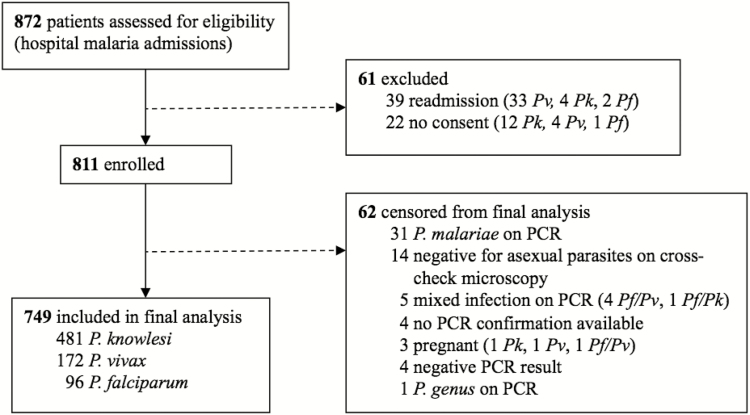
Of 481 knowlesi, 172 vivax, and 96 falciparum malaria cases enrolled, 44 (9%), 71 (41%), and 31 (32%) children aged ≤12 years. Median parasitemia was lower in knowlesi malaria (2480/μL [interquartile range, 538-8481/μL]) than in falciparum (9600/μL; P < .001) and vivax malaria. In P. knowlesi, World Health Organization-defined anemia was present in 82% (95% confidence interval [CI], 67%-92%) of children vs 36% (95% CI, 31%-41%) of adults. Severe knowlesi malaria occurred in 6.4% (95% CI, 3.9%-8.3%) of adults but not in children; the commenst severity criterion was acute kideny injury. No patient had coma. Age, parasitemia, schizont proportion, abdominal pain, and dyspnea were independently associated with severe knowlesi malaria, with parasitemia >15000/μL the best predictor (adjusted odds ratio, 16.1; negative predictive value, 98.5%; P < .001). Two knowlesi-related adult deaths occurred (fatality rate: 4.2/1000 adults).
Age distribution and parasitemia differed markedly in knowlesi malaria compared to human-only species, with both uncomplicated and severe disease occurring at low parasitemia. Severe knowlesi malaria occurred only in adults; however, anemia was more common in children despite lower parasitemia. Parasitemia independently predicted knowlesi disease severity: Intravenous artesunate is warranted initially for those with parasitemia >15000/μL.
疟原虫 knowlesi 在东南亚的报告越来越多,但缺乏对其在儿童中的临床谱的前瞻性研究以及与本土疟原虫属种的比较。
在 3.5 年期间,我们前瞻性评估了在马来西亚沙巴州的 3 家地区医院就诊的任何年龄的分子确诊的疟原虫单一感染患者。
共纳入 481 例疟原虫 knowlesi、172 例疟原虫 vivax 和 96 例疟原虫 falciparum 疟疾患者,其中 44(9%)、71(41%)和 31(32%)例为≤12 岁的儿童。疟原虫 knowlesi 疟疾的中位寄生虫血症(2480/μL [四分位距,538-8481/μL])低于疟原虫 falciparum(9600/μL;P <.001)和疟原虫 vivax 疟疾。在 P. knowlesi 中,世界卫生组织定义的贫血存在于 82%(95%置信区间 [CI],67%-92%)的儿童中,而在 36%(95% CI,31%-41%)的成人中。严重疟原虫 knowlesi 疟疾发生在 6.4%(95% CI,3.9%-8.3%)的成人中,但不在儿童中;共同严重标准是急性肾损伤。没有患者发生昏迷。年龄、寄生虫血症、裂殖体比例、腹痛和呼吸困难与严重疟原虫 knowlesi 独立相关,以寄生虫血症>15000/μL 为最佳预测指标(调整后的优势比,16.1;阴性预测值,98.5%;P <.001)。有 2 例疟原虫 knowlesi 相关成人死亡(病死率:4.2/1000 成人)。
与仅人类疟原虫属种相比,疟原虫 knowlesi 的年龄分布和寄生虫血症差异明显,无论是否合并疾病,在低寄生虫血症时均可能发生严重疾病。严重疟原虫 knowlesi 疟疾仅发生在成人中;然而,尽管寄生虫血症较低,儿童贫血更为常见。寄生虫血症独立预测疟原虫 knowlesi 疾病的严重程度:对于寄生虫血症>15000/μL 的患者,应首先静脉注射青蒿琥酯。