Clinical and Molecular Osteoporosis Research Unit, Department of Clinical Sciences and Orthopedics, Lund University, Skåne University Hospital, SE-205 02, Malmö, Sweden.
J Orthop Surg Res. 2021 Apr 9;16(1):245. doi: 10.1186/s13018-021-02380-y.
The hand is the second most fractured region in children. It is therefore important to update fracture epidemiology to be able to identify time trends for adequate health care planning. This study reports pediatric hand fracture incidence 2014-2016 and, using published data, also long-term time trends in 1950-2016.
The Swedish city of Malmö, with 328,494 inhabitants in 2016, has only one hospital. We used the hospital radiological archive, medical charts, and diagnosis registry to identify hand fractures in city residents < 16 years in 2014-2016. These data were compared to those from three published studies that evaluated periods in 1950-2006. Differences between two periods were calculated as both unadjusted and age- and sex-adjusted incident rate ratios (IRR) with 95% confidence intervals (95% CI). We used joinpoint regression to estimate time trends during the entire period and present annual percent changes (APC) with 95% CI.
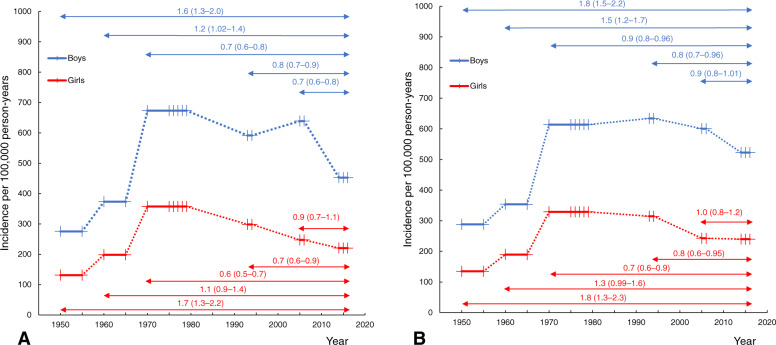
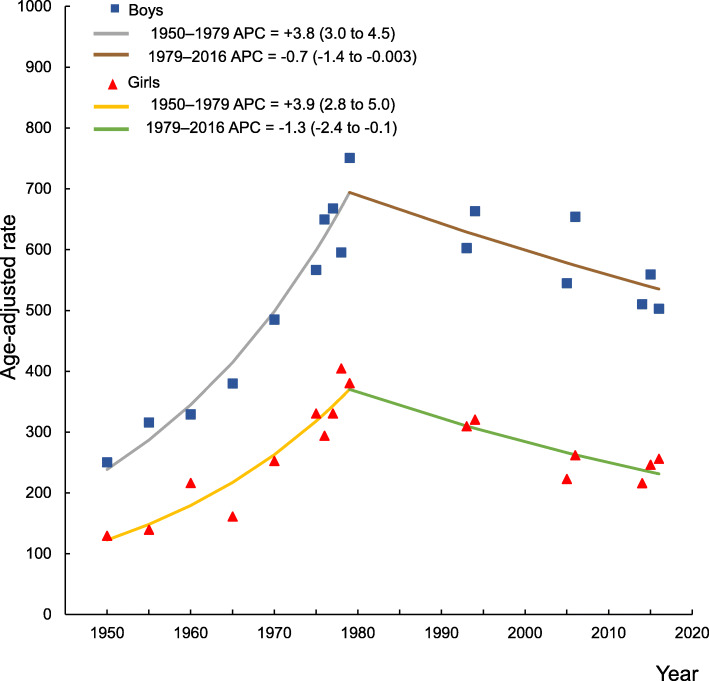
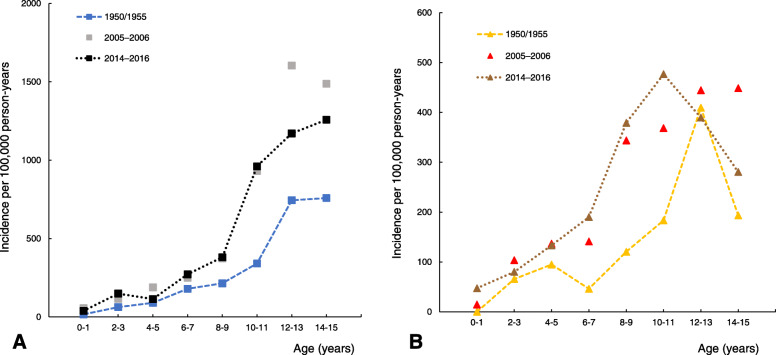
In 2014-2016 phalangeal fractures accounted for 71% of all hand fractures, metacarpal fractures for 24%, and carpal fractures for 5%. We identified 615 hand fractures (419 in boys and 196 in girls) during 181,617 person-years in 2014-2016, resulting in an unadjusted pediatric hand fracture incidence of 339/100,000 person-years (boys 452/100,000 person-years and girls 220/100,000 person-years). The age-adjusted incidence 2014-2016 was similar to 2005-2006, the most recently evaluated period (IRR in boys 0.9; 95% CI 0.8 to 1.01, and in girls 1.0; 95% CI 0.8 to 1.2). Looking at the entire period 1950-2016, we found that age-adjusted incidence increased in 1950-1979, in boys by APC + 3.8%; 95% CI 3.0 to 4.5 and in girls by + 3.9%; 95% CI 2.8 to 5.0, but decreased in 1979-2016, in boys by - 0.7%; 95% CI - 1.4 to - 0.003, and girls by - 1.3%; 95% CI - 2.4 to - 0.1.
Phalangeal fractures accounted for about three quarters of all hand fractures. The age-adjusted hand fracture incidence increased in both sexes in 1950-1979 and decreased in 1979-2016.
III.
手部是儿童中第二大易骨折的部位。因此,更新骨折流行病学数据以便能够确定时间趋势,对于适当的医疗保健规划是很重要的。本研究报告了 2014-2016 年小儿手部骨折的发病率,并使用已发表的数据报告了 1950-2016 年的长期时间趋势。
瑞典马尔默市有 328494 名居民,只有一家医院。我们使用医院放射学档案、病历和诊断登记册,以确定 2014-2016 年该市 16 岁以下居民的手部骨折情况。这些数据与三项已发表的研究进行了比较,这些研究评估了 1950-2006 年期间的情况。两个时期之间的差异通过未调整和年龄及性别调整后的发病率比(IRR)及其 95%置信区间(95%CI)来计算。我们使用连接点回归来估计整个时期的时间趋势,并呈现 95%CI 的年百分比变化(APC)。
2014-2016 年,掌骨骨折占所有手部骨折的 71%,掌骨骨折占 24%,腕骨骨折占 5%。我们在 2014-2016 年 181617 人年中发现了 615 例手部骨折(419 例为男性,196 例为女性),导致未经调整的小儿手部骨折发病率为 339/100000 人年(男性为 452/100000 人年,女性为 220/100000 人年)。2014-2016 年的年龄调整发病率与最近评估的 2005-2006 年期间相似(男性的 IRR 为 0.9;95%CI 0.8 至 1.01,女性为 1.0;95%CI 0.8 至 1.2)。纵观整个 1950-2016 年期间,我们发现年龄调整后的发病率在 1950-1979 年期间有所增加,男性的 APC 为 +3.8%;95%CI 3.0 至 4.5,女性的 APC 为 +3.9%;95%CI 2.8 至 5.0,但在 1979-2016 年期间有所下降,男性的 APC 为-0.7%;95%CI -1.4 至 -0.003,女性的 APC 为-1.3%;95%CI -2.4 至 -0.1。
掌骨骨折占所有手部骨折的近四分之三。1950-1979 年间,男女手部骨折的年龄调整发病率均有所增加,而 1979-2016 年间则有所下降。
III。