Lempesis Vasileios, Rosengren Björn E, Nilsson Jan-Åke, Landin Lennart, Tiderius Carl Johan, Karlsson Magnus K
a Clinical and Molecular Osteoporosis Research Unit, Department of Clinical Sciences and Orthopedics , Lund University, Skåne University Hospital , Malmö , Sweden.
Acta Orthop. 2017 Aug;88(4):440-445. doi: 10.1080/17453674.2017.1334284. Epub 2017 May 31.
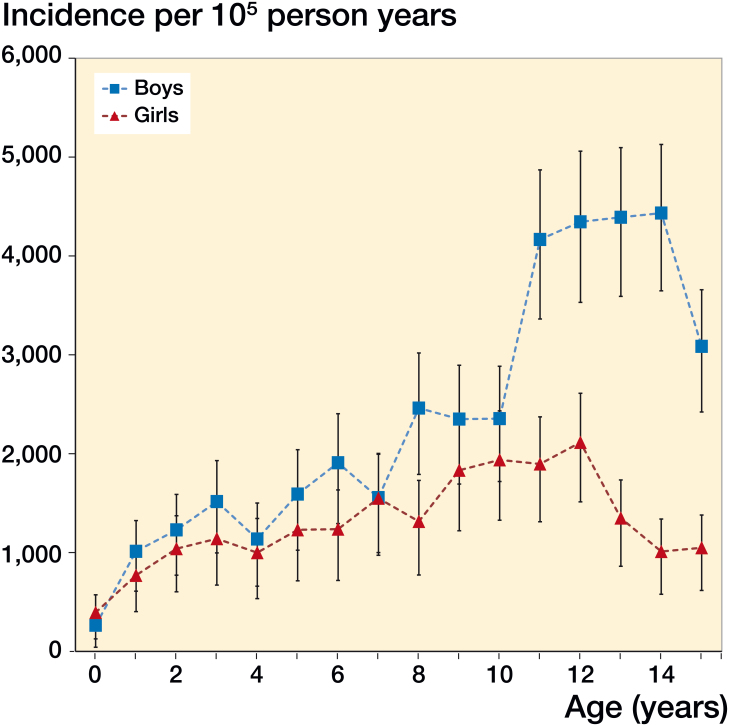
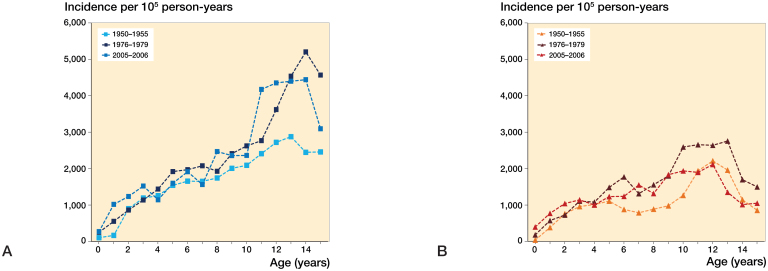
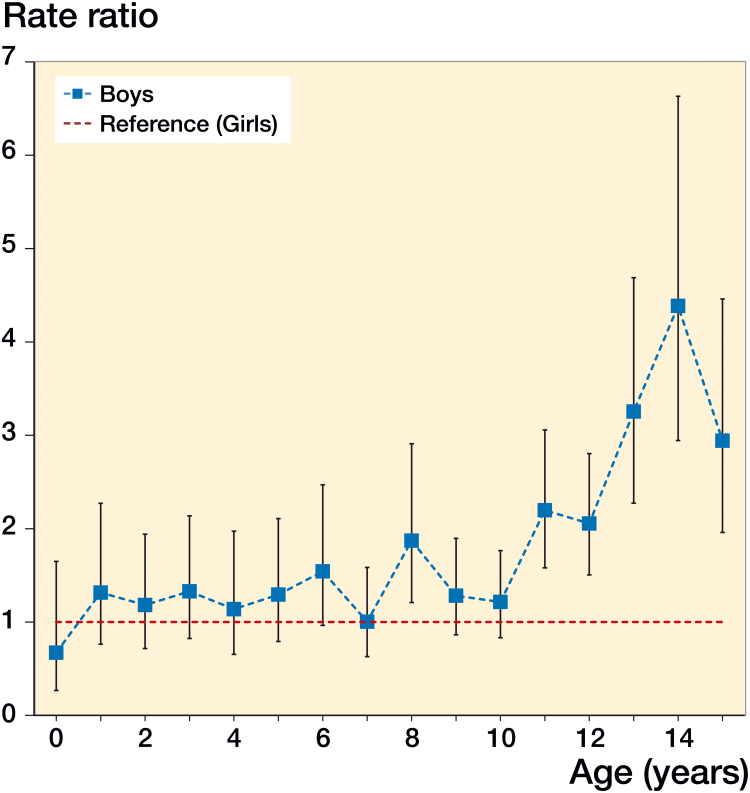
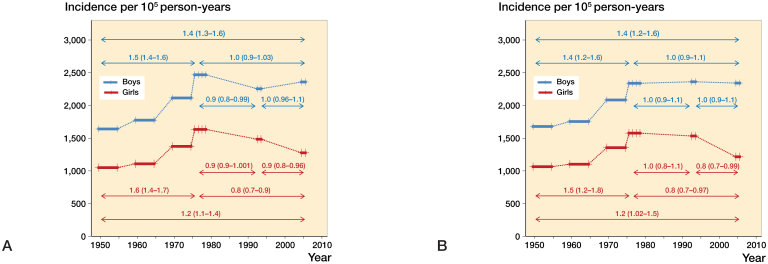
Background and purpose - Pediatric fracture incidence may not be stable. We describe recent pediatric fracture epidemiology and etiology and compare this to earlier data. Patients and methods - The city of Malmö (population 271,271 in 2005) in Sweden is served by 1 hospital. Using the hospital diagnosis registry, medical charts, and the radiographic archive, we identified fractures in individuals <16 years that had occurred during 2005 and 2006. We also retrieved previously collected fracture data from between 1950 and 1994, from the hospital's pediatric fracture database. We used official population data to estimate period-specific fracture incidence (the number of fractures per 10 person-years) and also age- and sex-adjusted incidence. Differences are reported as rate ratios (RRs) with 95% confidence intervals. Results - The pediatric fracture incidence during the period 2005-2006 was 1,832 per 10 person-years (2,359 in boys and 1,276 in girls), with an age-adjusted boy-to-girl ratio of 1.8 (1.6-2.1). Compared to the period 1993-1994, age-adjusted rates were unchanged (RR =0.9, 95% CI: 0.8-1.03) in 2005-2006, with lower rates in girls (RR =0.8, 95% CI: 0.7-0.99) but not in boys (RR =1.0, 95% CI: 0.9-1.1). We also found that the previously reported decrease in unadjusted incidence in Malmö from 1976-1979 to 1993-1994 was based on changes in demography, as the age-adjusted incidences were similar in the 2 periods (RR =1.0, 95% CI: 0.9-1.1). Interpretation - In Malmö, pediatric fracture incidence decreased from 1993-1994 to 2005-2006 in girls but not in boys. Changes in demography, and also other factors, influence the recent time trends.
背景与目的——儿童骨折发病率可能并不稳定。我们描述了近期儿童骨折的流行病学和病因,并将其与早期数据进行比较。
患者与方法——瑞典马尔默市(2005年人口为271,271)由1家医院提供医疗服务。利用医院诊断登记册、病历和放射影像存档,我们确定了2005年和2006年期间16岁以下个体发生的骨折。我们还从医院的儿童骨折数据库中检索了1950年至1994年期间先前收集的骨折数据。我们使用官方人口数据来估计特定时期的骨折发病率(每10人年的骨折数量)以及年龄和性别调整后的发病率。差异以率比(RRs)及95%置信区间报告。
结果——2005 - 2006年期间儿童骨折发病率为每10人年1,832例(男孩2,359例,女孩1,276例),年龄调整后的男孩与女孩发病率之比为1.8(1.6 - 2.1)。与1993 - 1994年期间相比,2005 - 2006年年龄调整后的发病率未变(RR = 0.9,95% CI:0.8 - 1.03),女孩发病率较低(RR = 0.