Department of Immunology, Genetics and Pathology and Science for Life Laboratory, Uppsala University, Uppsala, Sweden.
Faculty of Pharmacy and 3P Medicine Laboratory, International Research Agendas Programme, Medical University of Gdańsk, Gdańsk, Poland.
Cell Mol Life Sci. 2021 Apr;78(8):4019-4033. doi: 10.1007/s00018-021-03822-w. Epub 2021 Apr 10.
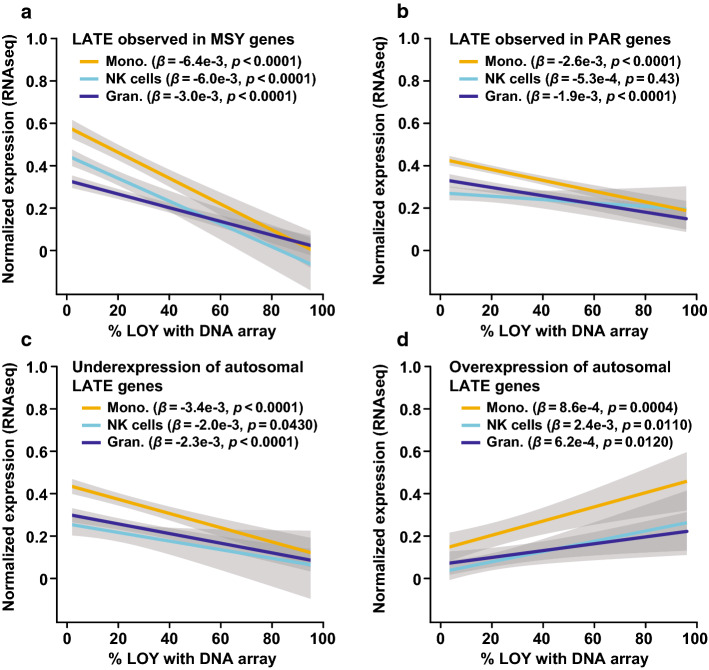
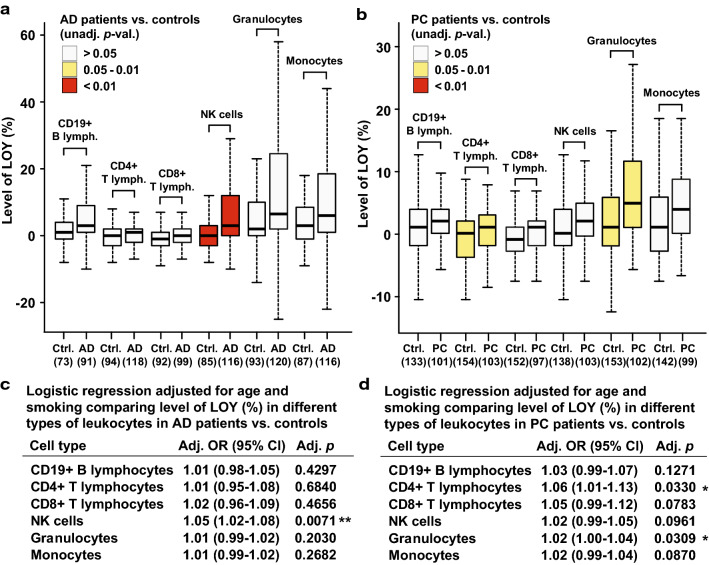
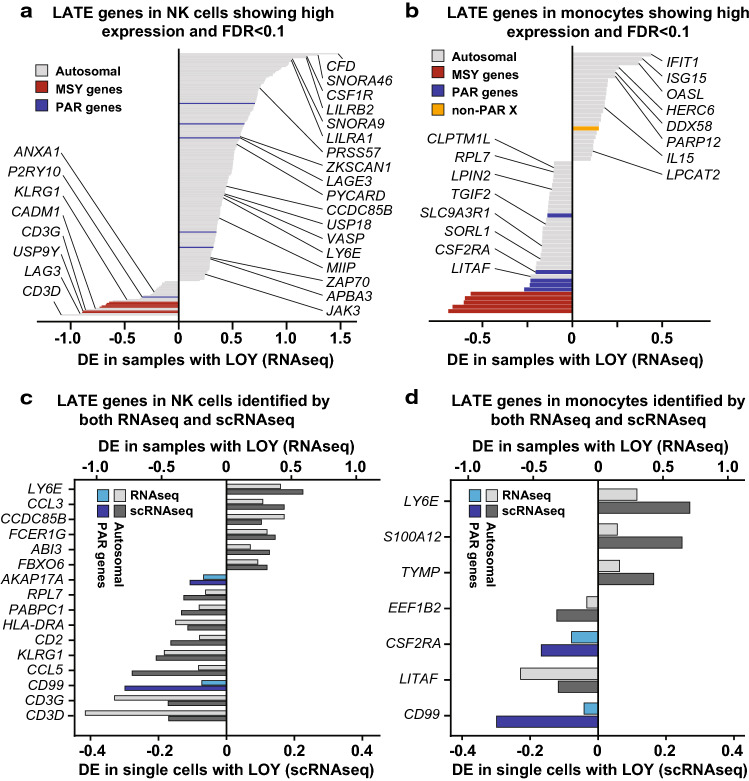
Epidemiological investigations show that mosaic loss of chromosome Y (LOY) in leukocytes is associated with earlier mortality and morbidity from many diseases in men. LOY is the most common acquired mutation and is associated with aberrant clonal expansion of cells, yet it remains unclear whether this mosaicism exerts a direct physiological effect. We studied DNA and RNA from leukocytes in sorted- and single-cells in vivo and in vitro. DNA analyses of sorted cells showed that men diagnosed with Alzheimer's disease was primarily affected with LOY in NK cells whereas prostate cancer patients more frequently displayed LOY in CD4 + T cells and granulocytes. Moreover, bulk and single-cell RNA sequencing in leukocytes allowed scoring of LOY from mRNA data and confirmed considerable variation in the rate of LOY across individuals and cell types. LOY-associated transcriptional effect (LATE) was observed in ~ 500 autosomal genes showing dysregulation in leukocytes with LOY. The fraction of LATE genes within specific cell types was substantially larger than the fraction of LATE genes shared between different subsets of leukocytes, suggesting that LOY might have pleiotropic effects. LATE genes are involved in immune functions but also encode proteins with roles in other diverse biological processes. Our findings highlight a surprisingly broad role for chromosome Y, challenging the view of it as a "genetic wasteland", and support the hypothesis that altered immune function in leukocytes could be a mechanism linking LOY to increased risk for disease.
流行病学研究表明,白细胞中染色体 Y(LOY)的镶嵌性缺失与男性许多疾病的更早死亡率和发病率有关。LOY 是最常见的获得性突变,与细胞异常克隆性扩张有关,但尚不清楚这种镶嵌性是否会产生直接的生理效应。我们在体内和体外的分选和单细胞中研究了白细胞的 DNA 和 RNA。分选细胞的 DNA 分析表明,被诊断患有阿尔茨海默病的男性主要受 NK 细胞中的 LOY 影响,而前列腺癌患者更常显示 CD4+T 细胞和粒细胞中的 LOY。此外,白细胞的批量和单细胞 RNA 测序可根据 mRNA 数据对 LOY 进行评分,并证实个体和细胞类型之间 LOY 率存在相当大的差异。在具有 LOY 的白细胞中观察到与 LOY 相关的转录效应(LATE)在大约 500 个常染色体基因中。在特定细胞类型中,LATE 基因的分数明显大于白细胞不同亚群之间共享的 LATE 基因的分数,这表明 LOY 可能具有多效性作用。LATE 基因参与免疫功能,但也编码在其他不同生物过程中具有作用的蛋白质。我们的研究结果突出了染色体 Y 的惊人广泛作用,挑战了将其视为“遗传荒地”的观点,并支持了这样一种假设,即白细胞中免疫功能的改变可能是将 LOY 与疾病风险增加联系起来的一种机制。