Neugornet Austin, O'Donovan Bernadette, Ortinski Pavel Ivanovich
Department of Neuroscience, School of Medicine, University of Kentucky, Lexington, KY, United States.
Department of Pharmacology, Physiology and Neuroscience, University of South Carolina School of Medicine, Columbia, SC, United States.
Front Neurosci. 2021 Mar 26;15:620869. doi: 10.3389/fnins.2021.620869. eCollection 2021.
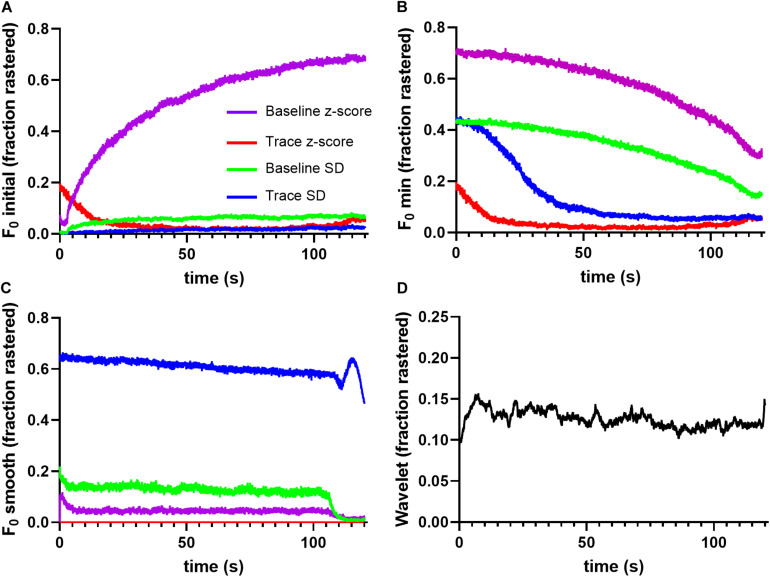
Calcium imaging has gained substantial popularity as a tool to profile the activity of multiple simultaneously active cells at high spatiotemporal resolution. Among the diverse approaches to processing of Ca imaging data is an often subjective decision of how to quantify baseline fluorescence or . We examine the effect of popular determination methods on the interpretation of neuronal and astrocyte activity in a single dataset of rats trained to self-administer intravenous infusions of cocaine and compare them with an -independent wavelet ridgewalking event detection approach. We find that the choice of the processing method has a profound impact on the interpretation of widefield imaging results. All of the d/ thresholding methods tended to introduce spurious events and fragment individual transients, leading to smaller calculated event durations and larger event frequencies. Analysis of simulated datasets confirmed these observations and indicated substantial intermethod variability as to the events classified as significant. Additionally, most d/ methods on their own were unable to adequately account for bleaching of fluorescence, although the smooth approach and the wavelet ridgewalking algorithm both did so. In general, the choice of the processing method led to dramatically different quantitative and sometimes opposing qualitative interpretations of the effects of cocaine self-administration both at the level of individual cells and at the level of cell networks. Significantly different distributions of event duration, amplitude, frequency, and network measures were found across the majority of d/ approaches. The wavelet ridgewalking algorithm broadly outperformed d/ -based methods for both neuron and astrocyte recordings. These results indicate the need for heightened awareness of the limitations and tendencies associated with decisions to use particular Ca image processing pipelines. Both quantification and interpretation of the effects of experimental manipulations are strongly sensitive to such decisions.
钙成像作为一种能够在高时空分辨率下描绘多个同时活跃细胞活性的工具,已获得了广泛的应用。在处理钙成像数据的各种不同方法中,如何量化基线荧光往往是一个主观的决定。我们研究了常用的确定方法对训练自行静脉注射可卡因的大鼠单个数据集中神经元和星形胶质细胞活性解释的影响,并将它们与一种独立于的小波脊行走事件检测方法进行比较。我们发现处理方法的选择对宽场成像结果的解释有深远影响。所有的d/阈值化方法都倾向于引入虚假事件并分割单个瞬变,导致计算出的事件持续时间更短和事件频率更高。对模拟数据集的分析证实了这些观察结果,并表明在分类为显著的事件方面,方法间存在很大的变异性。此外,大多数d/方法本身无法充分考虑荧光漂白,尽管平滑方法和小波脊行走算法都能做到这一点。一般来说,处理方法的选择导致在单个细胞水平和细胞网络水平上对可卡因自我给药效果的定量解释有显著差异,有时甚至是相反的定性解释。在大多数d/方法中,发现事件持续时间、幅度、频率和网络测量的分布有显著差异。对于神经元和星形胶质细胞记录,小波脊行走算法在很大程度上优于基于d/的方法。这些结果表明,需要更加意识到与使用特定钙图像处理管道的决策相关的局限性和趋势。实验操作效果的量化和解释都对这些决策非常敏感。