Department of Pathology, Xiangya Hospital, Central South University, Changsha, China.
Department of Hematology, The Affiliated Zhuzhou Hospital Xiangya Medical College, Central South University, Zhuzhou, China.
Front Immunol. 2021 Mar 25;12:625672. doi: 10.3389/fimmu.2021.625672. eCollection 2021.
Rapidly progressive glomerulonephritis caused by antineutrophil cytoplasmic antibody (ANCA)-associated vasculitis (AAV) is typically characterized as pauci-immune glomerulonephritis. However, immune complex (IC) deposition in the glomerulus has been reported in a growing number of studies. Here, we assess the presence of glomerular immune deposits alongside renal outcome in myeloperoxidase (MPO)-ANCA associated glomerulonephritis (MPO-ANCA GN).
Clinical and histopathologic characteristics of 97 patients with MPO-ANCA GN classified by renal biopsy from January 2008 to December 2019 were extracted retrospectively from electronic medical records. The extent of immune deposits in the kidney (C3, C4, C1q, IgA, IgG, IgM) at diagnosis were analyzed by immunofluorescence (IF). Patients were followed up for a median period of 15 months. The response to treatment and outcomes of renal and histological lesion changes were also assessed.
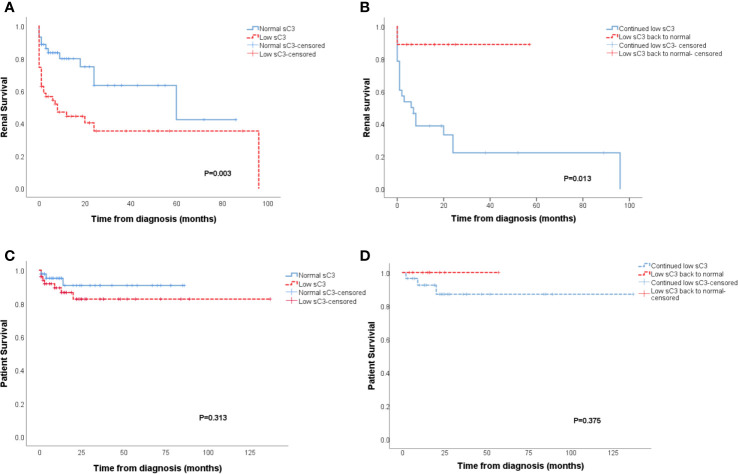
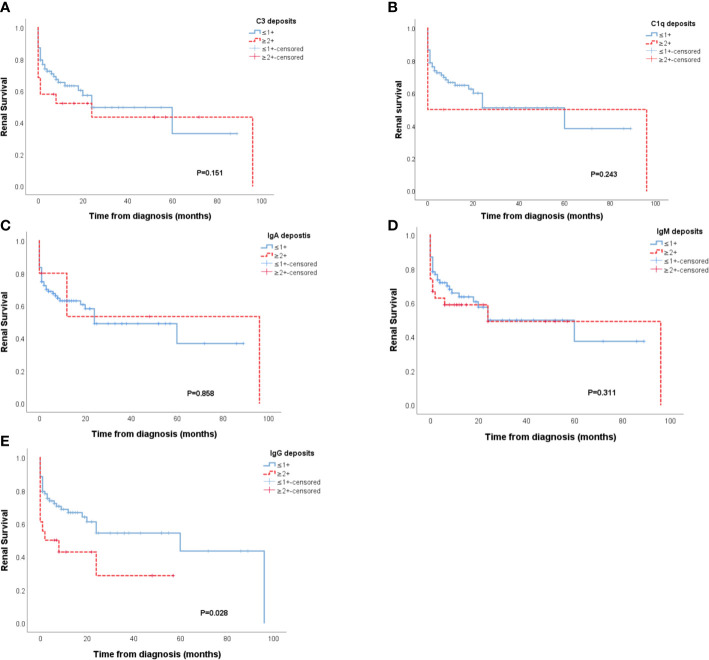
In our study, 41% (40/97) of patients showed positive IF (≥2+) for at least one of the six immunoglobulin or complement components tested. Patients with IC deposits showed higher levels of serum creatinine (p=0.025), lower platelet counts (p=0.009), lower serum complement C3 (sC3) (≤790 ml/L) (p=0.013) and serum IgG (p=0.018) than patients with pauci-immune (PI) deposition at diagnosis. End-stage renal disease was negatively associated with eGFR (HR 0.885, 95% CI 0.837 to 0.935, p<0.0001), platelet count (HR 0.996, 95% CI 0.992 to 1.000, p=0.046) and serum globulin (HR 0.905, 95% CI 0.854 to 0.959, p=0.001). Patients with lower sC3 levels showed a worse renal outcome than the patients with normal sC3 at diagnosis (p=0.003). Analysis of the components of the renal deposits found that patients with IgG deposits exhibited a poorer renal outcome compared to patients that were IgG negative (p=0.028). Moreover, Bowman's capsule rupture occurred less frequently in patients with IgM deposition compared with IgM negative counterparts (p=0.028). Vascular lesions and granuloma-like lesions had been seen more frequently in cases with IgA deposition than those without IgA deposition (p=0.03 and 0.015, respectively).
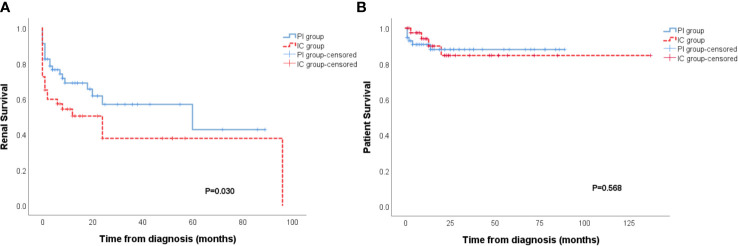
In conclusion, patients with immune complex deposits in the kidney showed less platelet count, lower sC3 and sIgG levels, and higher serum creatinine levels. Patients with low sC3 at initial and with continued low sC3 during the treatment displayed a trend toward poorer kidney survival. Moreover, the IC group showed a worse renal outcome than the PI group, further enforcing the present strategy of introducing complement targeted therapies in AAV.
由抗中性粒细胞胞质抗体(ANCA)相关血管炎(AAV)引起的快速进展性肾小球肾炎通常表现为少免疫性肾小球肾炎。然而,越来越多的研究报告了肾小球内免疫复合物(IC)的沉积。在这里,我们评估了髓过氧化物酶(MPO)-ANCA 相关肾小球肾炎(MPO-ANCA GN)中肾小球免疫沉积物的存在情况及其与肾脏预后的关系。
我们回顾性地从电子病历中提取了 2008 年 1 月至 2019 年 12 月期间因肾活检而诊断为 MPO-ANCA GN 的 97 例患者的临床和组织病理学特征。通过免疫荧光(IF)分析了肾脏中免疫沉积物(C3、C4、C1q、IgA、IgG、IgM)的程度。对患者进行了中位数为 15 个月的随访。还评估了治疗反应和肾脏及组织学病变变化的结果。
在我们的研究中,41%(40/97)的患者在至少一种检测的六种免疫球蛋白或补体成分中显示出阳性 IF(≥2+)。与 pauci-immune(PI)沉积组相比,IC 沉积组患者的血清肌酐水平更高(p=0.025)、血小板计数更低(p=0.009)、血清补体 C3(sC3)水平更低(≤790 ml/L)(p=0.013)和血清 IgG 水平更低(p=0.018)。终末期肾病与 eGFR 呈负相关(HR 0.885,95%CI 0.837 至 0.935,p<0.0001)、血小板计数(HR 0.996,95%CI 0.992 至 1.000,p=0.046)和血清球蛋白(HR 0.905,95%CI 0.854 至 0.959,p=0.001)。与 sC3 水平正常的患者相比,sC3 水平较低的患者肾脏预后更差(p=0.003)。对肾沉积物成分的分析发现,与 IgG 阴性患者相比,IgG 沉积患者的肾脏预后更差(p=0.028)。此外,与 IgG 阴性患者相比,IgM 沉积患者的肾小球囊破裂发生频率更低(p=0.028)。与无 IgA 沉积的患者相比,有 IgA 沉积的患者血管病变和肉芽肿样病变更常见(p=0.03 和 0.015)。
总之,肾脏有免疫复合物沉积的患者血小板计数更低、sC3 和 sIgG 水平更低、血清肌酐水平更高。在初始和治疗过程中持续 sC3 水平较低的患者肾脏存活率呈下降趋势。此外,IC 组的肾脏预后比 PI 组差,这进一步支持了目前在 AAV 中引入补体靶向治疗的策略。