Chen Congcong, Hou Jia, Yu Sizhe, Li Wenyuan, Wang Xiao, Sun Hong, Qin Tianjie, Claret Francois X, Guo Hui, Liu Zhiyan
School of Life Science, Northwest University, Xi'an, Shaanxi 710069, P.R. China.
Department of Medical Oncology, The First Affiliated Hospital of Xi'an Jiaotong University, Xi'an, Shaanxi 710061, P.R. China.
Oncol Lett. 2021 May;21(5):413. doi: 10.3892/ol.2021.12674. Epub 2021 Mar 23.
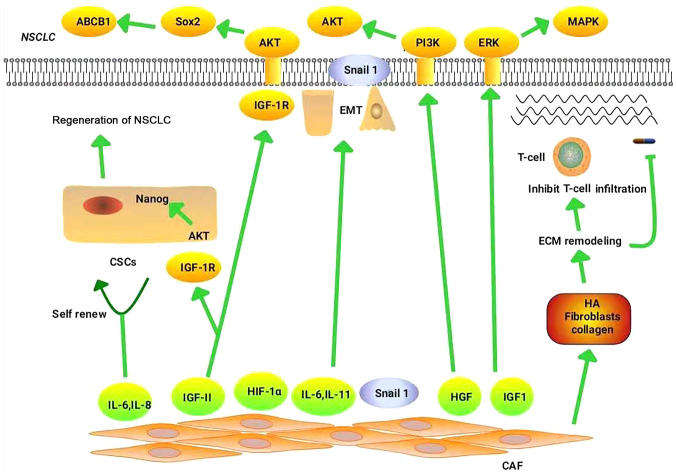
Non-small cell lung cancer (NSCLC) is a malignant tumor with high morbidity and mortality rates, which seriously endangers human health. Although treatment methods continue to evolve, the emergence of drug resistance is inevitable and seriously hinders the treatment of NSCLC. The tumor microenvironment (TME) protects tumor cells from the effects of chemotherapeutic drugs, which can lead to drug resistance. Cancer-associated fibroblasts (CAFs) are an important component of the TME, and various studies have demonstrated that CAFs play a crucial role in drug resistance in NSCLC. However, the drug resistance mechanism of CAFs and whether CAFs can be used as a target to reverse the resistance of tumor cells remain unclear. The present review discusses this issue and describes the heterogeneity of CAF markers, as well as their origins and resident organs, and the role and mechanism of this heterogeneity in NSCLC progression. Furthermore, the mechanism of CAF-mediated NSCLC resistance to chemotherapy, targeted therapy and immunotherapy is introduced, and strategies to reverse this resistance are described.
非小细胞肺癌(NSCLC)是一种发病率和死亡率都很高的恶性肿瘤,严重危害人类健康。尽管治疗方法不断发展,但耐药性的出现不可避免,严重阻碍了NSCLC的治疗。肿瘤微环境(TME)保护肿瘤细胞免受化疗药物的影响,这可能导致耐药性。癌症相关成纤维细胞(CAFs)是TME的重要组成部分,各种研究表明,CAFs在NSCLC的耐药性中起关键作用。然而,CAFs的耐药机制以及CAFs是否可作为逆转肿瘤细胞耐药性的靶点仍不清楚。本综述讨论了这个问题,并描述了CAF标志物的异质性,以及它们的起源和驻留器官,以及这种异质性在NSCLC进展中的作用和机制。此外,还介绍了CAF介导的NSCLC对化疗、靶向治疗和免疫治疗耐药的机制,并描述了逆转这种耐药性的策略。