Hotta Takamasa, Nakashima Kazuhisa, Hata Kojiro, Tsubata Yukari, Isobe Takeshi
Department of Internal Medicine, Division of Medical Oncology & Respiratory Medicine, Shimane University, Shimane, Japan.
J Thorac Dis. 2021 Mar;13(3):1476-1484. doi: 10.21037/jtd-20-3123.
The prognosis of non-small cell lung cancer (NSCLC) varies greatly depending on whether or not it can receive molecular-targeted drug treatment including epidermal growth factor receptor (EGFR) tyrosine kinase inhibitors (TKIs). We investigated the clinical utility of C-reactive protein (CRP) levels measured at the time of diagnosis in EGFR-mutant and wild-type NSCLC patients who had undergone first-line therapy.
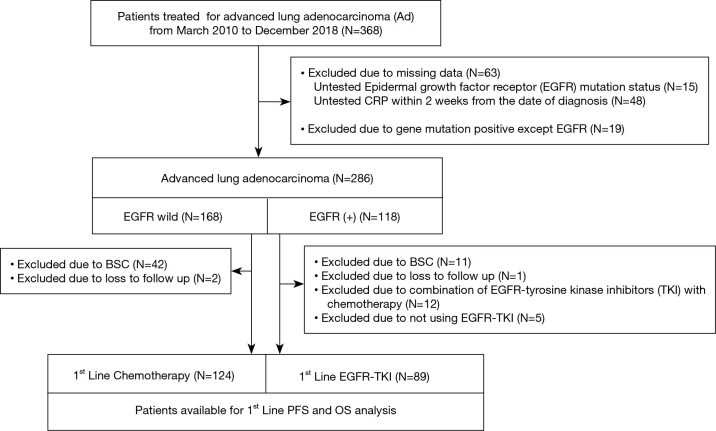
Serum CRP levels were analyzed in 213 patients, of whom 89 patients had advanced EGFR-mutated NSCLC who underwent first-line EGFR-TKI treatment. We used Cox proportional hazards models to study the relationship between CRP and overall survival (OS). CRP cutoff values were obtained from the receiver operating characteristic curve.
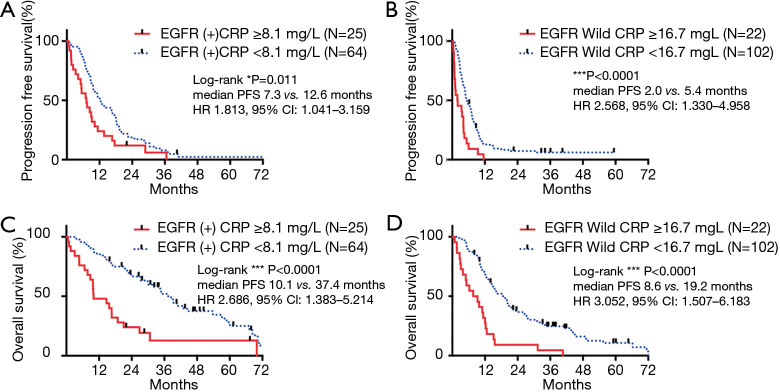
Mean serum CRP level in treated NSCLC patients were not significantly different in patients with or without EGFR mutations. The optimal CRP cutoff values were 8.1 mg/L for EGFR-mutated NSCLC and 16.7 mg/L for EGFR-wild NSCLC. Based on multivariate analysis, high CRP level (EGFR-mutated, HR: 2.479, 95% CI: 1.331-4.619, P=0.004; EGFR-wild, HR: 3.625, 95% CI: 2.149-6.116, P<0.001) was a significant and independent negative prognostic factor for OS in patients with or without EGFR mutations.
High CRP levels predicted a lack of response to treatment in patients with advanced lung adenocarcinoma with or without EGFR mutations. Thus, the CRP level is a good and easy to use prognostic factor and objective indicator for clinical practice.
非小细胞肺癌(NSCLC)的预后差异很大,这取决于其是否能够接受包括表皮生长因子受体(EGFR)酪氨酸激酶抑制剂(TKIs)在内的分子靶向药物治疗。我们研究了在接受一线治疗的EGFR突变型和野生型NSCLC患者诊断时测量的C反应蛋白(CRP)水平的临床效用。
分析了213例患者的血清CRP水平,其中89例患有晚期EGFR突变型NSCLC并接受一线EGFR-TKI治疗。我们使用Cox比例风险模型研究CRP与总生存期(OS)之间的关系。CRP临界值从受试者工作特征曲线获得。
接受治疗的NSCLC患者中,无论有无EGFR突变,其平均血清CRP水平无显著差异。EGFR突变型NSCLC的最佳CRP临界值为8.1mg/L,EGFR野生型NSCLC为16.7mg/L。基于多变量分析,高CRP水平(EGFR突变型,HR:2.479,95%CI:1.331-4.619,P=0.004;EGFR野生型,HR:3.625,95%CI:2.149-6.116,P<0.001)是有或无EGFR突变患者OS的显著且独立的不良预后因素。
高CRP水平预示有或无EGFR突变的晚期肺腺癌患者对治疗无反应。因此,CRP水平是临床实践中一个良好且易于使用的预后因素和客观指标。