Minami Seigo, Ihara Shouichi, Komuta Kiyoshi
Department of Respiratory Medicine, Osaka Police Hospital, 10-31 Kitayama-cho, Tennoji-ku, Osaka 543-0035, Japan.
World J Oncol. 2019 Feb;10(1):35-45. doi: 10.14740/wjon1179. Epub 2019 Feb 26.
Lung immune prognostic index (LIPI) was recently developed on the basis of the combination of baseline derived neutrophil to lymphocyte ratio (dNLR) and lactate dehydrogenase (LDH). This index was demonstrated as a specific biomarker of immune checkpoint inhibitors for non-small cell lung cancer (NSCLC). We aimed to show that LIPI may be a useful biomarker of cytotoxic chemotherapy and epidermal growth factor receptor (EGFR) tyrosine kinase inhibitor (TKI) for NSCLC.
We retrospectively collected 175 wild-type EGFR adenocarcinomas, 131 NSCLCs harboring mutant EGFR and 110 squamous cell carcinomas. All patients initiated first-line cytotoxic chemotherapy or EGFR-TKI monotherapy between July 2007 and August 2017 at our hospital. These patients were divided into good, intermediate and poor LIPI groups. We compared their overall survival (OS) and progression-free survival (PFS). Multivariate analyses detected prognostic and predictive factors of OS and PFS.
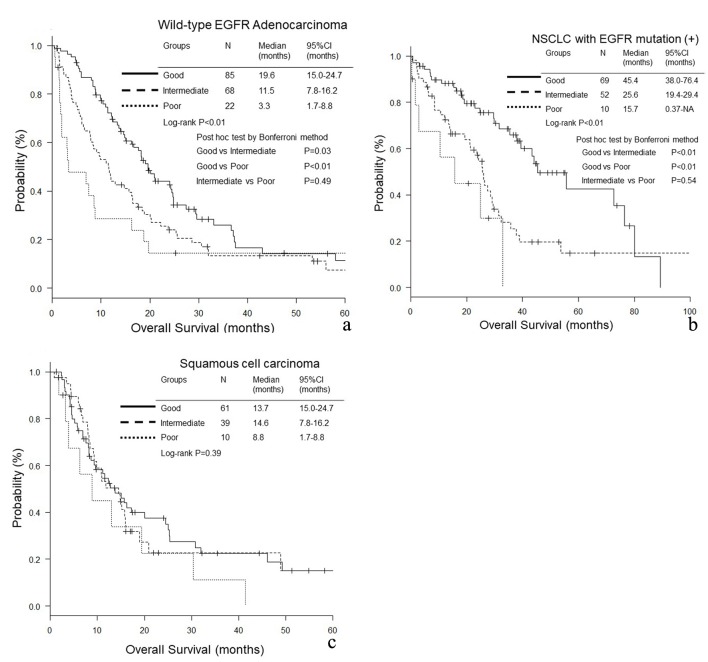
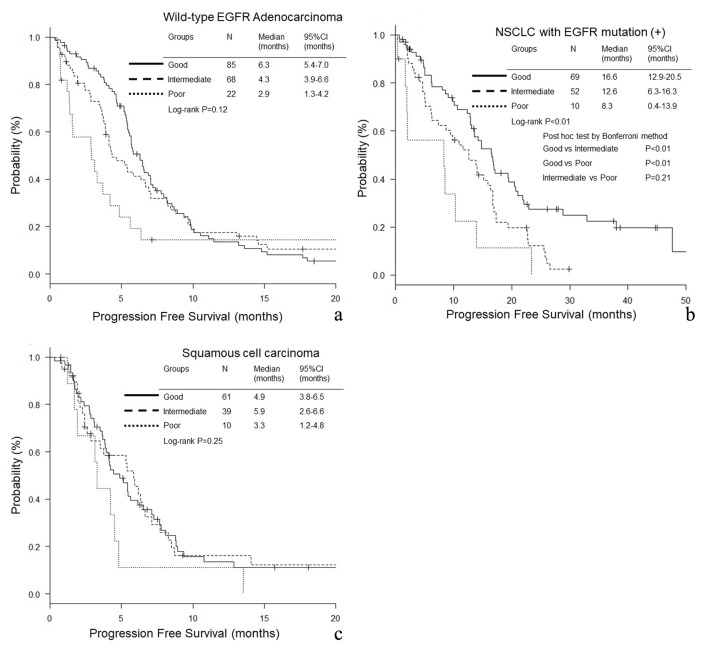
The good LIPI group survived longer than the intermediate and poor LIPI groups in wild-type EGFR adenocarcinoma (good, intermediate and poor LIPI groups: median 19.6, 11.5 and 3.3 months, P < 0.01, respectively) and mutant EGFR NSCLC (45.4, 25.6 and 15.7 months, P < 0.01). The PFS of good LIPI group was significantly longer that those of the other two groups in mutant EGFR NSCLC (16.6, 12.6 and 8.3 months, P < 0.01). The intermediate group (hazard ratio (HR) 1.49, 95% confidential interval (CI) 1.03 - 2.15, P = 0.04) of wild-type EGFR adenocarcinoma, intermediate (HR 2.30, 95% CI 1.33 - 3.99, P < 0.01) and poor (HR 2.76, 95% CI 1.03 - 7.42, P = 0.04) groups of mutant EGFR NSCLC were independent prognostic factors of poor OS. The intermediate (HR 1.57, 95% CI 1.01 - 2.44, P = 0.04) and poor (HR 2.63, 95% CI 1.14 - 6.07, P = 0.02) groups were significant prognostic factors of PFS of mutant EGFR NSCLC.
LIPI was an independent prognostic factor of chemotherapy for adenocarcinoma with wild-type EGFR and of EGFR-TKI for NSCLC harboring mutant EGFR. Thus, LIPI was not a specific biomarker for ICI therapy, but a useful biomarker for chemotherapy and EGFR-TKI therapy in specific subsets of NSCLC.
肺免疫预后指数(LIPI)最近是在基线衍生中性粒细胞与淋巴细胞比率(dNLR)和乳酸脱氢酶(LDH)相结合的基础上开发的。该指数被证明是非小细胞肺癌(NSCLC)免疫检查点抑制剂的一种特异性生物标志物。我们旨在表明LIPI可能是NSCLC细胞毒性化疗和表皮生长因子受体(EGFR)酪氨酸激酶抑制剂(TKI)的一种有用生物标志物。
我们回顾性收集了175例野生型EGFR腺癌、131例携带突变型EGFR的NSCLC和110例鳞状细胞癌。所有患者在2007年7月至2017年8月期间于我院开始一线细胞毒性化疗或EGFR-TKI单药治疗。这些患者被分为LIPI良好、中等和不良组。我们比较了他们的总生存期(OS)和无进展生存期(PFS)。多因素分析检测了OS和PFS的预后和预测因素。
在野生型EGFR腺癌中,LIPI良好组的生存期长于LIPI中等和不良组(LIPI良好、中等和不良组:中位生存期分别为19.6、11.5和3.3个月,P<0.01),在携带突变型EGFR的NSCLC中也是如此(45.4、25.6和15.7个月,P<0.01)。在携带突变型EGFR的NSCLC中,LIPI良好组的PFS明显长于其他两组(16.6、12.6和8.3个月,P<0.01)。野生型EGFR腺癌的中等组(风险比(HR)1.49,95%置信区间(CI)1.03 - 2.15,P = 0.04),携带突变型EGFR的NSCLC的中等组(HR 2.30,95%CI 1.33 - 3.99,P<0.01)和不良组(HR 2.76,,95%CI 1.03 -,7.42,P = 0.04)是OS不良的独立预后因素。携带突变型EGFR的NSCLC的中等组(HR 1.57,95%CI 1.01 - 2.44,P = 0.04)和不良组(HR 2.63,95%CI 1.14 - 6.07,P = 0.02)是PFS的显著预后因素。
LIPI是野生型EGFR腺癌化疗以及携带突变型EGFR的NSCLC的EGFR-TKI治疗的独立预后因素。因此,LIPI不是ICI治疗的特异性生物标志物,而是NSCLC特定亚组中化疗和EGFR-TKI治疗的有用生物标志物。