Counihan Natalie A, Modak Joyanta K, de Koning-Ward Tania F
School of Medicine, Deakin University, Waurn Ponds, VIC, Australia.
Front Cell Dev Biol. 2021 Mar 25;9:649184. doi: 10.3389/fcell.2021.649184. eCollection 2021.
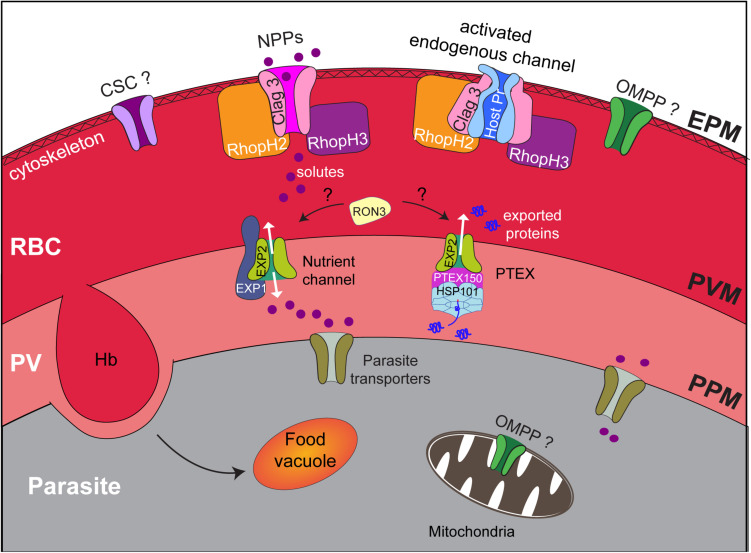
parasites responsible for the disease malaria reside within erythrocytes. Inside this niche host cell, parasites internalize and digest host hemoglobin to source amino acids required for protein production. However, hemoglobin does not contain isoleucine, an amino acid essential for growth, and the parasite cannot synthesize it . The parasite is also more metabolically active than its host cell, and the rate at which some nutrients are consumed exceeds the rate at which they can be taken up by erythrocyte transporters. To overcome these constraints, parasites increase the permeability of the erythrocyte membrane to isoleucine and other low-molecular-weight solutes it requires for growth by forming new permeation pathways (NPPs). In addition to the erythrocyte membrane, host nutrients also need to cross the encasing parasitophorous vacuole membrane (PVM) and the parasite plasma membrane to access the parasite. This review outlines recent advances that have been made in identifying the molecular constituents of the NPPs, the PVM nutrient channel, and the endocytic apparatus that transports host hemoglobin and identifies key knowledge gaps that remain. Importantly, blocking the ability of to source essential nutrients is lethal to the parasite, and thus, components of these key pathways represent potential antimalaria drug targets.
导致疟疾的寄生虫寄生于红细胞内。在这个特定的宿主细胞内,寄生虫摄取并消化宿主血红蛋白以获取蛋白质生产所需的氨基酸。然而,血红蛋白不含异亮氨酸(一种生长必需的氨基酸),且寄生虫无法合成它。寄生虫的代谢活性也高于其宿主细胞,一些营养物质的消耗速度超过了红细胞转运蛋白摄取它们的速度。为克服这些限制,寄生虫通过形成新的渗透途径(NPPs)来增加红细胞膜对异亮氨酸及其他生长所需低分子量溶质的通透性。除红细胞膜外,宿主营养物质还需穿过包裹寄生虫的空泡膜(PVM)和寄生虫质膜才能进入寄生虫体内。本综述概述了在确定NPPs、PVM营养通道以及运输宿主血红蛋白的内吞装置的分子组成方面取得的最新进展,并指出了仍然存在的关键知识空白。重要的是,阻断寄生虫获取必需营养物质的能力对其是致命的,因此,这些关键途径的组成部分代表了潜在的抗疟疾药物靶点。