Butler William, Huang Jiaoti
Department of Pathology, Duke University School of Medicine, Durham, NC 27710, USA.
Precis Clin Med. 2021 Jan 28;4(1):25-34. doi: 10.1093/pcmedi/pbab003. eCollection 2021 Mar.
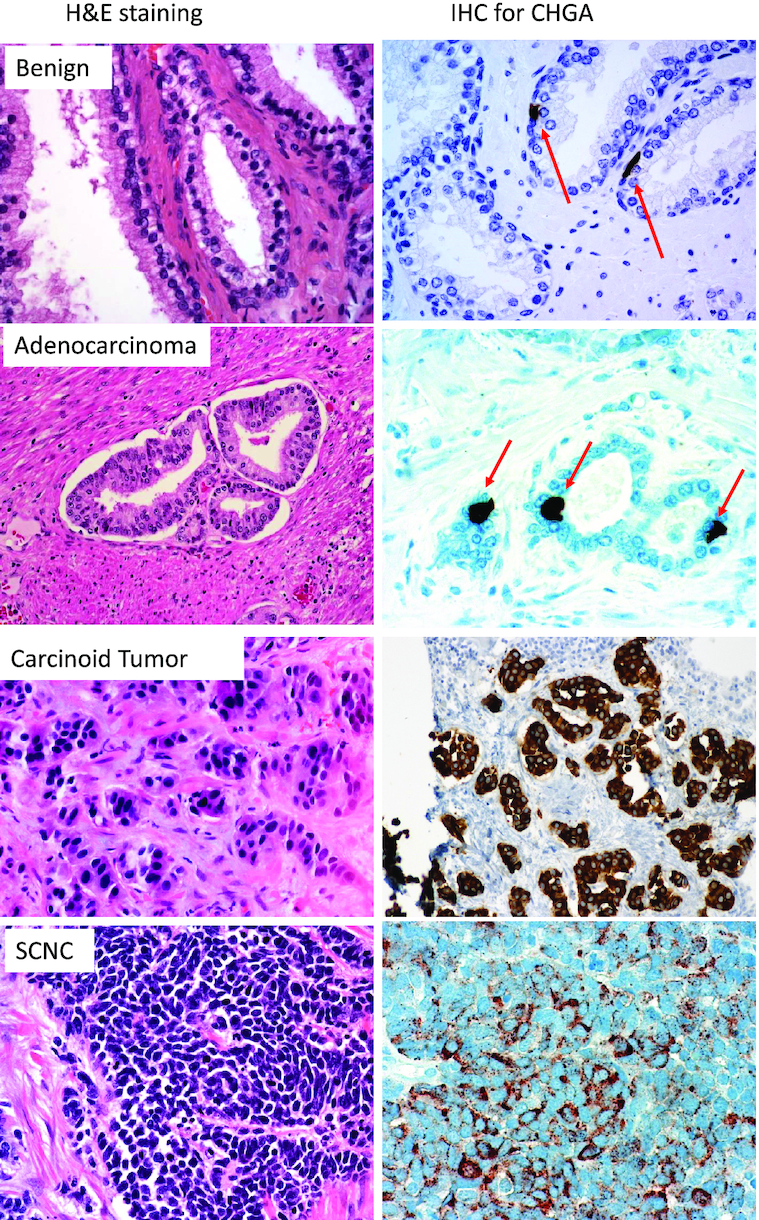
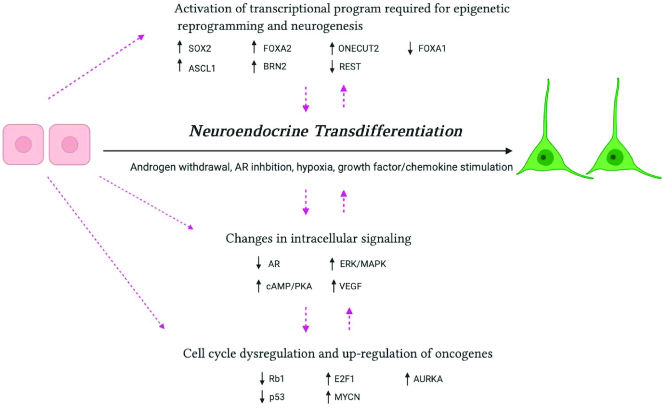
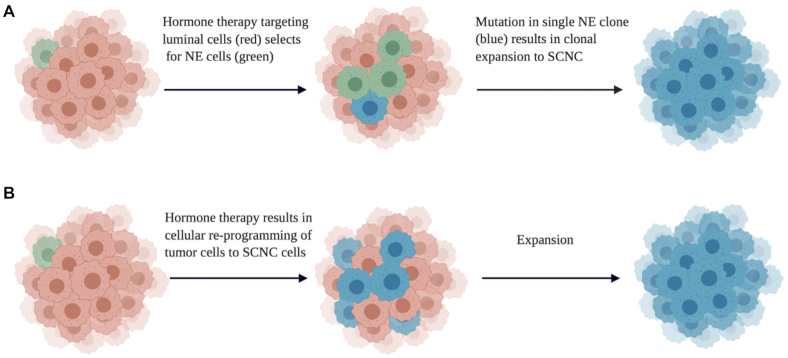
Prostate cancer (PCa) is a common cause of cancer-related mortality in men worldwide. Although most men are diagnosed with low grade, indolent tumors that are potentially curable, a significant subset develops advanced disease where hormone therapy is required to target the androgen receptor (AR). Despite its initial effect, hormone therapy eventually fails and the tumor progresses to lethal stages even through continued inhibition of AR. This review article focuses on the role of PCa cellular heterogeneity in therapy resistance and disease progression. Although AR-positive luminal-type cells represent the vast majority of PCa cells, there exists a minor component of AR-negative neuroendocrine (NE) cells that are resistant to hormonal therapy and are enriched by the treatment. In addition, it is now well accepted that a significant subset of hormonally treated tumors recur as small cell neuroendocrine carcinoma (SCNC), further highlighting the importance of targeting NE cells in addition to the more abundant luminal-type cancer cells. Although it has been long recognized that NE cells are present in PCa, their underlying function in benign prostate and molecular mechanisms contributing to PCa progression remains poorly understood. In this article, we review the morphology and function of NE cells in benign prostate and PCa as well as underlying molecular mechanisms. In addition, we review the major reported mechanisms for transformation from common adenocarcinoma histology to the highly lethal SCNC, a significant clinical challenge in the management of advanced PCa.
前列腺癌(PCa)是全球男性癌症相关死亡的常见原因。尽管大多数男性被诊断出患有低级别、惰性肿瘤,这些肿瘤有可能治愈,但仍有相当一部分患者会发展为晚期疾病,需要通过激素疗法来靶向雄激素受体(AR)。尽管激素疗法最初有效果,但最终还是会失效,即使持续抑制AR,肿瘤仍会进展到致命阶段。这篇综述文章聚焦于PCa细胞异质性在治疗抵抗和疾病进展中的作用。虽然AR阳性的管腔型细胞占PCa细胞的绝大多数,但存在一小部分AR阴性的神经内分泌(NE)细胞,它们对激素疗法具有抗性,并且在治疗过程中数量增加。此外,现在人们普遍认为,接受激素治疗的肿瘤中有相当一部分会复发为小细胞神经内分泌癌(SCNC),这进一步凸显了除了更丰富的管腔型癌细胞外,靶向NE细胞的重要性。尽管人们早就认识到PCa中存在NE细胞,但它们在良性前列腺中的潜在功能以及导致PCa进展的分子机制仍知之甚少。在本文中,我们综述了NE细胞在良性前列腺和PCa中的形态与功能以及潜在的分子机制。此外,我们还综述了从常见腺癌组织学转变为高度致命的SCNC的主要报道机制,这是晚期PCa管理中的一个重大临床挑战。