Sapkota Yadav, Li Nan, Pierzynski Jeanne, Mulrooney Daniel A, Ness Kirsten K, Morton Lindsay M, Michael J Robert, Zhang Jinghui, Bhatia Smita, Armstrong Gregory T, Hudson Melissa M, Robison Leslie L, Yasui Yutaka
Department of Epidemiology and Cancer Control, St. Jude Children's Research Hospital, Memphis, TN, USA.
Department of Oncology, St. Jude Children's Research Hospital, Memphis, TN, USA.
JACC CardioOncol. 2021 Mar;3(1):76-84. doi: 10.1016/j.jaccao.2021.01.007. Epub 2021 Mar 16.
Childhood cancer survivors experience significantly higher rates of hypertension which potentiates cardiovascular disease, but the contribution and relationship of genetic and treatment factors to hypertension risk are unknown.
To determine the contribution of a blood pressure polygenic risk score (PRS) from the general population and its interplay with cancer therapies to hypertension in childhood cancer survivors.
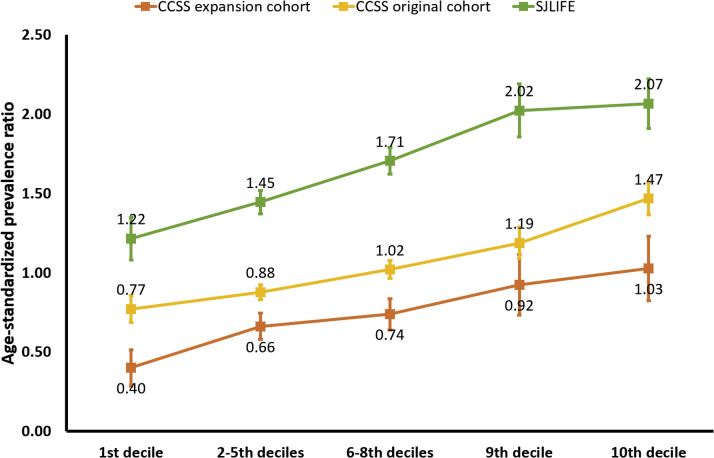
Using 895 established blood pressure loci from the general population, we calculated a PRS for 3572 childhood cancer survivors of European ancestry from Childhood Cancer Survivor Study (CCSS) original cohort, 1889 from CCSS expansion cohort, and 2534 from the St. Jude Lifetime Cohort (SJLIFE). Hypertension was assessed using National Cancer Institute criteria based on self-report of a physician diagnosis in CCSS and by blood pressure measurement in SJLIFE.
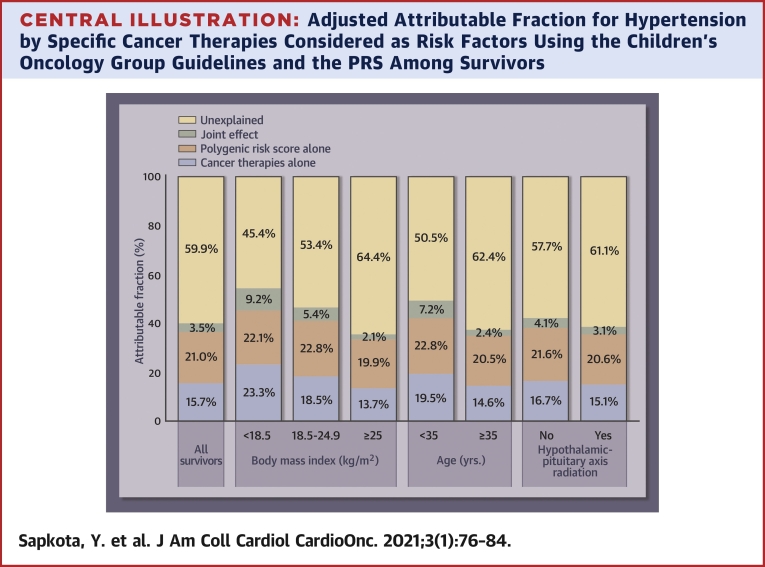
In the combined sample of 7995 survivors, those in the top decile of the PRS had an odds ratio (OR) of 2.66 (95% CI=2.03-3.48) for hypertension compared to survivors in the bottom decile. The PRS-hypertension association was modified by being overweight/obese (per SD interaction OR=1.13; 95% CI=1.01-1.27) and exposure to hypothalamic-pituitary axis radiation (per SD interaction OR=1.18; 95% CI=1.05-1.33). Attributable fractions for hypertension to the PRS and cancer therapies were 21.0% and 15.7%, respectively, they jointly accounted for 40.2% of hypertension among survivors.
A blood pressure PRS from the general population is significantly associated with hypertension among childhood cancer survivors and contributes to approximately one quarter of hypertension risk among survivors. These findings highlight the importance of screening for hypertension in all childhood cancer survivors, and identify higher risk subgroups.
儿童癌症幸存者患高血压的几率显著更高,而高血压会增加心血管疾病风险,但遗传因素和治疗因素对高血压风险的影响及二者关系尚不清楚。
确定来自普通人群的血压多基因风险评分(PRS)的影响及其与癌症治疗的相互作用对儿童癌症幸存者患高血压的作用。
利用来自普通人群的895个已确定的血压基因座,我们为来自儿童癌症幸存者研究(CCSS)原始队列的3572名欧洲血统的儿童癌症幸存者、来自CCSS扩展队列的1889名幸存者以及来自圣裘德终身队列(SJLIFE)的2534名幸存者计算了PRS。在CCSS中,根据医生诊断的自我报告,采用美国国立癌症研究所的标准评估高血压;在SJLIFE中,通过测量血压评估高血压。
在7995名幸存者的合并样本中,PRS处于最高十分位数的幸存者患高血压的比值比(OR)为2.66(95%置信区间=2.03 - 3.48),而处于最低十分位数的幸存者患高血压的比值比为1。PRS与高血压之间的关联因超重/肥胖(每标准差交互作用OR = 1.13;95%置信区间=1.01 - 1.27)和下丘脑 - 垂体轴辐射暴露(每标准差交互作用OR = 1.18;95%置信区间=1.05 - 1.33)而有所改变。PRS和癌症治疗对高血压的归因分数分别为21.0%和15.7%,二者共同占幸存者中高血压病例的40.2%。
来自普通人群的血压PRS与儿童癌症幸存者的高血压显著相关,约占幸存者高血压风险的四分之一。这些发现凸显了对所有儿童癌症幸存者进行高血压筛查的重要性,并确定了高风险亚组。