State Key Laboratory of Oncogenes and Related Genes, Center for Single-Cell Omics, School of Public Health, Shanghai Jiao Tong University School of Medicine, Shanghai, China.
Department of Epidemiology, Center for Global Health, School of Public Health, Nanjing Medical University, Nanjing, China.
Lancet Oncol. 2023 Oct;24(10):1147-1156. doi: 10.1016/S1470-2045(23)00403-5.
Carriers of cancer predisposing variants are at an increased risk of developing subsequent malignant neoplasms among those who have survived childhood cancer. We aimed to investigate whether cancer predisposing variants contribute to the risk of subsequent malignant neoplasm-related late mortality (5 years or more after diagnosis).
In this analysis, data were included from two retrospective cohort studies, St Jude Lifetime Cohort (SJLIFE) and the Childhood Cancer Survivor Study (CCSS), with prospective follow-up of patients who were alive for at least 5 years after diagnosis with childhood cancer (ie, long-term childhood cancer survivors) with corresponding germline whole genome or whole exome sequencing data. Cancer predisposing variants affecting 60 genes associated with well-established autosomal-dominant cancer-predisposition syndromes were characterised. Subsequent malignant neoplasms were graded using the National Cancer Institute Common Terminology Criteria for Adverse Events (CTCAE) version 4.03 with modifications. Cause-specific late mortality was based on linkage with the US National Death Index and systematic cohort follow up. Fine-Gray subdistribution hazard models were used to estimate subsequent malignant neoplasm-related late mortality starting from the first biospecimen collection, treating non-subsequent malignant neoplasm-related deaths as a competing risk, adjusting for genetic ancestry, sex, age at diagnosis, and cancer treatment exposures. SJLIFE (NCT00760656) and CCSS (NCT01120353) are registered with ClinicalTrials.gov.
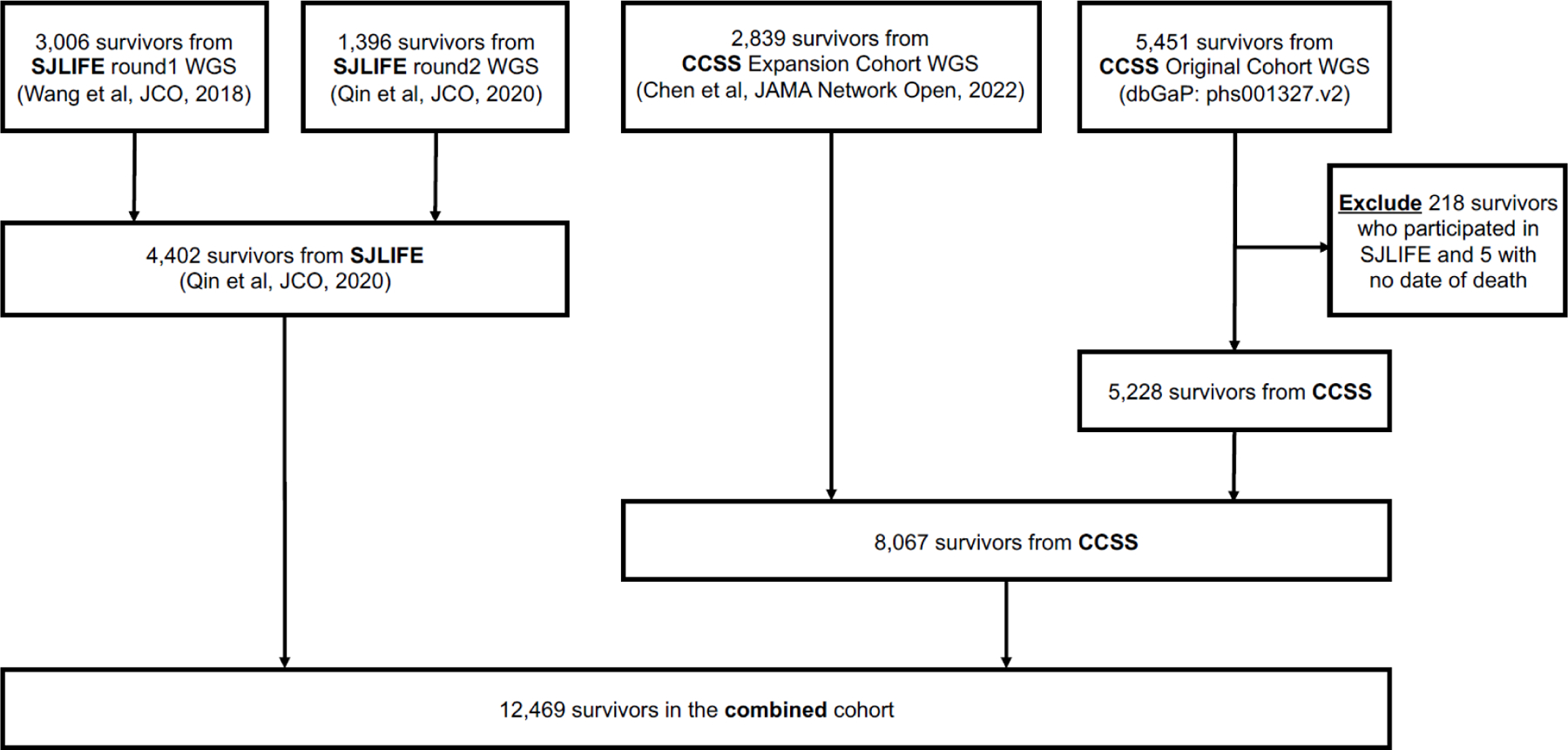
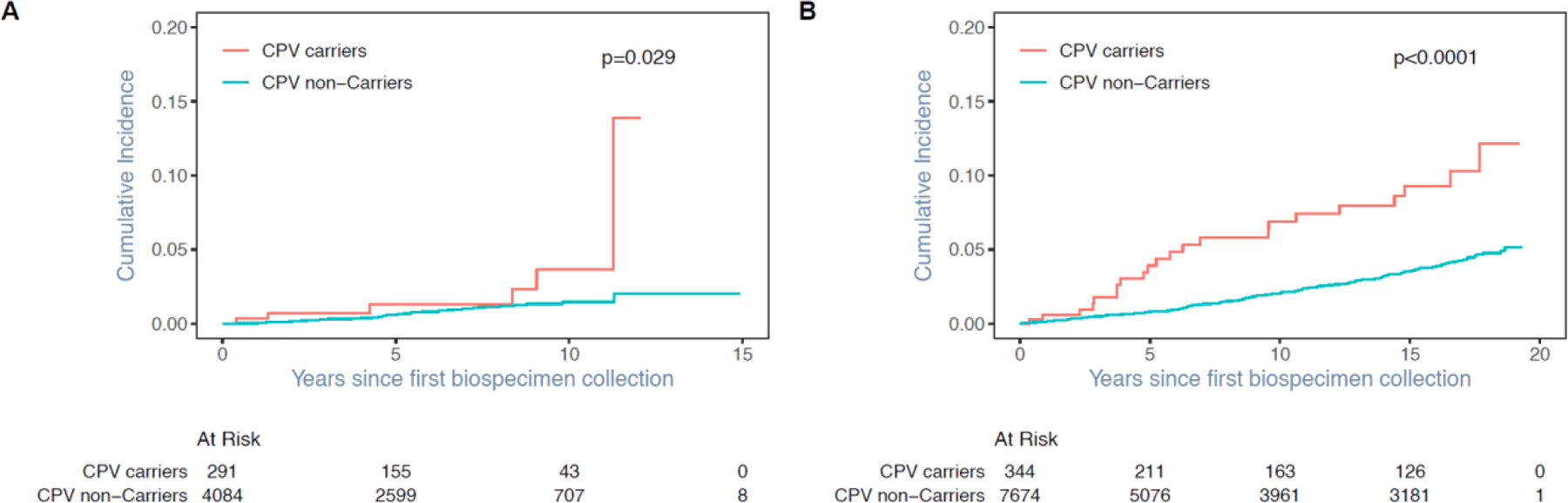
12 469 (6172 male and 6297 female) participants were included, 4402 from the SJLIFE cohort (median follow-up time since collection of the first biospecimen 7·4 years [IQR 3·1-9·4]) and 8067 from the CCSS cohort (median follow-up time since collection of the first biospecimen 12·6 years [2·2-16·6]). 641 (5·1%) of 12 469 participants carried cancer predisposing variants (294 [6·7%] in the SJLIFE cohort and 347 [4·3%] in the CCSS cohort), which were significantly associated with an increased severity of subsequent malignant neoplasms (CTCAE grade ≥4 vs grade <4: odds ratio 2·15, 95% CI 1·18-4·19, p=0·0085). 263 (2·1%) subsequent malignant neoplasm-related deaths (44 [1·0%] in the SJLIFE cohort; and 219 [2·7%] in the CCSS cohort) and 426 (3·4%) other-cause deaths (103 [2·3%] in SJLIFE; and 323 [4·0%] in CCSS) occurred. Cumulative subsequent malignant neoplasm-related mortality at 10 years after the first biospecimen collection in carriers of cancer predisposing variants was 3·7% (95% CI 1·2-8·5) in SJLIFE and 6·9% (4·1-10·7) in CCSS versus 1·5% (1·0-2·1) in SJLIFE and 2·1% (1·7-2·5) in CCSS in non-carriers. Carrying a cancer predisposing variant was associated with an increased risk of subsequent malignant neoplasm-related mortality (SJLIFE: subdistribution hazard ratio 3·40 [95% CI 1·37-8·43]; p=0·0082; CCSS: 3·58 [2·27-5·63]; p<0·0001).
Identifying participants at increased risk of subsequent malignant neoplasms via genetic counselling and clinical genetic testing for cancer predisposing variants and implementing early personalised cancer surveillance and prevention strategies might reduce the substantial subsequent malignant neoplasm-related mortality burden.
American Lebanese Syrian Associated Charities and US National Institutes of Health.
携带癌症易感变异体的个体在儿童癌症幸存者中发展后续恶性肿瘤的风险增加。我们旨在研究癌症易感变异体是否会增加随后发生与恶性肿瘤相关的晚期死亡(诊断后 5 年或以上)的风险。
在这项分析中,数据来自两项回顾性队列研究,圣裘德终身队列研究(SJLIFE)和儿童癌症幸存者研究(CCSS),对至少在诊断后 5 年内存活的儿童癌症长期幸存者(即长期儿童癌症幸存者)进行前瞻性随访,并进行相应的种系全基因组或全外显子测序数据。描述了影响 60 个与已确立的常染色体显性遗传癌症易感性综合征相关的基因的癌症易感变异体。随后的恶性肿瘤使用美国国立癌症研究所不良事件通用术语标准(CTCAE)版本 4.03 进行分级,并进行了修改。根据与美国国家死亡指数的链接和系统队列随访,确定特定原因的晚期死亡率。Fine-Gray 亚分布风险模型用于从第一个生物样本采集开始估计随后发生的与恶性肿瘤相关的晚期死亡率,将非随后发生的与恶性肿瘤相关的死亡视为竞争风险,调整遗传背景、性别、诊断时年龄和癌症治疗暴露情况。SJLIFE(NCT00760656)和 CCSS(NCT01120353)均在 ClinicalTrials.gov 注册。
共纳入 12469 名参与者(6172 名男性和 6297 名女性),其中 4402 名来自 SJLIFE 队列(自第一次生物样本采集以来的中位随访时间为 7.4 年[IQR 3.1-9.4]),8067 名来自 CCSS 队列(自第一次生物样本采集以来的中位随访时间为 12.6 年[2.2-16.6])。12469 名参与者中有 641 名(5.1%)携带癌症易感变异体(SJLIFE 队列 294 名[6.7%],CCSS 队列 347 名[4.3%]),这与随后发生的恶性肿瘤严重程度显著相关(CTCAE 分级≥4 与分级<4:比值比 2.15,95%CI 1.18-4.19,p=0.0085)。发生 263 例与随后发生的恶性肿瘤相关的死亡(SJLIFE 队列 44 例[1.0%],CCSS 队列 219 例[2.7%])和 426 例其他原因死亡(SJLIFE 队列 103 例[2.3%],CCSS 队列 323 例[4.0%])。在 SJLIFE 和 CCSS 中,携带癌症易感变异体的个体在首次生物样本采集后 10 年的与随后发生的恶性肿瘤相关的死亡率分别为 3.7%(95%CI 1.2-8.5)和 6.9%(4.1-10.7),而非携带者分别为 1.5%(1.0-2.1)和 2.1%(1.7-2.5)。携带癌症易感变异体与随后发生的恶性肿瘤相关的死亡风险增加相关(SJLIFE:亚分布风险比 3.40[95%CI 1.37-8.43];p=0.0082;CCSS:3.58[2.27-5.63];p<0.0001)。
通过遗传咨询和癌症易感变异体的临床遗传检测,识别出具有更高风险发生后续恶性肿瘤的参与者,并实施早期个性化癌症监测和预防策略,可能会降低随后发生的恶性肿瘤相关的高死亡率负担。
美国黎巴嫩叙利亚联合慈善协会和美国国立卫生研究院。