Liseno Jacob, Lager Brittney, Miller Catherine, Shankar Sai L, Mendoza Jason P, Lewin James B
AcariaHealth, Orlando, FL, USA.
Biogen, 225 Binney St, Cambridge, MA, 02142, USA.
Neurol Ther. 2021 Jun;10(1):349-360. doi: 10.1007/s40120-021-00242-7. Epub 2021 Apr 12.
Persistence to multiple sclerosis (MS) disease-modifying therapy is fundamental for maximal treatment outcomes. Diroximel fumarate (DRF) is approved in the USA for relapsing MS. Following oral administration, DRF is metabolized to monomethyl fumarate, the active metabolite of dimethyl fumarate (DMF). DRF showed clinically significant improvements in gastrointestinal (GI) tolerability versus DMF in a head-to-head clinical trial; however, real-world persistence/adherence has not been assessed. We evaluated persistence/adherence in DRF-treated patients in a real-world clinical practice.
This retrospective analysis of the AcariaHealth Specialty Pharmacy Program included patients initiating DRF from 4 December 2019 through 3 April 2020 and followed until data extraction (31 August 2020). Exclusion criteria included undetermined treatment status (e.g., DRF prescription transfer to a different pharmacy). Endpoints included persistence (overall proportion of patients remaining on DRF), discontinuation rate due to GI adverse events (AEs), and adherence (proportion of days covered [PDC]). GI AEs included GI-related AEs occurring at any time, or any unknown AE without details about the nature of the event if the unknown AE occurred ≤ 90 days after DRF initiation.
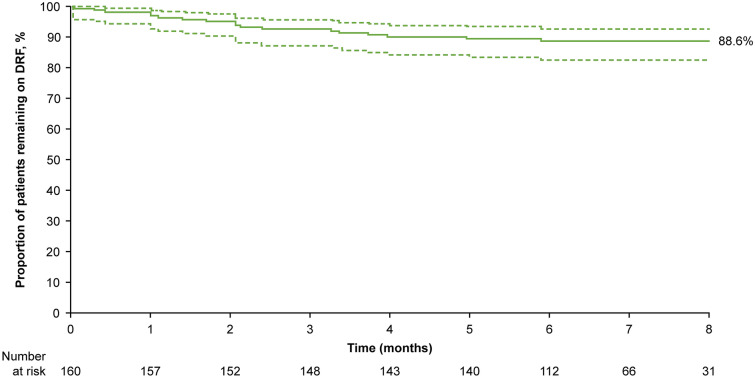
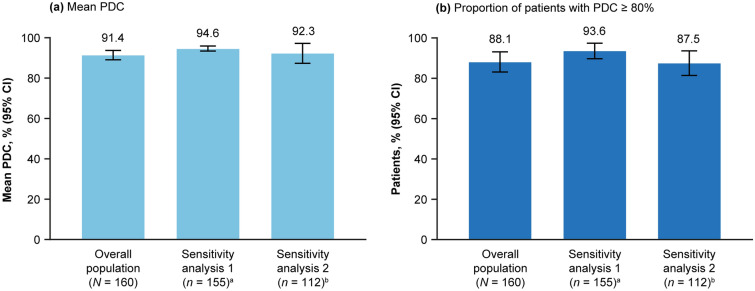
Overall, 160 patients with MS were included. Median (range) patient age was 51 (20-79) years, 80.6% (129/160) of patients were female, and 16.3% (26/160) had prior DMF treatment. Median (range) treatment duration was 7.6 (0.1-10.4) months. Estimated proportion of patients remaining persistent on DRF treatment at 8 months was 88.6% (95% confidence interval [CI] 82.5-2.7). Overall, 3.8% (6/160) of patients discontinued due to GI AEs. Mean PDC was 91.4% (95% CI 89.1-93.7). In a DMF-to-DRF switch subgroup, 92.3% (24/26) remained persistent on DRF, and 3.8% (1/26) discontinued DRF due to GI AEs.
This real-world analysis of DRF-treated patients showed high overall persistence, low discontinuation rate due to GI AEs, and high adherence to therapy, aligning with expectations based on DRF clinical trials. Data were consistent in the DMF-to-DRF subgroup. INFOGRAPHIC.
坚持使用多发性硬化症(MS)疾病修正疗法对于实现最佳治疗效果至关重要。二甲基富马酸罗索昔芬(DRF)在美国被批准用于复发型MS。口服给药后,DRF代谢为单甲基富马酸,即二甲基富马酸(DMF)的活性代谢物。在一项头对头临床试验中,与DMF相比,DRF在胃肠道(GI)耐受性方面显示出具有临床意义的改善;然而,尚未评估其在现实世界中的持续用药/依从性情况。我们在现实世界的临床实践中评估了接受DRF治疗患者的持续用药/依从性情况。
对AcariaHealth专科药房项目进行的这项回顾性分析纳入了2019年12月4日至2020年4月3日开始使用DRF并随访至数据提取(2020年8月31日)的患者。排除标准包括治疗状态未确定(例如,DRF处方转移至其他药房)。观察终点包括持续用药率(继续使用DRF的患者总体比例)、因胃肠道不良事件(AE)导致的停药率以及依从性(覆盖天数比例[PDC])。胃肠道AE包括在任何时间发生的与胃肠道相关的AE,或者如果未知AE在DRF开始使用后≤90天发生且未详细说明事件性质的任何未知AE。
总体而言,纳入了160例MS患者。患者年龄中位数(范围)为51(20 - 79)岁,80.6%(129/160)的患者为女性,16.3%(26/160)的患者曾接受过DMF治疗。治疗持续时间中位数(范围)为7.6(0.1 - 10.4)个月。估计在8个月时继续坚持接受DRF治疗的患者比例为88.6%(95%置信区间[CI] 82.5 - 92.7)。总体而言,3.8%(6/160)的患者因胃肠道AE停药。平均PDC为91.4%(95% CI 89.1 - 93.7)。在从DMF转换为DRF的亚组中,92.3%(24/26)继续坚持使用DRF,3.8%(1/26)因胃肠道AE停用DRF。
这项对接受DRF治疗患者的现实世界分析显示总体持续用药率高、因胃肠道AE导致的停药率低以及治疗依从性高,与基于DRF临床试验的预期相符。在从DMF转换为DRF的亚组中数据一致。信息图表。