Williams Mitzi J, Amezcua Lilyana, Okai Annette, Okuda Darin T, Cohan Stanley, Su Ray, Parks Becky, Mendoza Jason P, Lewin James B, Jones Cynthia C
Joi Life Wellness MS Center, Atlanta, GA, USA.
Keck School of Medicine, University of Southern California, Los Angeles, CA, USA.
Neurol Ther. 2020 Dec;9(2):483-493. doi: 10.1007/s40120-020-00193-5. Epub 2020 May 29.
Black or African American (black/AA) patients with multiple sclerosis (MS) are reported to exhibit greater disease severity compared with non-black or non-AA patients. Whether differences exist in response to MS disease-modifying therapies remains uncertain, as MS clinical trials have included low numbers of non-white patients. We evaluated real-world safety and effectiveness of dimethyl fumarate (DMF) on MS disease activity in black/AA patients.
ESTEEM is an ongoing, 5-year, multinational, prospective study evaluating long-term safety and effectiveness of DMF in patients with MS. This interim analysis included patients newly prescribed DMF in routine practice at 394 sites globally.
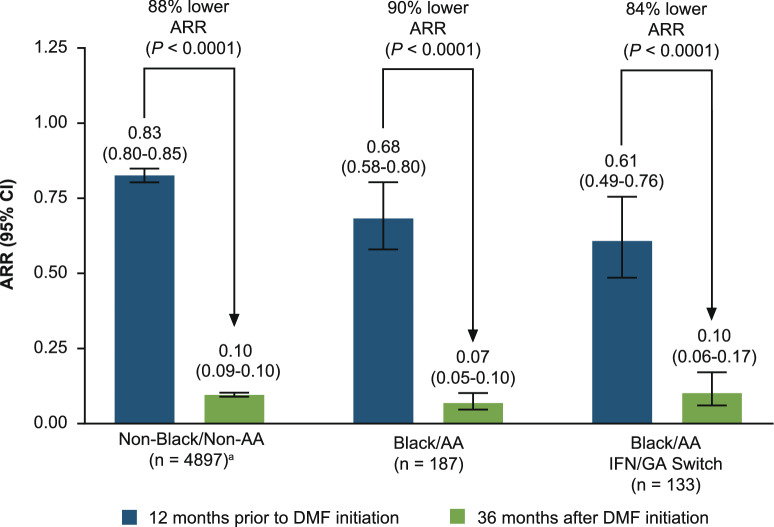
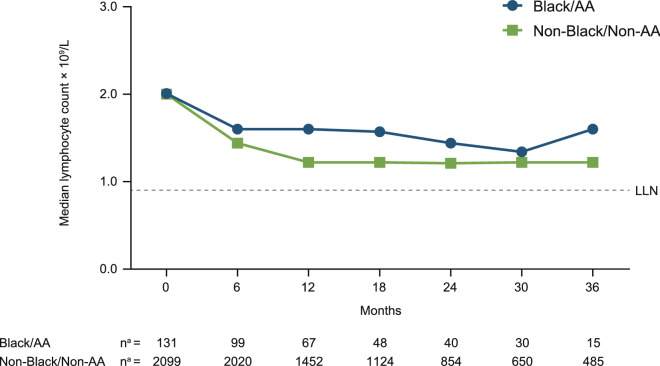
Overall, 4897 non-black/non-AA and 187 black/AA patients were analyzed; median (range) follow-up 18 (2-37) months. Unadjusted annualized relapse rates (ARRs) for 12 months before DMF initiation versus 36 months post DMF initiation, respectively, were: non-black/non-AA patients, 0.83 (95% CI 0.80-0.85) versus 0.10 (95% CI 0.09-0.10), 88% lower ARR (P < 0.0001); black/AA patients, 0.68 (95% CI 0.58-0.80) versus 0.07 (95% CI 0.05-0.10), 90% lower ARR (P < 0.0001). In total, 35 (19%) black/AA patients reported adverse events leading to treatment discontinuation; gastrointestinal disorders were most common (7%), consistent with non-black/non-AA patients (8%). Median lymphocyte counts decreased by 22% in the first year (vs 36% in non-black/non-AA patients), then remained stable and above lower limit of normal in most patients.
Relapse rates remained low in black/AA patients, consistent with non-black/non-AA patients. The safety profile of DMF in black/AA patients was consistent with that in the non-black/non-AA ESTEEM population, although lymphocyte decrease was less pronounced in black/AA patients.
据报道,与非黑人或非非裔美国人患者相比,患有多发性硬化症(MS)的黑人或非裔美国人(黑人/非裔美国人)患者的疾病严重程度更高。由于MS临床试验纳入的非白人患者数量较少,因此对MS疾病修正疗法的反应是否存在差异仍不确定。我们评估了富马酸二甲酯(DMF)对黑人/非裔美国人患者MS疾病活动的真实世界安全性和有效性。
ESTEEM是一项正在进行的为期5年的多国前瞻性研究,评估DMF对MS患者的长期安全性和有效性。这项中期分析纳入了全球394个地点在常规实践中新开具DMF的患者。
总体而言,分析了4897名非黑人/非非裔美国人和187名黑人/非裔美国人患者;中位(范围)随访时间为18(2 - 37)个月。DMF起始前12个月与起始后36个月的未调整年化复发率(ARR)分别为:非黑人/非非裔美国人患者,0.83(95%CI 0.80 - 0.85)对0.10(95%CI 0.09 - 0.10),ARR降低88%(P < 0.0001);黑人/非裔美国人患者,0.68(95%CI 0.58 - 0.80)对0.07(95%CI 0.05 - 0.10),ARR降低90%(P < 0.0001)。共有35名(19%)黑人/非裔美国人患者报告了导致治疗中断的不良事件;胃肠道疾病最为常见(7%),与非黑人/非非裔美国人患者(8%)一致。第一年淋巴细胞计数中位数下降了22%(非黑人/非非裔美国人患者为36%),然后在大多数患者中保持稳定且高于正常下限。
黑人/非裔美国人患者的复发率仍然较低,与非黑人/非非裔美国人患者一致。DMF在黑人/非裔美国人患者中的安全性概况与非黑人/非非裔美国人ESTEEM人群一致,尽管黑人/非裔美国人患者的淋巴细胞减少不太明显。