Queensland Paediatric Infectious Disease Laboratory, Children's Health Queensland Hospitals and Health Service, Queensland Children's Hospital, Brisbane, Australia.
Child Health Research Centre, The University of Queensland, Brisbane, Australia.
Hum Vaccin Immunother. 2021 Sep 2;17(9):3230-3238. doi: 10.1080/21645515.2021.1904758. Epub 2021 Apr 13.
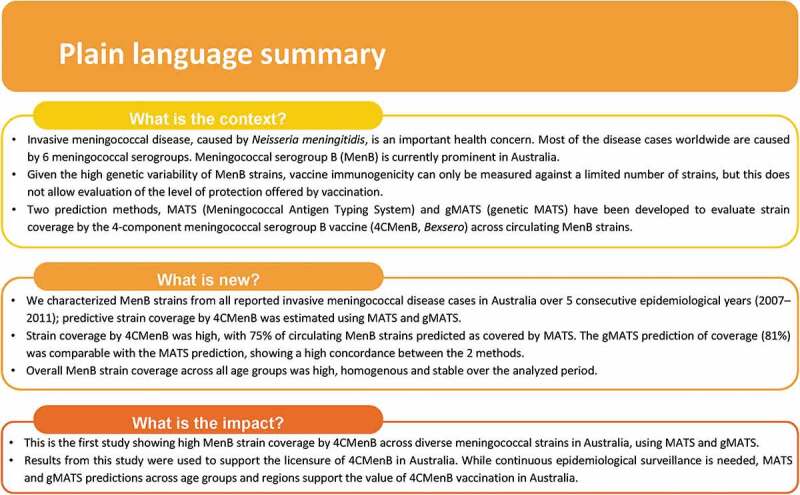
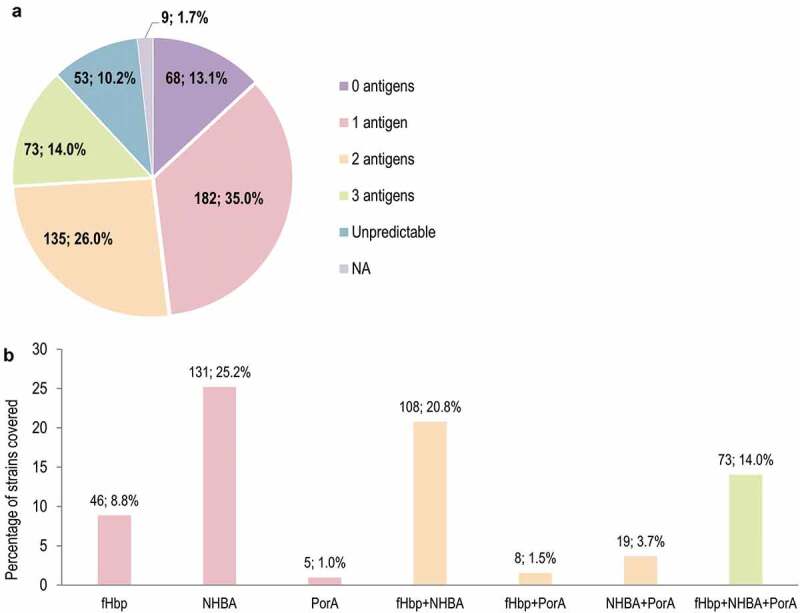
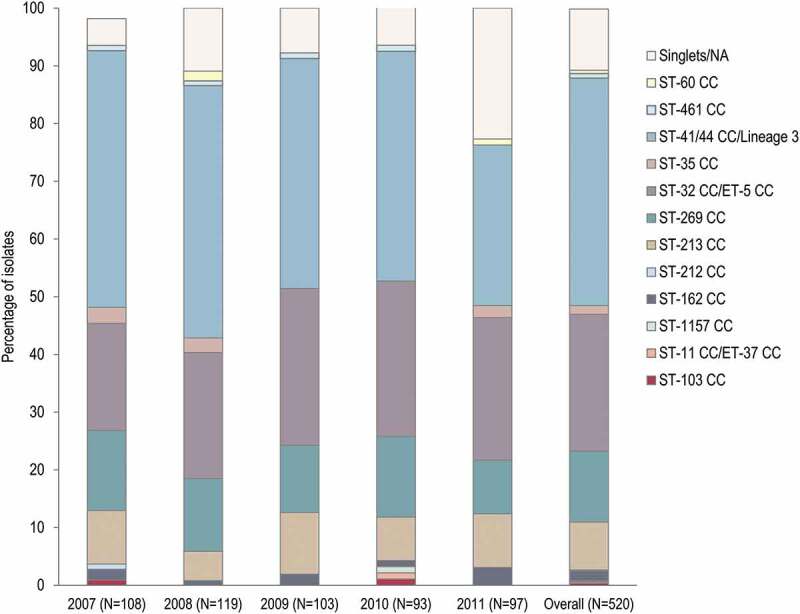
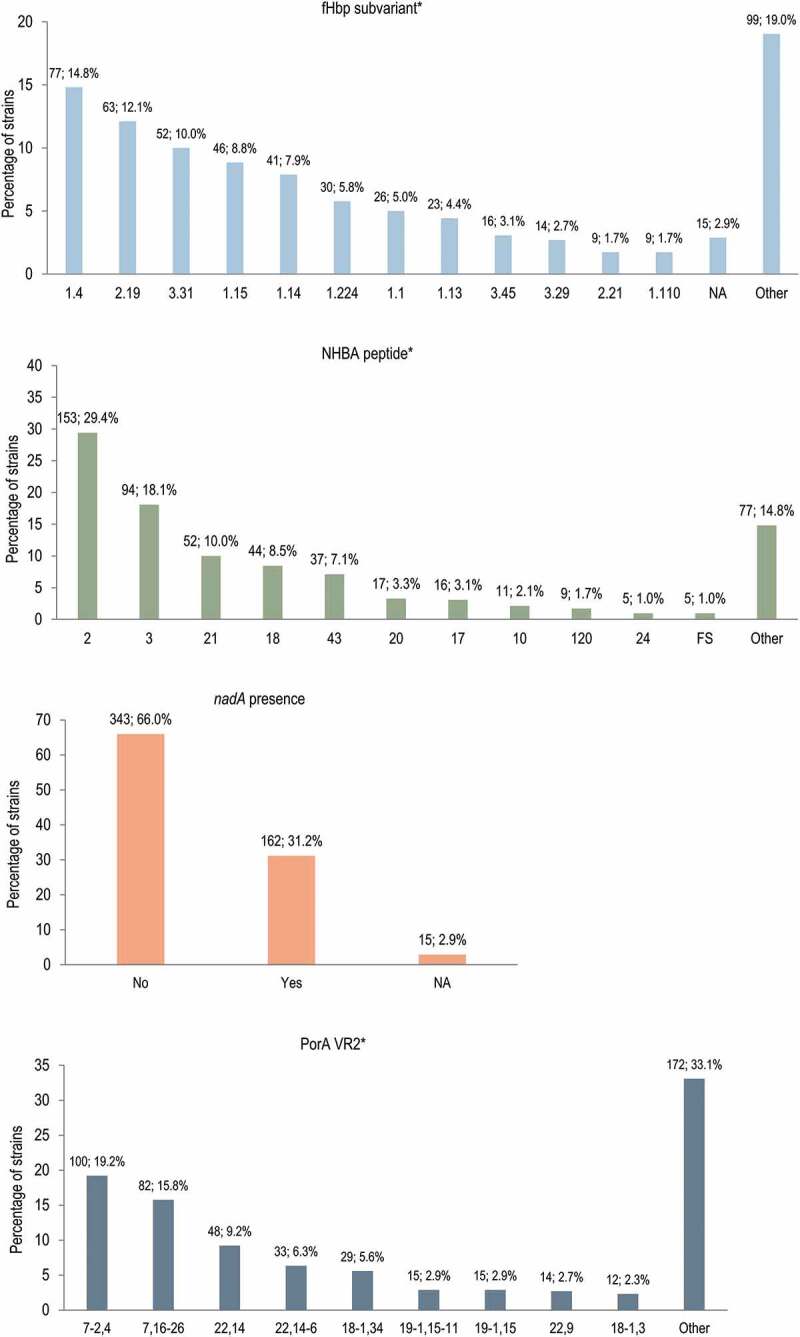
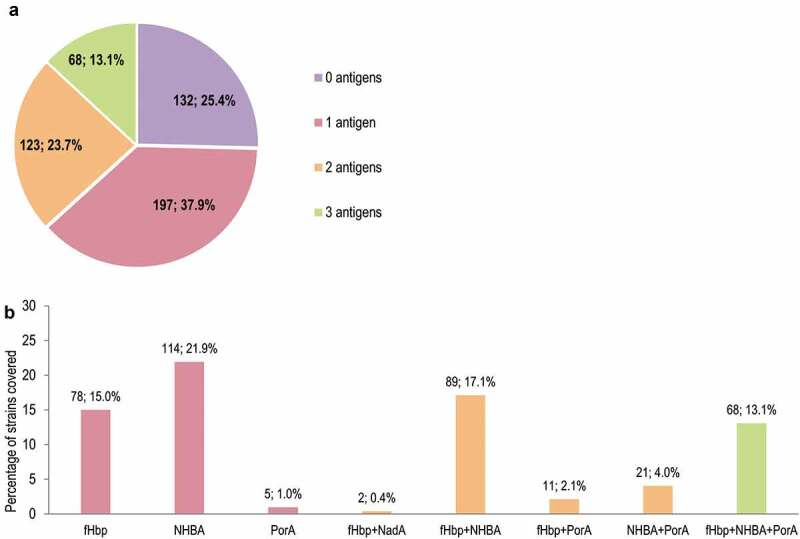
Meningococcal serogroup B (MenB) accounts for an important proportion of invasive meningococcal disease (IMD). The 4-component vaccine against MenB (4CMenB) is composed of factor H binding protein (fHbp), neisserial heparin-binding antigen (NHBA), adhesin A (NadA), and outer membrane vesicles of the New Zealand strain with Porin 1.4. A meningococcal antigen typing system (MATS) and a fully genomic approach, genetic MATS (gMATS), were developed to predict coverage of MenB strains by 4CMenB. We characterized 520 MenB invasive disease isolates collected over a 5-year period (January 2007-December 2011) from all Australian states/territories by multilocus sequence typing and estimated strain coverage by 4CMenB. The clonal complexes most frequently identified were ST-41/44 CC/Lineage 3 (39.4%) and ST-32 CC/ET-5 CC (23.7%). The overall MATS predicted coverage was 74.6% (95% coverage interval: 61.1%-85.6%). The overall gMATS prediction was 81.0% (lower-upper limit: 75.0-86.9%), showing 91.5% accuracy compared with MATS. Overall, 23.7% and 13.1% (MATS) and 26.0% and 14.0% (gMATS) of isolates were covered by at least 2 and 3 vaccine antigens, respectively, with fHbp and NHBA contributing the most to coverage. When stratified by year of isolate collection, state/territory and age group, MATS and gMATS strain coverage predictions were consistent across all strata. The high coverage predicted by MATS and gMATS indicates that 4CMenB vaccination may have an impact on the burden of MenB-caused IMD in Australia. gMATS can be used in the future to monitor variations in 4CMenB strain coverage over time and geographical areas even for non-culture confirmed IMD cases.
脑膜炎奈瑟菌 B 群(MenB)在侵袭性脑膜炎奈瑟菌病(IMD)中占很大比例。针对 MenB 的 4 组份疫苗(4CMenB)由因子 H 结合蛋白(fHbp)、奈瑟菌肝素结合抗原(NHBA)、黏附素 A(NadA)和新西兰菌株的外膜囊泡与 Porin 1.4 组成。开发了脑膜炎奈瑟菌抗原分型系统(MATS)和全基因组方法,遗传 MATS(gMATS),以预测 4CMenB 对 MenB 菌株的覆盖范围。我们通过多位点序列分型对 5 年内(2007 年 1 月至 2011 年 12 月)从澳大利亚所有州/地区收集的 520 例侵袭性疾病分离株进行了表征,并估计了 4CMenB 的菌株覆盖率。最常识别的克隆复合体是 ST-41/44 CC/Lineage 3(39.4%)和 ST-32 CC/ET-5 CC(23.7%)。总体 MATS 预测覆盖率为 74.6%(95%覆盖率区间:61.1%-85.6%)。总体 gMATS 预测为 81.0%(下限-上限:75.0-86.9%),与 MATS 相比准确率为 91.5%。总体而言,23.7%和 13.1%(MATS)和 26.0%和 14.0%(gMATS)的分离株分别至少被 2 种和 3 种疫苗抗原覆盖,其中 fHbp 和 NHBA 对覆盖率的贡献最大。按分离株采集年份、州/地区和年龄组分层时,MATS 和 gMATS 菌株覆盖率预测在所有分层中均一致。MATS 和 gMATS 预测的高覆盖率表明,4CMenB 疫苗接种可能会对澳大利亚 MenB 引起的 IMD 负担产生影响。gMATS 可用于未来监测一段时间内和地理区域内 4CMenB 菌株覆盖率的变化,即使对于非培养确认的 IMD 病例也是如此。