Department of Orthopedic Surgery, Fujian University of Traditional Chinese Medicine, Fuzhou, Fujian, China.
Department of Orthopedic Surgery, Fujian University of Traditional Chinese Medicine, Fuzhou, Fujian, China;Department of Orthopedic Surgery, Fuzhou Second Hospital Affiliated to Xiamen University, the Teaching Hospital of Fujian Medical University, Fuzhou, Fujian, China.
Acta Orthop Traumatol Turc. 2021 Mar;55(2):118-126. doi: 10.5152/j.aott.2021.20168.
This meta-analysis study aims to determine the efficacy and safety of surgical and conservative treatments for distal radius fractures (DRFs) in adults.
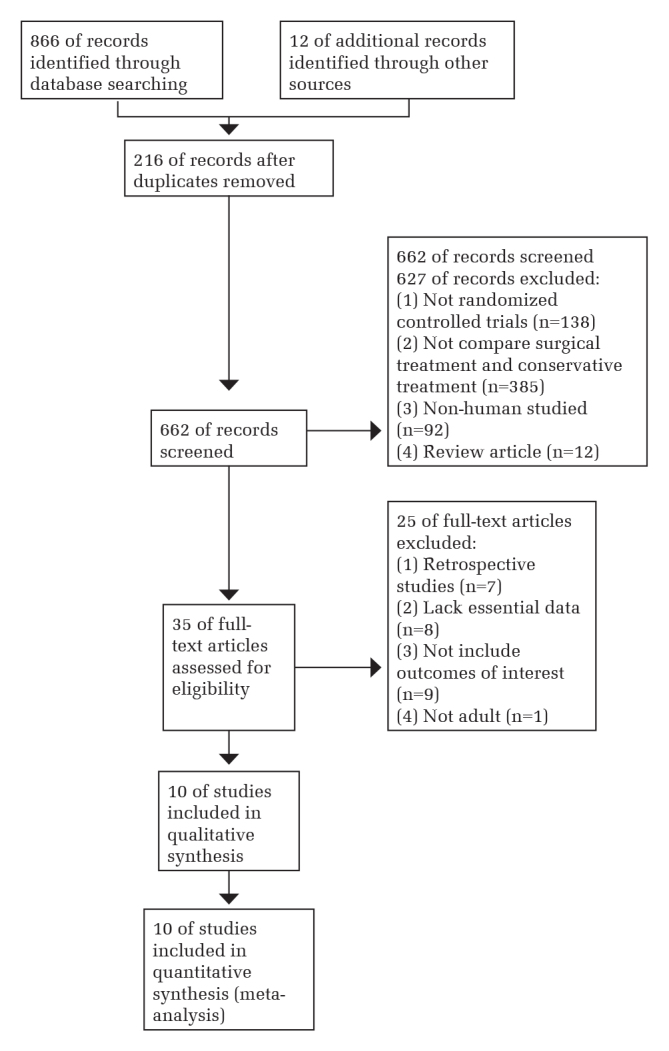
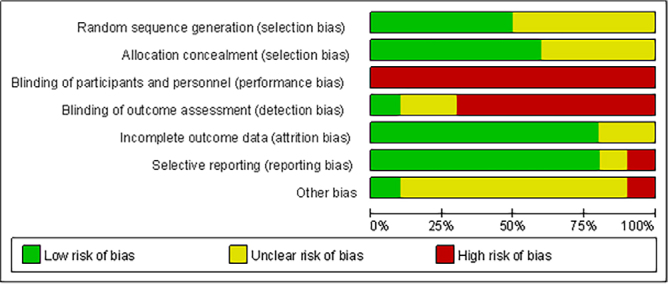
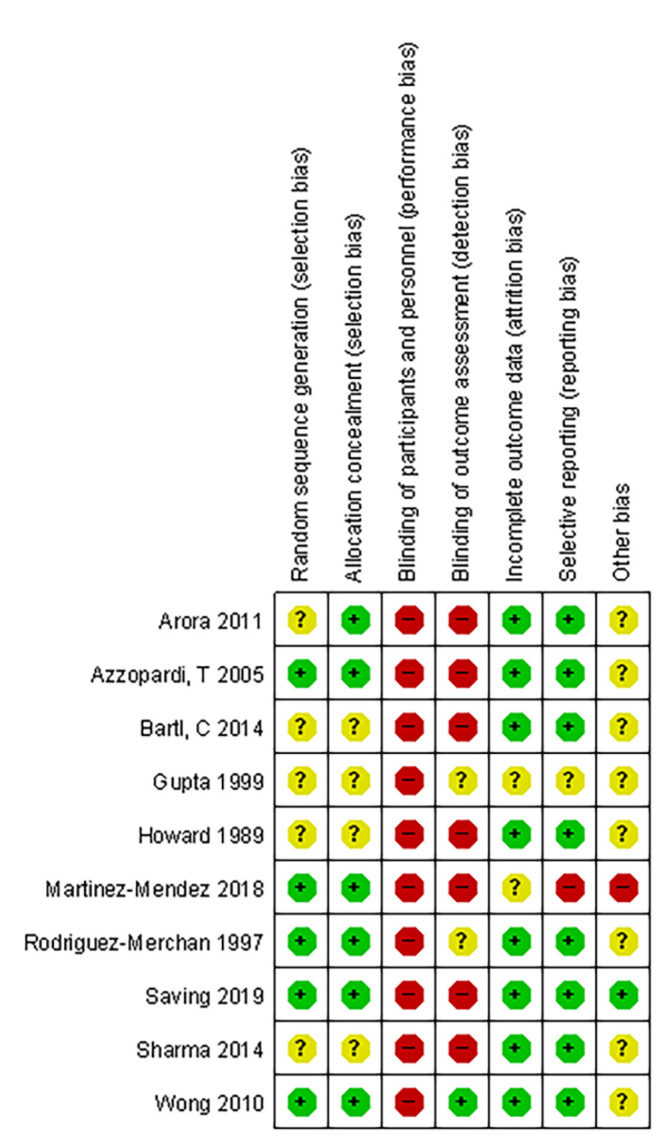
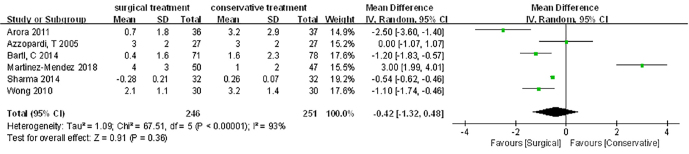
Reports of randomized controlled trials were retrieved from the Web of Science, Pubmed, Google Scholar, EMBASE, Cochrane Library, Medline, Ovid, and BIOSIS for studies that met the eligibility criteria. The search was limited to human subjects and had no language limits. The search strategy was check by two independent reviewers. If there was any dispute, a third reviewer was consulted. Primary outcomes were: (1) the active wrist range of motion including flexion, extension, pronation, supination, radial, and ulnar deviation; (2) the Disabilities of the Arm, Shoulder, and Hand (DASH) score; and (3) radiological outcomes including radial inclination and ulnar variance. Secondary outcomes were the number of complications including non-infectious and infectious. Quality assessment was performed using the Cochrane Risk of Bias Tool provided by the Cochrane Review Manager 5.3.
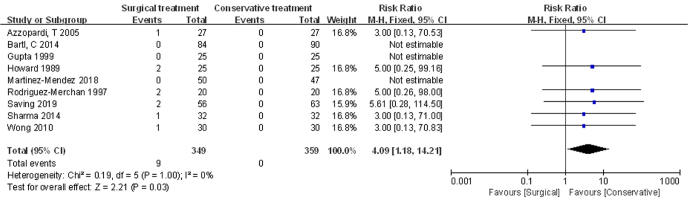
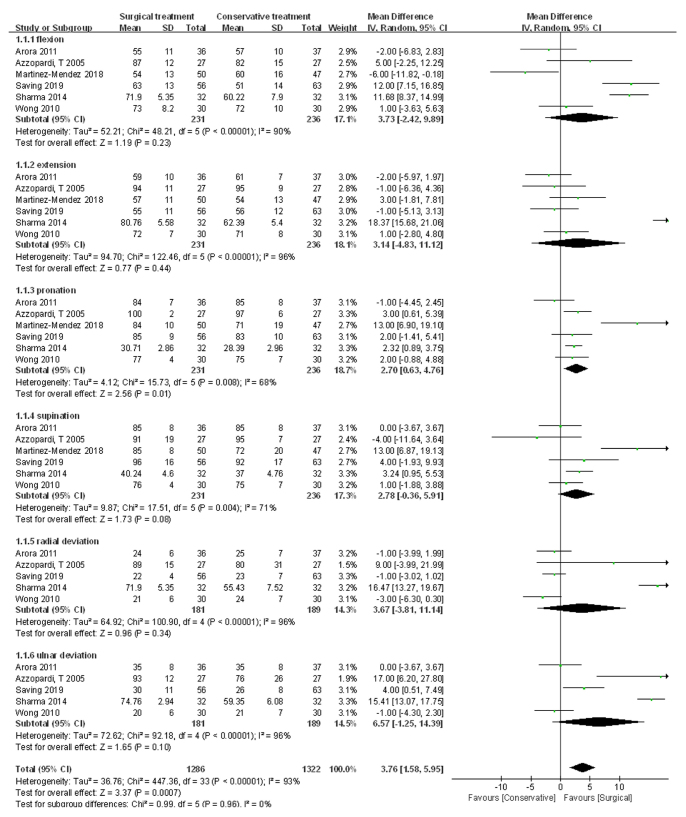
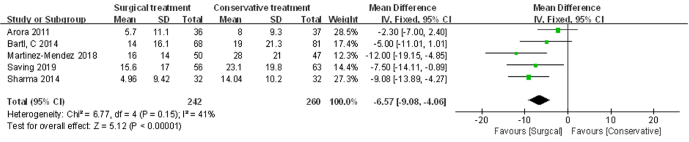
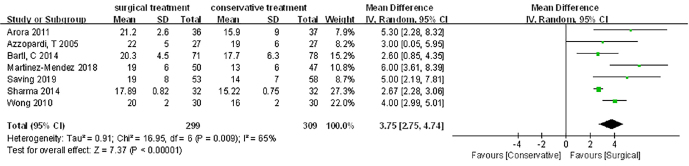
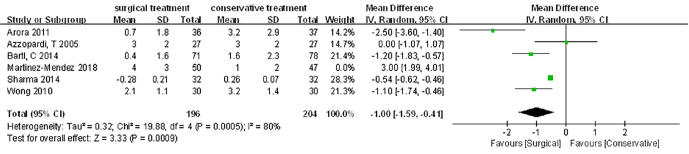
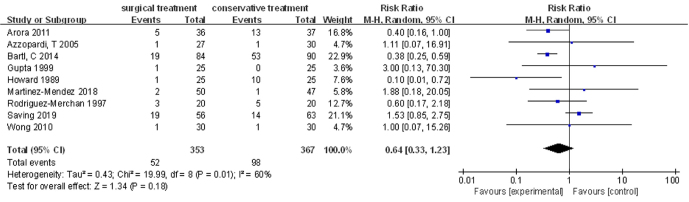
A total of 10 randomized controlled trials were included. The meta-analysis detected no statistically significant difference in pooled data for complications not included infection (MD 0.64, CI: 0.33 to 1.23, Z=1.34, p=0.18). Surgical treatment achieved a better range of motion (MD 3.76, CI: 1.58 to 5.95, Z=3.37, p=0.0007), DASH score (MD -6.57, CI: -9.08 to -4.06, Z=5.12, p<0.00001), and radiographic outcomes (MD 3.75, CI: 2.75 to 4.74, Z=7.37, p<0.00001) compared with conservative treatment. In contrast, the conservative treatment achieved less infection rate compared with surgical treatment (MD 4.09, CI: 1.18 to 14.21, Z=2.21, p=0.03).
Findings of this study reveal that when compared with conservative treatment, surgical treatment can ensure better clinical and radiological results for the treatment of DRFs in adults. Although similar complication rates can be encountered with both treatment modalities, it should be taken into account that the rate of infection may be higher in surgical treatment.
Level I, Therapeutic Study.
本荟萃分析旨在确定成人桡骨远端骨折(DRF)的手术和保守治疗的疗效和安全性。
从 Web of Science、Pubmed、Google Scholar、EMBASE、Cochrane Library、Medline、Ovid 和 BIOSIS 检索符合纳入标准的随机对照试验报告。检索仅限于人类研究,且没有语言限制。由两位独立评审员检查检索策略。如果存在任何争议,则咨询第三位评审员。主要结果包括:(1)主动腕关节活动范围,包括屈伸、旋前、旋后、桡偏和尺偏;(2)手臂、肩部和手部残疾(DASH)评分;和(3)影像学结果,包括桡倾角和尺侧差异。次要结果包括并发症的数量,包括非感染性和感染性。使用 Cochrane 审查经理 5.3 提供的 Cochrane 风险偏倚工具进行质量评估。
共纳入 10 项随机对照试验。荟萃分析未检测到非感染性并发症的合并数据存在统计学差异(MD 0.64,CI:0.33 至 1.23,Z=1.34,p=0.18)。手术治疗在运动范围(MD 3.76,CI:1.58 至 5.95,Z=3.37,p=0.0007)、DASH 评分(MD-6.57,CI:-9.08 至-4.06,Z=5.12,p<0.00001)和影像学结果(MD 3.75,CI:2.75 至 4.74,Z=7.37,p<0.00001)方面优于保守治疗。相比之下,与手术治疗相比,保守治疗的感染率较低(MD 4.09,CI:1.18 至 14.21,Z=2.21,p=0.03)。
本研究结果表明,与保守治疗相比,手术治疗可确保成人桡骨远端骨折的临床和影像学结果更好。尽管两种治疗方法可能会出现相似的并发症发生率,但应考虑手术治疗的感染率可能更高。
一级,治疗性研究。