Department of Orthopedics, All India Institute of Medical Sciences, Deoghar, India.
Department of Orthopedics, All India Institute of Medical Sciences, Deoghar, India.
Chin J Traumatol. 2023 Jul;26(4):204-210. doi: 10.1016/j.cjtee.2022.12.005. Epub 2022 Dec 13.
The aim of this study was to analyze if any difference exists on the type of immobilisation (above elbow vs. below elbow) in the conservative treatment of distal end radius fractures in adults.
The study was performed in accordance with Preferred Reporting Items for Systematic Reviews and Meta-analyses. An electronic literature search was performed up to 1st October 2021 in Medline, Embase, Ovid and Cochrane database using the search terms, "distal end radius fractures OR fracture of distal radius", "conservative treatment OR non-surgical treatment", "above elbow immobilisation" and "below elbow immobilisation". Randomized clinical trials written in English, describing outcome of distal end radius fractures in adults by conservative or non-surgical means using above elbow immobilisation or below elbow immobilisation were included and assessed according to the risk of bias assessment (RoB2) tool by Cochrane collaboration. Non-randomized clinical trials, observational studies, retrospective studies, review articles, commentaries, editorials, conference presentations, operative techniques and articles without availability of full text were excluded from this review. The meta-analysis was performed using Review Manager version 5.4.1 (The Cochrane Collaboration, Copenhagen, Denmark).
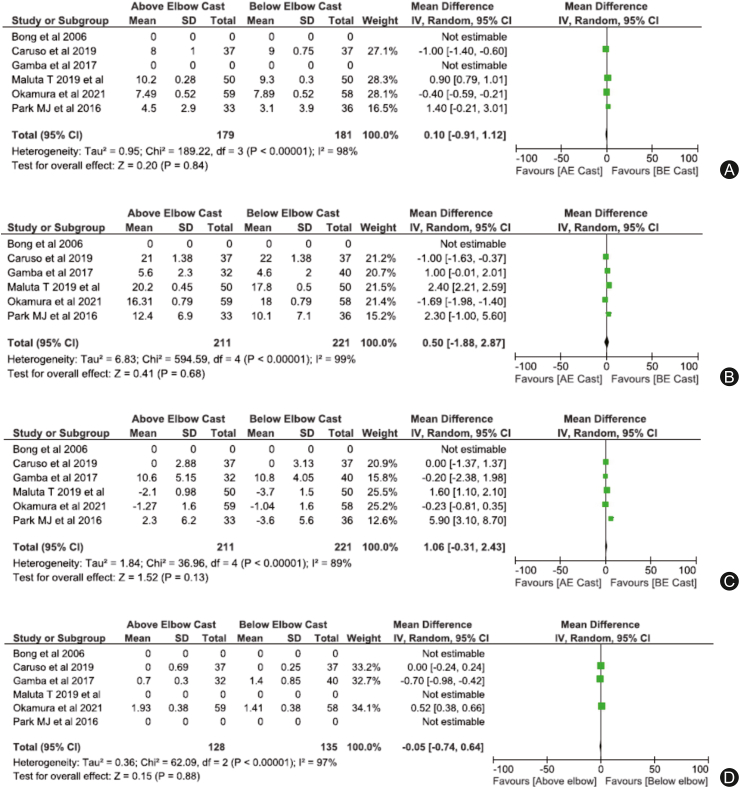
Six randomized clinical trials were included for quantitative review. High heterogeneity (I > 75%) was noted among all the studies. The standard mean difference (MD) between the disability of the arm, shoulder and hand scores in both the groups was 0.52 (95% CI: -0.28 to 1.32) which was statistically non-significant. There was no statistical difference in the radial height (MD = 0.10, 95% CI: -0.91 to 1.12), radial inclination (MD = 0.5, 95% CI: -1.88 to 2.87, palmar tilt (MD =1.06, 95% CI: -0.31 to 2.43) and ulnar variance (MD = 0.05, 95% CI: -0.74 to 0.64). It was observed that shoulder pain occurred more commonly as a complication in above elbow immobilisation and the values were statistically significant (above elbow: 38/92, 41.3%; below elbow: 19/94, 20.2%).
This two-armed systematic review on the above elbow or below elbow immobilisation to be used for conservative treatment of the distal end radius fracture in adults resulted in non-significant differences in terms of functional and radiological scores among the 2 groups but significant increase in the complication rates in the above elbow group.
本研究旨在分析成人桡骨远端骨折的保守治疗中,不同的固定方式(肘上与肘下)是否存在差异。
本研究按照系统评价和荟萃分析的首选报告项目进行。在 Medline、Embase、Ovid 和 Cochrane 数据库中,使用“distal end radius fractures OR fracture of distal radius”、“conservative treatment OR non-surgical treatment”、“above elbow immobilisation”和“below elbow immobilisation”等检索词,对截止到 2021 年 10 月 1 日的文献进行电子检索。纳入使用肘上固定或肘下固定的保守或非手术治疗成人桡骨远端骨折的英文随机临床试验,并根据 Cochrane 协作组的偏倚风险评估(RoB2)工具进行评估。本综述排除了非随机临床试验、观察性研究、回顾性研究、综述文章、评论、社论、会议演讲、手术技术和无法获取全文的文章。使用 Review Manager 版本 5.4.1(Cochrane 协作组,丹麦哥本哈根)进行荟萃分析。
纳入了 6 项随机临床试验进行定量综述。所有研究的异质性均很高(I > 75%)。两组间手臂、肩部和手部残疾评分的标准均数差(MD)为 0.52(95%CI:-0.28 至 1.32),无统计学意义。桡骨高度(MD = 0.10,95%CI:-0.91 至 1.12)、桡骨倾斜度(MD = 0.5,95%CI:-1.88 至 2.87)、掌倾角(MD = 1.06,95%CI:-0.31 至 2.43)和尺侧偏距(MD = 0.05,95%CI:-0.74 至 0.64)无统计学差异。观察到肘上固定时更常见肩部疼痛并发症,且数值具有统计学意义(肘上固定:38/92,41.3%;肘下固定:19/94,20.2%)。
本项关于成人桡骨远端骨折保守治疗中使用肘上或肘下固定的双臂系统评价,在两组间的功能和影像学评分方面没有显著差异,但肘上固定组的并发症发生率显著增加。